
Immunovant’s 2026 Pivot: Balancing High Clinical Stakes with HanAll Licensing Complexities
Immunovant faces a defining year as eager Wall Street optimism meets operational realities tied to its licensing structure and Phase 3 readouts.
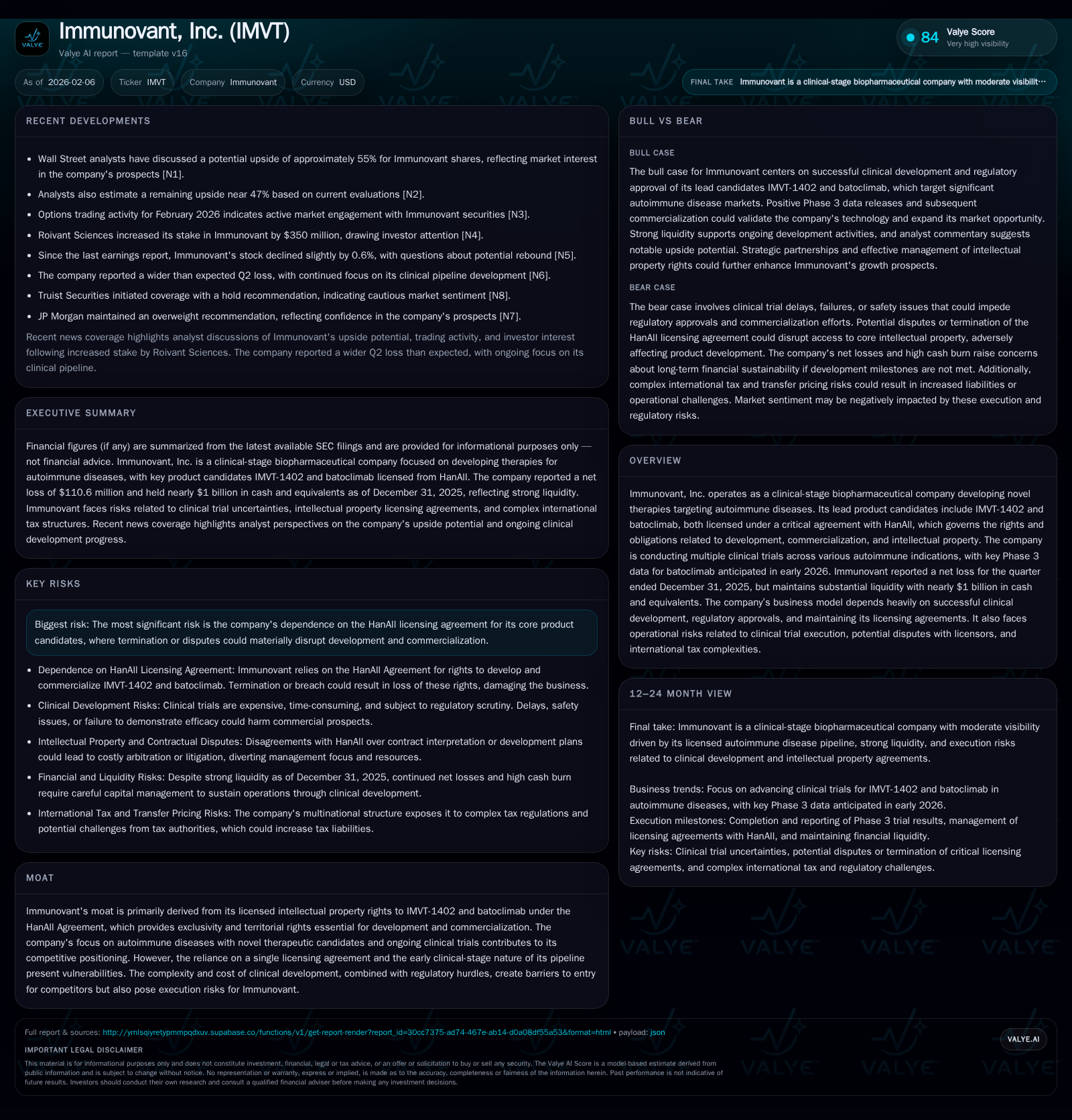
Immunovant, Inc. stands at a critical juncture propelled by strong analyst upgrades projecting over 50% upside driven by imminent Phase 3 data for its lead autoimmune therapy batoclimab. However, the company’s dependence on a complex licensing agreement with HanAll introduces material execution risks that could disrupt development or commercialization. Financially solid with nearly $1 billion in cash, Immunovant must navigate clinical trial results, licensing negotiations, and operational challenges to sustain its growth trajectory.
Bullish Wall Street Outlook Meets Clinical Milestone Countdown
The start of 2026 has ushered in an elevated level of optimism around Immunovant, marked by multiple analyst upgrades that anticipate share price appreciation north of 50%. Reports from Wolfe Research and Nasdaq sources signal growing confidence centered on upcoming clinical data readouts that may significantly re-rate the company’s value [N1][N2][N3]. This bullish consensus sets the stage against a backdrop where patient market enthusiasm aligns with tangible catalysts – chiefly, the release of topline Phase 3 results for batoclimab in the first half of this year.
This convergence of market expectations and clinical milestones presents a suspenseful dynamic: while enthusiasm is palpable, the stakes are high. The timing is critical; batoclimab’s outcomes will either validate current optimism or compel reassessment. For investors and industry watchers alike, this represents more than a routine data release—it is a potential inflection point for Immunovant's trajectory.
Batoclimab’s Phase 3 Data: A Make-Or-Break Junction
Batoclimab stands as the cornerstone therapy within Immunovant’s pipeline targeting autoimmune diseases through neonatal Fc receptor (FcRn) inhibition. The company is conducting two parallel Phase 3 TED studies designed to confirm efficacy and safety profiles established in earlier trials [valye_report_excerpt][S2]. These studies are pivotal not only from a regulatory standpoint but also in demonstrating therapeutic innovation that could distinguish Immunovant amid a crowded autoimmune space.
The dual nature of these Phase 3 trials reflects strategic rigor—validating treatment effects across varying patient populations to maximize the robustness of evidence submitted for regulatory approval. However, this also amplifies risk. A negative or statistically inconclusive readout could delay product approval timelines or impair commercial momentum. Given that batoclimab’s development operates under a licensing umbrella limiting ultimate control to Immunovant within specified territories, alignment with partners and regulators adds further complexity.
HanAll Licensing Dynamics: Pillar or Potential Pitfall?
A defining feature—and potential vulnerability—of Immunovant's business model lies in its intellectual property rights framework dictated by a licensing agreement with HanAll [valye_report_excerpt][S2]. This agreement grants Immunovant exclusive regional rights for IMVT-1402 and batoclimab but comes tethered with substantial operational strings: exclusivity enforcement, funding commitments, development diligence milestones, and royalty structures.
Of particular note are present discussions regarding the possible return of certain batoclimab rights to HanAll. Such negotiations underscore ongoing tension points within the alliance, raising red flags about future territorial scope and development control. Moreover, contract language noted for susceptibility to divergent interpretations increases dispute potential. The consequences are not purely theoretical; substantial breaches could lead to damages payments or outright termination—scenarios capable of materially disrupting pipeline continuity.
The license confers final control over development decisions within Immunovant's territories; however, disagreements with HanAll on strategic execution pose risks that could lead to arbitration or litigation. Despite management's confidence in contesting any breach claims vigorously, such proceedings are costly distractions that may hinder operational focus during this critical clinical phase.
Financial Fortitude Amid Clinical-Stage Uncertainties
Despite operating at a net loss north of $110 million for the quarter ended December 31, 2025 [F1], Immunovant approaches its clinical milestones from a position of notable liquidity strength. With almost $1 billion in cash and equivalents paired against current liabilities under $67 million, it sports a hefty current ratio exceeding 15 [F1].
This cushion provides runway flexibility vital for advancing costly late-stage trials absent immediate revenue streams—a typical profile for clinical-stage biopharmaceuticals. However, the persistent burn underscores dependence on successful trial outcomes to justify subsequent funding rounds or partnership infusions. Cash sufficiency offers breathing room but does not immunize Immunovant against dilution risk or capital scarcity if setbacks arise.
Pipeline Focus: IMVT-1402’s Promise and Priority
While batoclimab commands center stage, IMVT-1402 represents an important developmental asset pursuing related autoimmune mechanisms through shared licensed intellectual property [valye_report_excerpt]. Although earlier in its clinical journey than batoclimab, IMVT-1402 embodies strategic breadth in product offerings that can hedge against single-asset concentration risk.
Progress here could materially enhance Immunovant's value proposition by expanding therapeutic indications or improving patient access frameworks. Conversely, setbacks in IMVT-1402 would accentuate pipeline fragility given limited alternative candidates currently disclosed.
Operational Risks: What Management Must Navigate
Behind headline milestones lie rugged operational terrain shaped by complex contractual obligations and regulatory hurdles. The HanAll Agreement explicitly articulates "material breach" clauses accompanied by cure periods—a double-edged sword requiring vigilant compliance management [S2]. Noncompliance risks expensive damage awards or loss of license rights.
These legal constraints dictate rigorous internal controls around clinical execution timelines, development funding disbursements, sublicensing terms, and intellectual property safeguarding—all within heightened scrutiny due to forthcoming pivotal trial data. Arbitration readiness looms as a latent threat; protracted litigation can sap managerial bandwidth precisely when focused execution is paramount.
Additionally, biotechnology development inherently faces regulatory uncertainties—FDA feedback loops, safety monitoring challenges, and manufacturing scalability—all complicated further when external partnerships require delicate balancing acts.
Competitive Moat Woven Through IP and Development Strategy
Immunovant’s moat derives principally from exclusivities afforded under its license from HanAll paired with novel therapeutic modalities centered on FcRn antagonists targeting autoimmune pathologies [valye_report_excerpt]. This positioning offers a defensible niche as drug development costs create high barriers to entry for newcomers attempting equivalent innovation trajectories.
Nonetheless, reliance on one major partner creates asymmetrical vulnerabilities. Should licensing terms deteriorate or conflicting interests emerge—especially as HanAll maintains vested interests beyond Immunovant's Licensed Territories—the moat risks being compromised. Thus far, the interplay between innovation advantage and contractual fragility defines competitive positioning.
Market Implications and What Investors Should Watch Next
Looking ahead into mid-2026 and beyond, several focal points crystallize for market observers. Foremost will be the arrival of Phase 3 topline data for batoclimab—results poised either to unlock accelerated regulatory pathways or necessitate strategy recalibrations depending on outcome quality [N1][N2][N3].
Simultaneously, developments around ongoing HanAll negotiations warrant close attention given potential ramifications on rights scope and commercialization latitude [S2]. Any signals resolving disputes favorably could renew confidence; conversely prolonged discord might weigh heavily on valuation dynamics.
Financial monitoring remains crucial—while sizable cash reserves provide near-term stability [F1], sustained net losses obligate efficient burn management aligned with milestone achievements.
Analyst commentary shows willingness to increase price targets reflecting upside potential but carefully hedges against operational pitfalls raising volatility concerns.[N1][N2][N3]
In sum, Immunovant exemplifies a biotech at a crossroads—combining exciting clinical promise with intricate partnership overlays that demand disciplined navigation to fulfill its market promise.
This analysis synthesizes publicly available information as of early February 2026 without providing investment advice. Readers should conduct independent due diligence before making financial decisions involving Immunovant securities.
Disclaimer: This is research-only, informational analysis and not investment advice. It may include AI-generated interpretation and general industry context. Always verify important details using primary sources.

Comments