
indie Semiconductor's Ambitious Growth Against Earnings Headwinds
indie Semiconductor pursues automotive edge sensor innovation while managing substantial operating losses and navigating geopolitical risks.
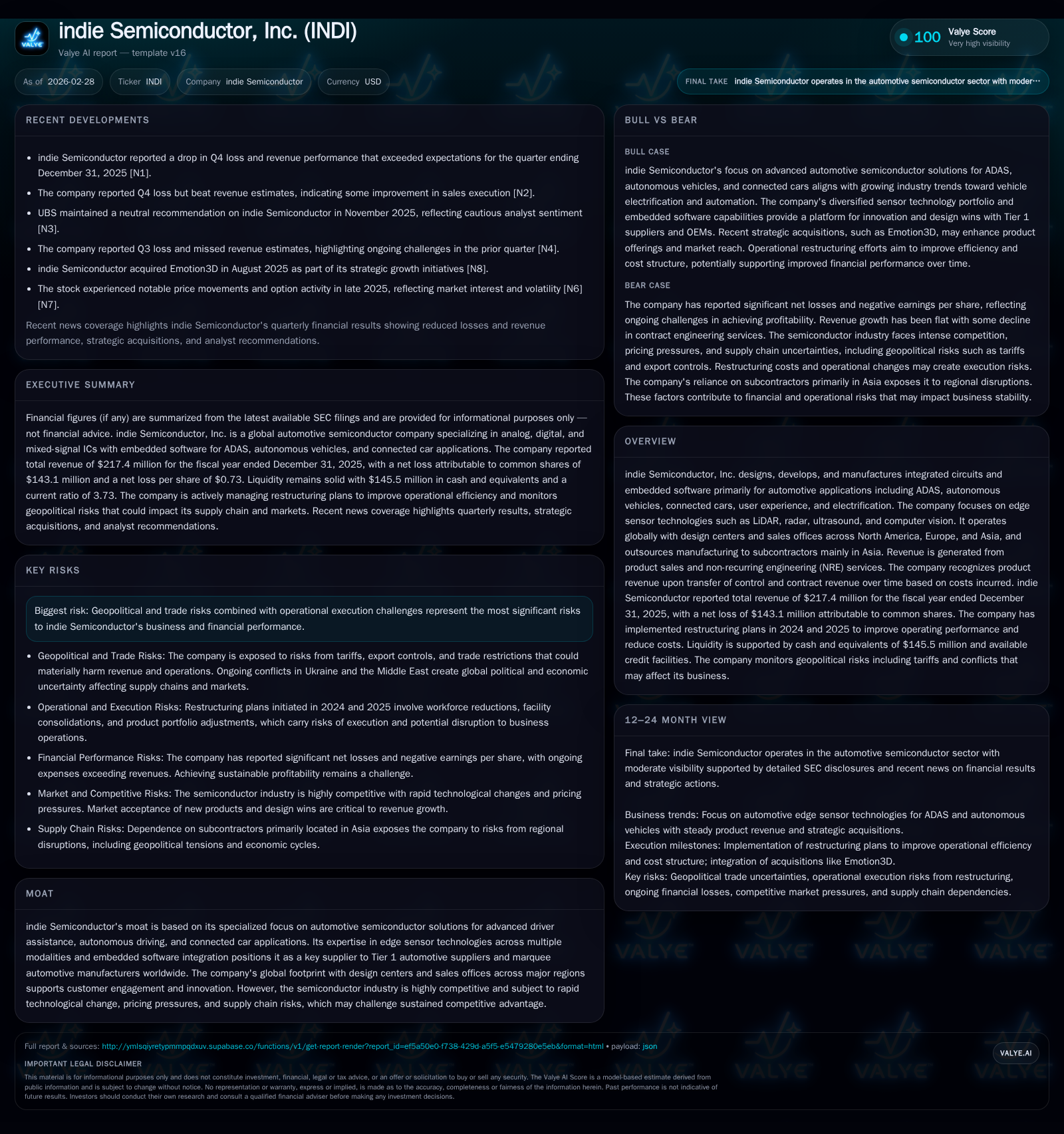
indie Semiconductor has expanded revenue through its focus on automotive integrated circuits tailored for ADAS and autonomous driving technologies, leveraging multi-modal edge sensing and embedded software platform integration. Despite top-line progress, the company endures significant operating losses and negative free cash flow driven by heavy R&D investment and restructuring costs. Geographic revenues are concentrated in Greater China and the US, exposing indie to geopolitical tensions and trade restrictions that may impact supply chains. Capital allocation remains growth-oriented with cautious debt management but no dividends or buybacks recently. Monitoring operational efficiency gains post-restructuring and design win traction will be key to future profitability.
Engineering Growth: Revenue Drivers and Operational Trends Through 2025
indie Semiconductor’s revenue streams derive principally from sales of analog, digital, and mixed-signal integrated circuits (ICs) designed for advanced driver assistance systems (ADAS), autonomous vehicle modules, connected car features, user interface enhancements, and electric vehicle electrification. These product revenues are supplemented by non-recurring engineering (NRE) fees tied to bespoke IC design services commissioned by customers. The dual revenue model entails recognition of product sales upon transfer of control and contract-based NRE revenue over time based on input costs incurred [S1].
Fiscal year 2025 culminated with total revenue reported at approximately $217.4 million [N1], reflecting growth supported by increased semiconductor content per vehicle and success in design win traction within marquee automotive programs. The company's strategic pruning under its restructuring plans initiated in mid-2024 and May 2025 aimed to shed lower-margin product lines outside core ADAS applications has sought to sharpen the product portfolio toward higher growth sectors [S4].
Operating income posted a loss of $154.2 million in FY25, a modest improvement over the prior year’s $170.1 million loss representing a 9.3% Year-over-Year amelioration [F1]. The trend evidences early benefits from operational efficiencies achieved through workforce realignment and facility consolidations outlined in restructuring initiatives [S4]. However, continued high expenditures in research & development alongside warranty provisions temper further margin expansion.
Historical performance (annual)
| FY | Net ($mm) | CFO ($mm) | OpInc ($mm) | Capex ($mm) | Net YoY |
|---|---|---|---|---|---|
| 2025 | -143 | -57 | -154 | 14 | -7.9% |
| 2024 | -133 | -59 | -170 | 14 | -12.7% |
| 2023 | -118 | -104 | -135 | 13 | -171.0% |
| 2022 | -43 | -77 | -119 | 8 |
Source: SEC companyfacts cache [F1].
Capital returns and efficiency (annual)
| FY | Buybacks ($mm) | FCF ($mm) | ROE% |
|---|---|---|---|
| 2025 | -71 | -40.0 | |
| 2024 | 0 | -73 | -31.7 |
| 2023 | 0 | -117 | -26.4 |
| 2022 | 7 | -84 | -13.9 |
Source: SEC companyfacts cache [F1].
Table above summarizes indie Semiconductor’s operating income losses steadily progressing despite challenging industry dynamics [F1]. Notably, capex spending remained steady near $14M annually indicative of continuous technology investment [F1][S4].
Technology Edge in Automotive Semiconductors: Edge Sensors and Embedded Software
indie’s competitive moat stems from its cross-modal expertise in edge sensing technologies encompassing LiDAR, radar, ultrasound sensors, and computer vision capabilities crucial for next-gen automotive safety ecosystems [S7]. The company develops ICs integrated with embedded processors executing sophisticated sensor fusion algorithms facilitating platform-level data synthesis—a key requirement for autonomous driving systems demanding low latency perception.
Embedded processor integration tightens collaboration cycles between hardware design teams and software developers enabling rapid customization for Tier 1 automotive suppliers contending with stringent validation cycles [S7]. This full-stack supplier integration represents a barrier to entry as customers seek cohesive vendor solutions reducing system complexity.
Expanding beyond single modality chips into software-enabled sensor fusion platforms lays foundation for sustained design win traction especially as automakers push towards connected user experience frameworks combining infotainment with driver assistance data pathways [S7].
Financial Performance Review: Operating Losses and Cash Flow Dynamics
Despite clear top-line progress fostered through expanded customer engagements and improved market share in ADAS segment verticals, indie Semiconductor faces persistent earnings headwinds evidenced by aggregate operating losses totaling $156 million across 2024–25 periods [F1]. Net income deteriorated further to a loss of $143 million in FY25 marking an approximate decline of nearly eight percent compared to prior year levels [F1].
Free cash flow remained substantially negative approaching -$71 million principally due to heavy R&D investments needed to support competitive technology roadmaps along with incremental restructuring charges comprising workforce reductions, asset impairments related to intellectual property licenses, and contract termination costs orchestrated during the past two years [S4][F1]. Operating cash flow still declined marginally slower than previous years’ steep drops signaling initial containment but underscores continuing negative cash generation pressures as recurring losses persist.
These financial dynamics underscore the challenge typical within semiconductor startups scaling complex IC technologies where upfront capital intensity competes against longer sales cycle timelines characteristic of automotive OEM procurement processes.
Geographic Revenue Distribution and Market Exposure Implications
Geographically, indie’s shipment data indicates dominant concentration within the Greater China region accounting for approximately 47% of total revenues for fiscal year ended December 31, 2025 [S6], an increase relative to prior years reflecting strategic exposure therein despite attendant risks.
The United States market contributed roughly 15% while Europe added another significant chunk near 20% collectively indicating dependency on these major automotive manufacturing hubs [S5][S6]. Such regional distribution renders indie Semiconductor vulnerable to geopolitical tensions notably escalating U.S.-China trade frictions constraining semiconductor supply chains through tariffs or intensified export control regimes detailed under risk disclosures [S19].
Trade restrictions impacting subcontractor partners mainly located across Asia amplify potential supply chain bottlenecks especially given the sophisticated nature of indie’s IC fabrication requiring specialized wafer processing facilities that cannot be rapidly diversified without significant lead times.
Capital Allocation Focus: Debt Management, R&D Investment, and Shareholder Returns
Capital management activity reveals deliberate efforts aimed at deleveraging where feasible while preserving liquidity for R&D continuity vital to innovation momentum [S9][S24]. In June 2025 indie repurchased $30 million principal amount of its outstanding convertible notes due 2027 at a discount generating a pre-tax gain of approximately $2.6 million improving overall debt profile albeit modestly relative to aggregate indebtedness near $353 million as year-end [S9][F1].
Robust liquidity is evident from cash plus equivalents totaling $145 million accompanied by a healthy current ratio exceeding 3.7 suggesting short-term obligations coverage remains sound despite operating deficits [F1][S9]. Meanwhile capital expenditures hover just above $14 million annually demonstrating steady commitment toward sustaining technological capabilities including facilities upgrades and mask tooling amortization aligned with projected development timelines [F1][S18].
Shareholder returns have been deprioritized; no dividends or share repurchases took place during recent years contrasting initial buyback programs completed in early periods signaling firm focus on reinvestment over distributions amid ongoing scaling phases [F1][S24].
Outlook for Profitability and Innovation Amid Trade and Geopolitical Risks
Recent quarterly results suggest improvement trends as operating loss narrowed from prior periods evidencing operational leverage gains emerging post-restructuring though still distant from profitability inflection points warranting scrutiny [N1][N2]. Future growth depends heavily on continued design win traction especially within burgeoning autonomous vehicle segments as well as evolving connected car use cases demanding comprehensive sensor arrays fused through embedded software architectures.
However, heightened global political uncertainty—exemplified by conflict zones affecting critical supply regions—and increasingly restrictive trade policies introduce volatility into forecast horizons limiting visibility on shipping cadence from parts subcontractors particularly those domiciled within Asia-Pacific jurisdictions [S19].
From a balance sheet perspective constraints imposed by ongoing negative cash flows suggest that further external financing or equity issuances might be required absent near-term positive operational reversals which investors should monitor closely as indicators ahead.
Key Milestones to Monitor in Capex, Revenue Scaling, and Restructuring Impact
Going forward stakeholders should track sequential quarterly order book expansion reflective of market demand ramp-ups alongside metrics quantifying realized cost savings under the May 2025 restructuring program targeting workforce optimization coupled with facility consolidation effects expected to normalize cost base dynamics supporting margin recovery initiatives [N1][N2][S4].
Furthermore pipeline timings revealing rollout schedules of next-generation sensor IC families integrating upgraded compute cores will signal indie’s competitive positioning vis-à-vis both established semiconductor incumbents and emerging niche suppliers targeting high-performance ADAS tiers.
Additionally prospective M&A activity aimed at supplementing latest edge sensing innovations or accelerating connectivity stack offerings could alter long-term value creation trajectories therefore remains important watchpoints amidst organic growth pursuits.
This analysis synthesizes available regulatory filings ([S#]), news releases ([N#]), and official financial disclosures ([F1]) as of February 28, 2026 regarding indie Semiconductor without providing investment directives or price forecasts. Forward-looking considerations discussed derive exclusively from documented company statements or clearly marked analytical interpretation subject to material business environment uncertainties inherent to the semiconductor sector.
Disclaimer: This is research-only, informational analysis and not investment advice. It may include AI-generated interpretation and general industry context. Always verify important details using primary sources.

Comments