
Indaptus Therapeutics Reports Q2 2026 Results with No Active Trials and Management Transition
Indaptus Therapeutics discontinues clinical enrollment and undergoes executive changes amid liquidity challenges, raising uncertainty about its development path and financial sustainability.
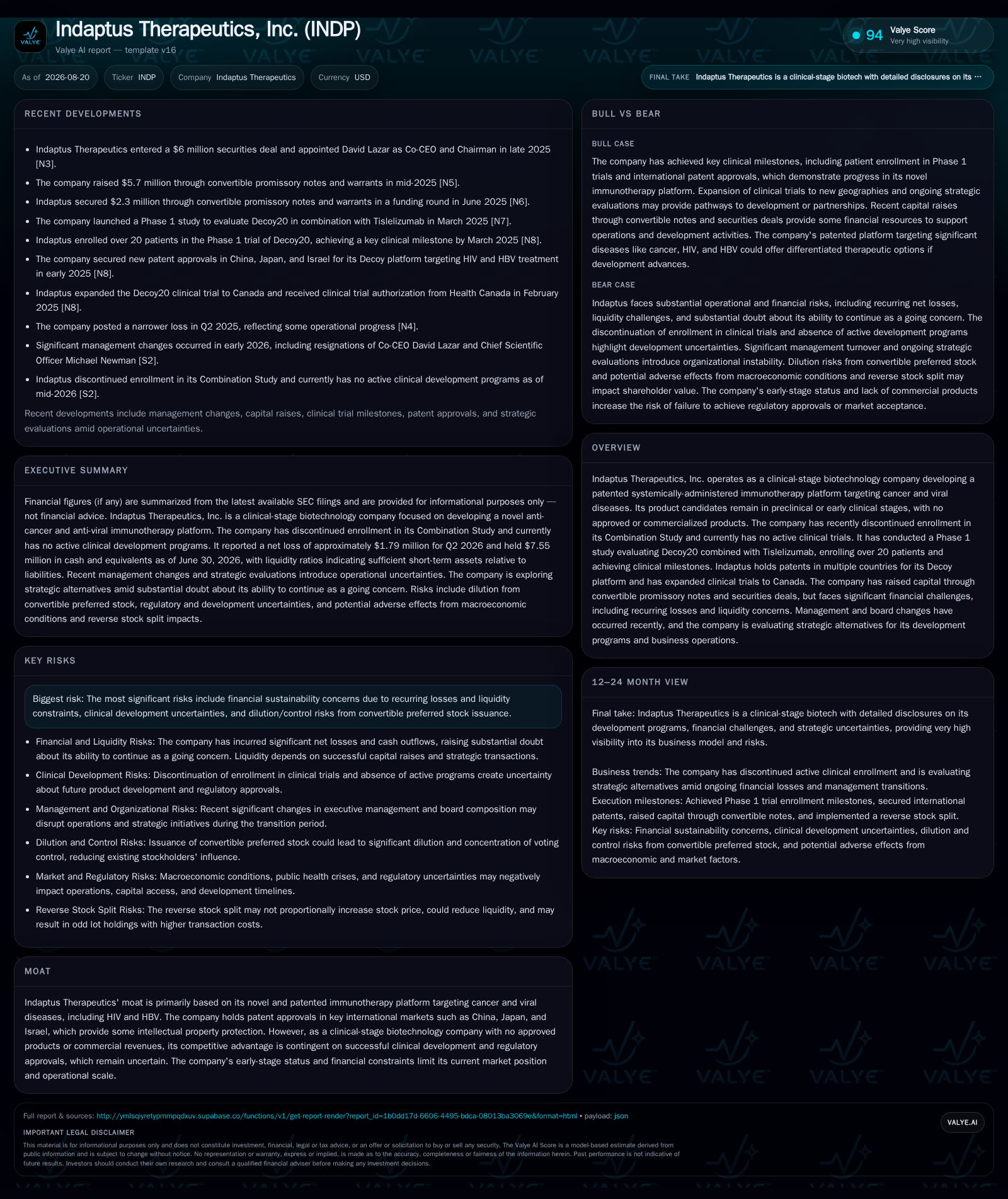
In Q2 2026, Indaptus Therapeutics halted enrollment in its Decoy20 Combination Study and currently has no active clinical trials, marking a significant operational pause. Concurrently, key executive departures including the CEO, CFO, and Chief Scientific Officer have introduced governance and operational uncertainties. The company holds $7.55 million in cash as of June 30, 2026, but with no revenue-generating operations and ongoing losses, liquidity constraints pose risks. Indaptus is evaluating strategic alternatives, but the near-term outlook remains uncertain pending financing or new partnerships.
Q2 2026 Operating Update and Clinical Development Status
Indaptus Therapeutics reported a significant operational pause in its clinical development activities during the second quarter of 2026. The company discontinued enrollment in its Combination Study for the Decoy20 immunotherapy program and currently has no participants remaining in any ongoing clinical trial as of Q2 2026 [S2][S1]. Furthermore, Indaptus has no active clinical development programs and no current plans to initiate new clinical trials, which is expected to lead to a short-term decrease in research and development expenses [S2][S1]. This pause in clinical enrollment halts progress on product candidates and delays potential regulatory milestones, which are critical value drivers for a clinical-stage biotechnology company. The suspension of clinical activity reduces near-term cash outflows related to costly trial operations but simultaneously raises uncertainty about the company’s ability to advance its therapeutic pipeline and generate future revenues.
Management Transition and Strategic Review
The company has experienced significant executive management changes in the first half of 2026, including the resignations of key officers such as the CEO, CFO, and Chief Scientific Officer [S2]. These departures have introduced operational and governance uncertainties during a critical transition period. Such management turnover can disrupt decision-making processes and operational continuity, particularly for early-stage biotech firms that rely heavily on focused leadership to navigate complex clinical and regulatory pathways. Indaptus is currently engaged in an ongoing strategic review to evaluate alternatives for its Decoy20 program and broader business operations. Potential options under consideration include strategic transactions, collaborations, investments, or acquisitions [S2]. However, no definitive plans or commitments have been announced, which contributes to near-term uncertainty regarding the company’s direction and viability.
Financial Position and Liquidity Analysis
As of June 30, 2026, Indaptus held approximately $7.55 million in cash and cash equivalents, providing liquidity to support near-term operations [F1]. The balance sheet as of March 31, 2026, showed current assets of $2.18 million exceeding current liabilities of $0.93 million, resulting in a current ratio of 2.34 [F1]. While this indicates a positive working capital position, the absence of operating cash inflows and ongoing losses create liquidity risk. The company’s clinical-stage status means it does not generate revenue, and the recent clinical pause further reduces near-term R&D spending, which may extend the cash runway but also delays progress toward potential value inflection points. Careful cash management will be essential as Indaptus evaluates strategic alternatives and seeks additional financing or partnerships to sustain operations.
Business Model and Industry Context
Indaptus operates as a clinical-stage biotechnology company focused on developing immunotherapy treatments, with its value primarily derived from advancing therapeutic candidates through clinical trials and regulatory approvals [S1]. The company currently has no paying customers or active clinical programs, and future revenue depends on successful development, commercialization, or strategic transactions. Research and development expenses, primarily payments to contract research organizations (CROs) and contract manufacturing organizations (CMOs), constitute the main operating costs and drive negative margins and cash burn [S1]. The discontinuation of clinical enrollment reduces these expenses in the short term but also postpones potential clinical milestones that could unlock value. The company’s patented immunotherapy platform represents a competitive asset, yet the lack of active development programs and financial constraints limit its near-term competitive positioning.
In the broader clinical-stage biotech sector, companies typically rely on capital raises and strategic partnerships to fund costly R&D until product approvals occur. Successful clinical progression and regulatory milestones are critical inflection points for value creation. Liquidity management is a key constraint given high burn rates and the absence of product revenue. Indaptus’s current operational pause and management turnover reflect challenges common to early-stage biotech firms facing financing and execution risks.
Scenario Analysis and Near-Term Outlook
The discontinuation of clinical enrollment materially reduces near-term R&D spending but increases uncertainty about the company’s ability to advance its product candidates and generate future revenues [S2][S1]. One possible interpretation is that this pause serves as a cost containment measure amid liquidity constraints, but it also delays the achievement of clinical milestones that are essential for attracting capital or partners.
Recent management turnover and ongoing strategic evaluations introduce operational risks and governance uncertainties that may affect the execution of any new development or business initiatives [S2]. The transition period could disrupt strategic focus and operational continuity, which are critical for clinical-stage biotech companies.
This scenario would be confirmed by further cash depletion without financing or announcements of operational cutbacks.
Base Case: Indaptus maintains its current cash runway while continuing to evaluate strategic alternatives, resulting in a period of operational pause with limited clinical activity but preserved corporate viability. Stable cash balances and public disclosures of strategic review progress would support this scenario.
Bull Case: The company successfully identifies a strategic partner or transaction that provides capital and resources to resume clinical development and advance its immunotherapy platform. These indicators will provide insight into whether Indaptus can overcome its current operational pause and financial constraints to advance its clinical-stage pipeline.
While the operational pause reduces near-term expenses, it also raises significant uncertainty about the company’s future development trajectory and financial sustainability. The outcome will depend heavily on the company’s ability to secure financing or strategic partnerships to resume clinical progress [S2].
Disclaimer: This is research-only, informational analysis and not investment advice. It may include AI-generated interpretation and general industry context. Always verify important details using primary sources.

Comments