
Inhibitor Therapeutics Faces Capital Uncertainty While Advancing Early-Stage Oncology Pipeline
The company’s pending litigation over $3 million financing introduces liquidity risks as it advances proprietary itraconazole therapies targeting rare oncology indications.
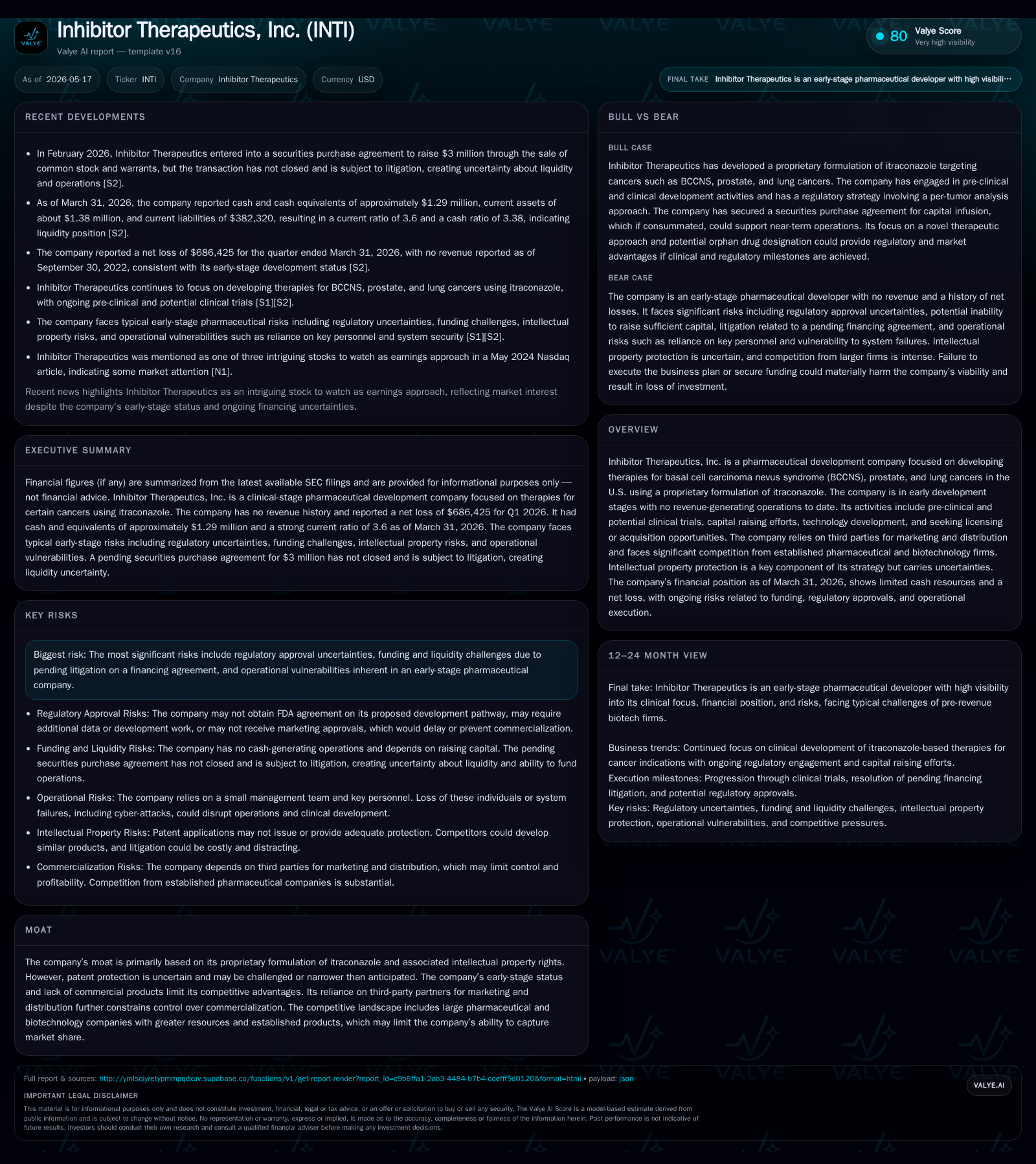
Inhibitor Therapeutics recently disclosed ongoing litigation against an institutional investor failing to close a $3 million financing, casting near-term doubt on liquidity and operational funding [S2][S3]. The company focuses on developing a novel itraconazole formulation for basal cell carcinoma nevus syndrome and select cancers, remaining early-stage without revenue or commercial products [S1][F1]. Intellectual property protection centered on proprietary formulations offers a potential moat, though patent risk and heavy competition from larger pharma/biotech limit defensive barriers. Regulatory approval pathways and clinical progress remain uncertain, underscoring the necessity of fresh capital and strategic partnerships to advance trials and commercialization [S4][S16]. Financially, Inhibitor Therapeutics held approximately $1.29 million in cash against modest liabilities as of March 31, 2026, but unresolved financing litigation clouds its runway outlook [F1][S2].
Latest Quarter Highlights and Financing Litigation Impact
Inhibitor Therapeutics’ most recent quarterly filing dated May 15, 2026 reveals a critical operational challenge: the failure of an institutional investor to consummate a previously announced $3 million securities purchase agreement entered into in February 2026 [S2][S3]. After months of attempts to secure funding under this SPA (securities purchase agreement), Inhibitor Therapeutics initiated litigation against the investor in late March 2026 seeking enforcement of the agreement terms or damages due to nonperformance
This unresolved litigation creates acute uncertainty around near-term liquidity [S2]. Without receipt of these funds, the company faces constraints that may force delaying or scaling back pivotal research and development activities associated with its clinical programs. Furthermore, the legal dispute introduces reputational risk that could complicate relationships with other investors, vendors, collaborators, and licensors. This scenario underscores the fragility common among early-stage pharmaceutical developers highly dependent on timely equity financing for sustained operations
Business Model Centered on Proprietary Itraconazole for Niche Oncology Indications
Inhibitor Therapeutics operates as a clinical-stage pharmaceutical development company focused primarily on repurposing itraconazole — an antifungal agent — formulated uniquely for anti-cancer activity targeting basal cell carcinoma nevus syndrome (BCCNS) alongside prostate and lung cancers within the U.S. market [S1]. The company's strategy leverages a proprietary formulation intended to differentiate itraconazole’s pharmacokinetic profile for potential efficacy in oncology.
Currently devoid of any commercialized products or generated revenues, Inhibitor Therapeutics is predominantly engaged in preclinical activities and planning potential clinical trials contingent upon regulatory progress. The business model's revenue mechanics will depend fundamentally on eventual regulatory approval facilitating commercialization either through direct sales infrastructure or more likely via third-party marketing partnerships — given the company's limited internal sales capacity [S1][F1][S23]. This partner reliance introduces margin compression risks but reduces upfront commercialization costs
Given the orphan drug status sought for BCCNS indications—a rare genetic condition—Inhibitor aims to benefit from regulatory exclusivity provisions designed to extend market protection post-approval [S1][S16]. However, achieving such exclusivity is conditional upon satisfying statutory requirements at FDA approval stage; thus this path retains significant uncertainty
Competitive and Patent Environment in Early-Stage Oncology Therapeutics
The oncology pharmaceuticals space where Inhibitor operates is fiercely competitive, dominated by major pharmaceutical companies and biotechnology firms with robust R&D budgets and established commercial platforms that dwarf those of Inhibitor Therapeutics [S1][S23]. There are numerous small-cap biopharmaceutical entities also vying for innovative oncology niches.
Inhibitor’s intellectual property fortress primarily consists of patents covering its proprietary itraconazole formulation filed since 2015 [S4][S6][S8][S15][S26][S29]. Despite these protections, the company faces substantial patent risk including challenges regarding patent validity, scope being narrower than expected, or potential infringement claims. Such risks are accentuated by active patent prosecution reforms (e.g., Leahy-Smith Act) and evolving case law tightening patent eligibility standards around natural products and formulations
Licenses from third parties underpin essential technology rights linked to itraconazole repurposing. The possibility that these licenses may not be maintained or renewed on favorable terms adds further vulnerability to exclusivity claims. Intellectual property disputes — both defensive against competitors and offensive to enforce rights — could divert resources significantly without guaranteed success due to opponents’ superior financial firepower [S4][S6][S8].
Key Development and Commercialization Challenges
Clinical advancement relies heavily on regulatory acceptance of Inhibitor’s proposed development approach. The company has sought FDA Type C meetings concerning its development pathway designed around a per-tumor analysis using existing datasets (HP2001). However, no assurance exists that FDA will endorse this strategy or accept the use of prior data with an abbreviated "505(b)(2)" approval route—a pathway that requires demonstration of equivalence or bridging data rather than full independent efficacy trials [S1][S16]
Furthermore, delays or requests for additional data by regulators could substantially increase capital needs and push timelines beyond management estimates.
Notably absent is any product liability insurance coverage—which is customary post-approval but may be costly to secure after initial studies commence—exposing the company to significant legal and financial risk if harmed trial participants emerge or adverse events occur during eventual commercialization efforts [S5]
Growth Opportunities via Regulatory Strategy and Partnering
Despite headwinds, growth opportunities exist if Inhibitor can secure orphan drug designations that confer marketing exclusivity typically lasting seven years under U.S. law—critical in small patient populations like BCCNS [S1]. Positive regulatory feedback supporting the proposed clinical frameworks would materially enhance valuation prospects by reducing perceived go-to-market uncertainty.
Further upside would stem from initiation of new clinical trials demonstrating itraconazole’s therapeutic benefits in targeted oncology indications.
Given internal limitations in salesforce scale and commercialization experience, the company explicitly plans third-party partnerships or licensing deals for marketing and distribution functions. Such collaborations would amplify market reach without proportionally increasing fixed costs while providing milestone payments or royalties valuable to non-revenue generating entities like Inhibitor Therapeutics [S1][S23]
Risks Including Funding, Intellectual Property, and Regulatory Approval
Key risks include ongoing dependency on external financing amid precarious capital market conditions exacerbated by active litigation jeopardizing secured funds [$3M SPA] critical for runway sustainability; failure here risks forcing operational shutdowns or restructurings [S2][S7][F1]. Intellectual property uncertainties present persistent threats especially given active patent office proceedings that might invalidate or limit protective claims foundational to competitive advantage [S4][S6][S8].
Regulatory setbacks are plausible if FDA rejects developmental shortcuts (e.g., 505(b)(2)), imposes new trial demands, delays orphan designation grants or post-approval pricing/reimbursement hurdles materialize given uncertain insurer policies on repurposed drugs within niche indications [S1][S5][S16]. Clinical trial failures typical in biotech carry inherent downside.
The absence of product liability insurance escalates exposure to potentially crippling legal ramifications linked to drug safety issues—especially risky given anticipated first-in-indication approvals within an often highly litigious environment in oncology therapeutics development [S5]. Lastly, competition by better-capitalized peers capable of faster approvals or broader indication captures poses existential threats long term despite current niche focus [S23][S26].
Critical Upcoming Milestones and What Investors Should Monitor Next
Investors should closely watch resolution developments around litigation with the institutional investor regarding consummation of the stalled $3 million funding round as this directly conditions near-term liquidity availability impacting R&D continuity [S2][S3]
Regulatory feedback milestones such as further FDA Type C meetings outcomes clarifying acceptance of clinical endpoints will be pivotal signals validating or refuting management’s strategic positioning around expedited approval pathways.
Initiation timelines for any planned clinical studies post-regulatory review will also serve as leading indicators reflecting operational execution capability following funding uncertainties.
Announcements regarding licensing partnerships or strategic collaborations aimed at expanding commercial reach could materially alter growth vectors given internal limitations in marketing resources [S1][S23]. Monitoring orphan drug exclusivity status updates is similarly crucial due to their bearing on future competitive barriers.
Financial Position Overview: Liquidity and Runway Considerations
As per March 31, 2026 balance sheet data sourced from SEC filings and companyfacts cache, Inhibitor Therapeutics held approximately $1.29 million in cash and equivalents against current liabilities totaling around $382 thousand—a healthy current ratio near 3.6 indicating short-term liquidity adequacy absent unforeseen expenses [F1]. Total debt remained minimal near $29 thousand making net debt effectively negative (net cash position).
Nonetheless, this nominal liquidity buffer is jeopardized by unresolved litigation surrounding anticipated $3 million equity investment closure delayed since February 2026 that had been projected as a crucial boost for ongoing research programs [F1][S2]. Any protracted absence of this capital inflow threatens immediate funding gaps endangering continuance beyond several upcoming quarters absent new financings or successful lawsuit outcome favoring fund receipt
This report synthesizes recent SEC disclosures alongside Valye News’ sector-informed analysis frameworks providing focused insight into Inhibitor Therapeutics’ current business model dynamics, growth strategies amidst critical capital challenges, patent landscape complexity, regulatory hurdles typical for repurposed therapies seeking niche oncology indications, competition pressure points from incumbent pharma/biotech firms with financial depth enhanced by strategic partnership imperatives.
Valye News maintains strict adherence to factual grounding sourced exclusively from cited filings without speculative forward-looking prognostications beyond evidenced roadmap timelines.
Disclaimer: This is research-only, informational analysis and not investment advice. It may include AI-generated interpretation and general industry context. Always verify important details using primary sources.

Comments