
Intuit Inc: Navigating Growth and Innovation Amid Competitive Financial Software Landscape
Intuit maintains leadership in financial software through integrated cloud offerings, intelligent automation, and robust liquidity, despite cautious near-term guidance.
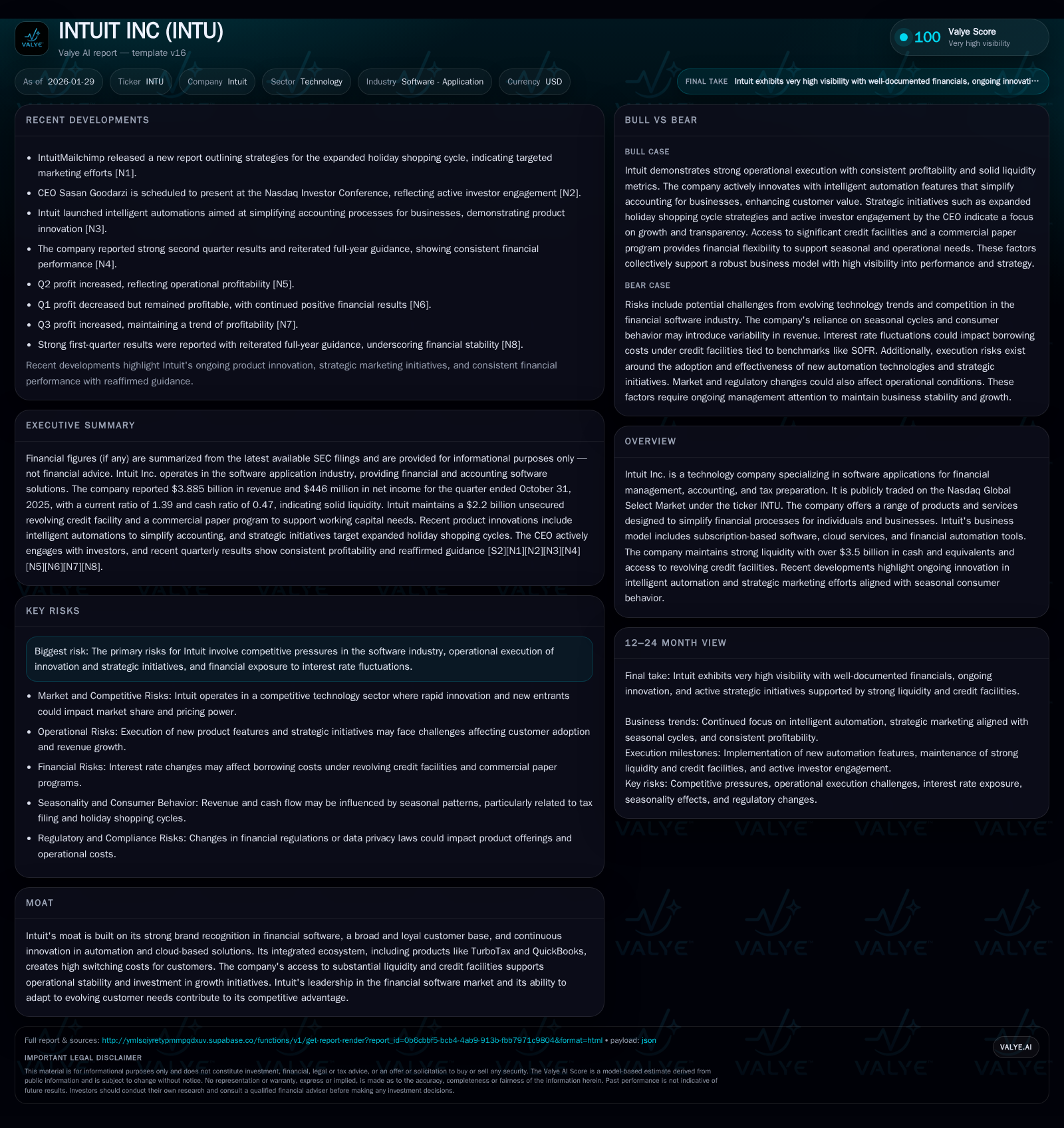
Intuit reported strong quarterly results and reiterated full-year guidance, emphasizing double-digit revenue growth and margin expansion driven by core products like TurboTax and QuickBooks. Recent strategic advances include intelligent automation features aimed at simplifying accounting workflows for businesses and targeted marketing strategies aligned with evolving consumer behaviors. However, cautious fiscal 2026 guidance and sector-wide AI-driven competition temper near-term outlook, underscoring execution and innovation as critical to sustaining its competitive moat.
What Changed Recently
Intuit Inc. has reported a series of strong quarterly results, with its first and second quarters of fiscal 2026 showing revenue growth and profitability improvements, albeit with some fluctuations in net income. The company reiterated full-year guidance with expectations of double-digit revenue growth and continued operating margin expansion [N1, N2, N3, N14]. Despite these positive results, the stock experienced downward pressure following cautious guidance announcements, reflecting investor sensitivity to near-term execution risks [N4, N5, N12].
Strategically, Intuit launched new intelligent automation features designed to simplify accounting tasks for businesses, signaling a significant push into AI-driven product enhancements [N13]. Additionally, Intuit’s Mailchimp brand released a report outlining strategies to capitalize on the expanded holiday shopping cycle, focusing on evolving consumer behavior and increased digital marketing opportunities [N10]. CEO Sasan Goodarzi’s forthcoming presentation at the Nasdaq Investor Conference indicates management’s intent to reinforce investor confidence and articulate growth initiatives [N9].
Business Model as a System
Intuit operates primarily in the technology sector, specializing in application software for financial management, tax preparation, and small business accounting [S1-S6]. Its core revenue drivers are subscription-based cloud software products including TurboTax for individual tax preparation, QuickBooks for small and medium business (SMB) accounting, and Mailchimp for marketing automation. This integrated ecosystem allows cross-selling opportunities and creates high switching costs; customers embedded in Intuit’s platforms find migration costly and operationally disruptive, fostering customer loyalty and recurring revenue.
The subscription model generates predictable, recurring revenue streams, supplemented by financial automation tools that enhance product stickiness and operational efficiency for users. Intuit’s offerings increasingly leverage AI and machine learning to automate complex financial workflows, reduce manual data entry, and improve accuracy, enabling customers to save time and reduce errors [N13].
Financially, Intuit maintains strong liquidity with over $3.5 billion in cash and equivalents and access to a $2.2 billion unsecured revolving credit facility expiring in 2031, alongside other credit arrangements for specific product financing needs such as TurboTax early refund offers [S8, S9, S10, S11]. This capital structure supports operational stability and provides flexibility for investments in R&D and strategic acquisitions.
Industry Map & Competitive Battlefield
The financial software industry is highly competitive and rapidly evolving, driven by increasing digitization of financial processes and a surge in AI adoption across software platforms. Key competitors range from traditional incumbents like Oracle and SAP, who are also investing heavily in AI, to niche challengers offering specialized accounting and tax solutions [N6].
Intuit’s integrated platform approach combining tax, accounting, and marketing automation services distinguishes it from competitors reliant on standalone offerings. However, the accelerating pace of AI innovation introduces pressure to continuously enhance product capabilities to meet rising customer expectations.
The SMB market, a key segment for Intuit’s QuickBooks and lending services, is fragmented and price-sensitive, with many customers seeking cloud-based, user-friendly solutions that can scale with their growth. Intuit’s deep brand recognition and ecosystem presence provide a moat, but competitors increasingly target these customers with aggressive pricing and AI-enabled features.
Moreover, consumer tax preparation software faces seasonal demand spikes, requiring Intuit to align product innovation and marketing efforts with predictable cycles, such as the tax filing season and holiday shopping periods [N10].
Where the Economics Become Real
Unit economics for Intuit hinge on subscription revenue per user, customer lifetime value (LTV), and efficient customer acquisition costs (CAC). The subscription model provides recurring revenue streams with relatively high gross margins typical of SaaS businesses. Intuit’s investments in AI-driven automation reduce operational costs by streamlining customer support and improving product efficiency.
The company’s robust liquidity and credit facilities are crucial to managing working capital, especially given the seasonal nature of key products like TurboTax which require upfront investments in marketing and refund financing [S8, S9, S11]. The revolving credit facility and commercial paper programs provide flexible funding to smooth cash flow volatility associated with these cycles.
Margins are influenced by the pace of R&D spending, particularly in AI and automation capabilities, competitive pricing pressures, and marketing investments aligned with consumer behavior shifts. The recent guidance highlights management’s focus on expanding operating margins despite these headwinds [N3].
Customer retention and upsell within the integrated ecosystem are vital to sustaining unit economics, as switching costs and platform integration encourage longer customer tenure and higher average revenue per user.
Diligence Questions / Disconfirming Signals
- How effectively is Intuit integrating AI and automation into its core products without compromising user experience or incurring excessive R&D costs?
- What is the retention rate among small business customers in QuickBooks amid rising competition offering AI-enhanced solutions?
- How dependent is Intuit on seasonal product cycles, and what risks arise if consumer behaviors shift unexpectedly?
- Can the company sustain double-digit revenue growth and margin expansion while investing heavily in innovation?
- Are there emerging competitive threats from new entrants leveraging AI that could erode Intuit’s moat?
- How stable is the company’s cash flow given its working capital needs and credit facility utilization?
- What impact could regulatory or macroeconomic changes have on the financial software industry and Intuit’s product adoption?
Conclusion
Intuit stands as a leading figure in the financial software space, underpinned by a diversified product suite, strong brand equity, and a subscription-based, cloud-first business model. Recent quarterly results affirm operational strength, while strategic initiatives in intelligent automation and marketing align with shifting industry dynamics. However, cautious guidance and intensifying AI-driven competition underscore the importance of execution and innovation. The company’s financial flexibility and integrated ecosystem provide important buffers against risk, but monitoring evolving customer preferences and competitive actions remains critical.
This analysis is based solely on publicly available information and does not constitute investment advice. Financial figures are derived from the latest SEC filings and news reports and are presented for informational purposes only.
Disclaimer: This is research-only, informational analysis and not investment advice. It may include AI-generated interpretation and general industry context. Always verify important details using primary sources.

Comments