
Professional Diversity Network Broadens Digital Horizons in Q1 2026
The latest quarterly Form 10-Q reveals Professional Diversity Network’s strategic pivot towards Web3 and digital assets while maintaining focus on its core diverse talent networks.
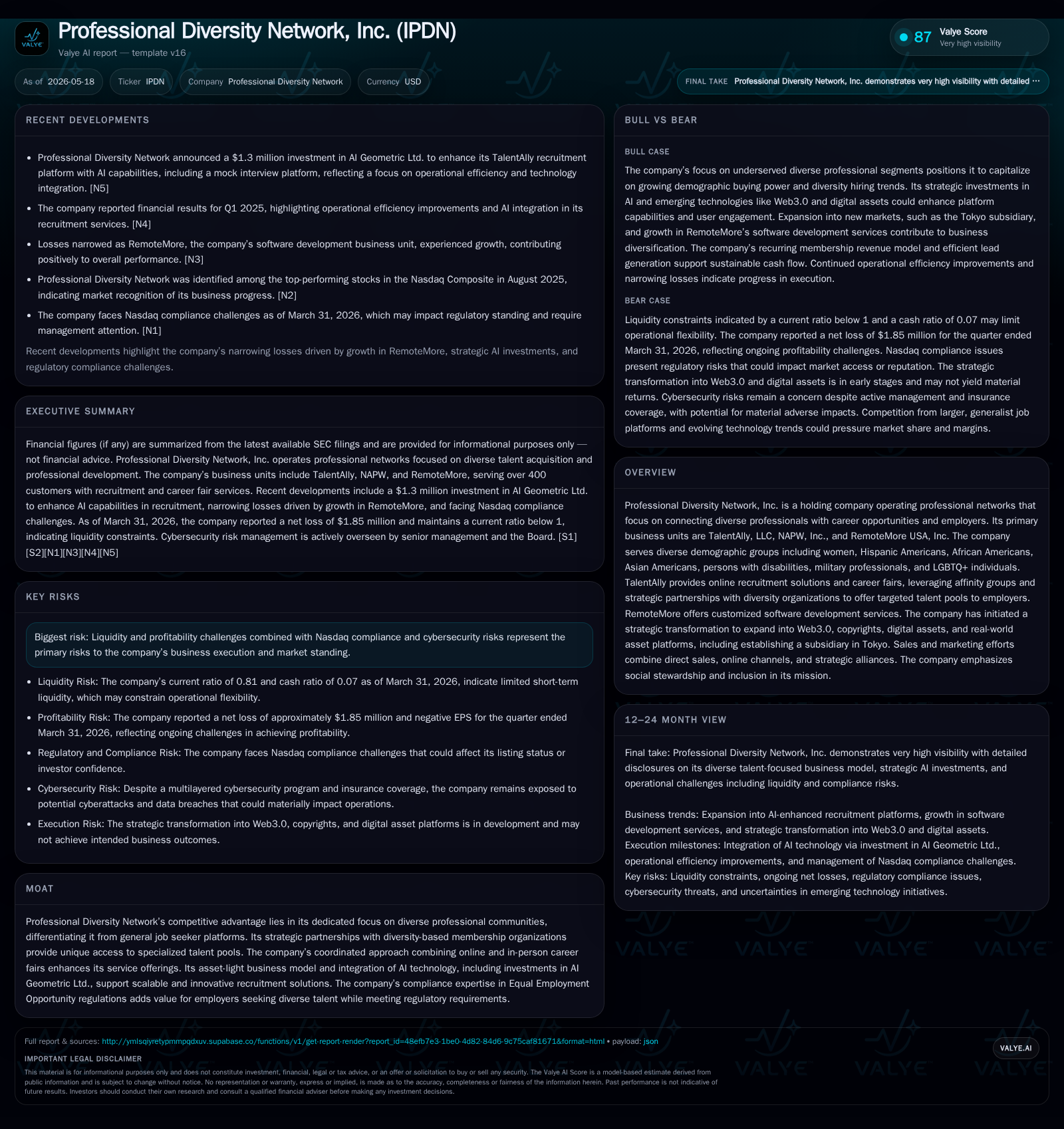
In its Q1 2026 filing, Professional Diversity Network (IPDN) highlights ongoing operational efforts and a strategic shift to blockchain-enabled platforms, including real-world asset tokenization via a Tokyo subsidiary. The company’s holding structure manages specialized recruitment and networking subsidiaries serving diverse professional communities, leveraging affinity group partnerships to access niche talent pools. Despite liquidity and profitability challenges, IPDN is investing in AI integration and emerging digital assets to diversify revenue streams. Key risks include regulatory uncertainties and Nasdaq compliance, with progress on user growth, partner synergies, and platform launches as important near-term milestones.
Latest Quarterly Operating Highlights and Strategic Updates
The May 15, 2026 Form 10-Q filing ([S2]) anchors the recent operational narrative for Professional Diversity Network (PDN or IPDN). The company reiterates progress on various strategic fronts notably its transformation toward Web3.0 initiatives including copyrights, digital asset platforms, and real-world asset (RWA) tokenization ventures targeting Asia-Pacific markets through a wholly owned Tokyo subsidiary established in 2025 ([S1], [S11]). Although this entity is nascent and non-revenue generating currently, it signals an explicit shift aiming at diversifying PDN's long-term revenue base beyond traditional online professional networking.
Operationally, the company continues developing its core recruitment network services through TalentAlly and NAPW while enhancing RemoteMore USA’s custom software offerings. The recent 8-K dated May 15 ([S3]) confirms ongoing management oversight but does not provide granular financial updates beyond standard reporting. Importantly, the filings mention the integration of artificial intelligence capabilities through their investment in Ai Geometric Ltd., which supports scalable recruitment matching – a potentially differentiating technological edge.
This strategic pivot reflects management’s ambition to blend legacy professional diversity networking solutions with emergent blockchain-enabled business models. Such an approach could capture new digital enterprise value chains but also requires navigating regulatory complexity across jurisdictions.
Business Model and Diversified Talent Network Services
Professional Diversity Network operates as a holding entity for three main subsidiaries: TalentAlly LLC (fully owned), NAPW Inc. (fully owned), and RemoteMore USA Inc. (approximately 85% owned) ([S12]). Its primary revenue mechanic involves serving employers seeking specialized talent pools drawn from underrepresented demographic groups — including women, Hispanic Americans, African Americans, Asian Americans, disabled persons, military personnel, and LGBTQ+ communities.
Employers pay for recruitment services encompassing online job postings, access to curated candidate databases within affinity networks, virtual and physical career fairs alongside OFCCP compliance consultation—a salient feature given federal contractor diversity mandates ([S1]). Revenue streams also extend into membership fees (primarily via NAPW), advertising/marketing solutions tailored to these demographic segments, and custom software development contracts chiefly handled by RemoteMore USA.
This multi-pronged service model benefits from an asset-light structure that allows investment flexibility towards scaling operations digitally. Incorporating AI-driven solutions aims to enhance matching efficiency between employer requirements and candidate profiles across affinity groups.
A core strength lies in IPDN's reputation for navigating equal employment opportunity regulatory frameworks—an increasingly relevant offering as organizations balance compliance demands with diversity hiring objectives. Management further emphasizes internal controls safeguarding intellectual property rights around trademarks and copyrighted content associated with their network brands ([S27]).
Competitive Positioning Within Professional Networking Markets
While publicly traded peers or direct comparables are limited given IPDN’s specialized focus on professionally diverse affinity groups rather than generalized job boards or conventional LinkedIn-style networks ([S1]), this niche provides inherent competitive separation. Many larger competitors pursue broad-spectrum professional social networking; by contrast, PDN’s curated communities offer employer clients targeted access that reduces candidate search friction.
IPDN blends digital engagement with offline event-based recruiting—including career fairs—to enhance client stickiness and reduce switching propensity. The integration of AI technology such as investments in Ai Geometric Ltd further differentiates their offering by improving candidate-employer matching accuracy at scale.
Their holding company structure permits nimble adaptation by individual business units while enabling cross-subsidiary synergy optimization (0% integration potential based on shared affinity group memberships). However, absent detailed market share data or peer financials in filings limits precise benchmarking.
Sector-Specific Growth Catalysts: Technology and Demographics
Key growth levers center on expanding registered users within the TalentAlly network which acts as the central online community hub for recruitment engagement ([S1], [S2]). Registered users provide vital volume for employer clients paying for targeted access; growth here fuels overall top-line expansion potential.
Parallel adoption of emergent digital platforms exploring copyrights, tokenized real-world assets (RWA), and blockchain ecosystems represents an exploratory yet forward-looking diversification strategy ([S11]). Early-stage development seen in the Tokyo subsidiary situates PDN well to capture cross-border demand for Web3 enabled recruitment or entertainment-related intellectual property offerings.
Furthermore, demographic shifts increasing workforce diversity awareness along with continued enforcement of OFCCP compliance requirements bolster demand structurally rather than cyclically for IPDN’s core services ([S13]). Automation through AI stands to improve margin profiles over time by reducing manual sourcing costs.
Supply-side constraints might arise from quality control over talent pools as well as regulatory hurdles surrounding digital asset monetization across multinational frameworks; thus capacity expansions should cautiously align with validated user engagement metrics.
Risks and Operational Constraints to Monitor
Liquidity remains a critical concern with a suboptimal current ratio of approximately 0.81 at quarter-end March 31, 2026 ([F1]), indicating current liabilities outstrip current assets. Cash balances are tight at around $35K while total debt stands close to $445K based on last available figure from 2016 [F1]. These metrics underscore risk to execution pace especially amid capital-intensive Web3 explorations requiring external financing ( unknown availability).
Nasdaq compliance risks are noted within the latest Form 10-K risk disclosures; alongside cybersecurity threats which IPDN actively manages via a CTO-led multilayered security program reporting directly to the board audit committee ([S24]). Nonetheless residual cyber risk persists due to evolving threat sophistication—a material consideration given reliance on digital platforms.
Profitability challenges persist with operating losses exceeding $6 million in recent annual data [F1]. Management must balance investment in innovation against tightening cost control measures to reach sustainable breakeven thresholds.
Upcoming Milestones and Market Signals to Track
Near-term attention should focus on quarterly releases clarifying how registered user growth trajectories evolve alongside employer client acquisition rates involved in recruitment advertising campaigns ([S2], [S3]). Integration progress of emerging Web3 products including copyright monetization and RWA tokenization efforts especially through Asia-Pacific initiatives led by the Tokyo subsidiary will be critical for validating diversification strategy efficacy.
Monitoring partnership developments with affinity organizations can shed light on expanding talent pool breadth—key to unlocking additional recurring revenue streams via memberships or ancillary services. Also worth watching are enhancements in AI utilization metrics tracking automation-driven cost savings versus headcount increases.
Guidance updates or management commentary related to capital raising plans will be informative about execution feasibility given liquidity constraints identified.
Concise Financial Overview Reflecting Recent Quarter Results
As of March 31, 2026, PDN held cash reserves approximating $34,708 while total debt was estimated at roughly $445,000 (most recently reported in September 2016) resulting in net debt near $410,000 [F1]. Current assets totaled $3.34 million against current liabilities of approximately $4.12 million yielding a current ratio of about 0.81—highlighting working capital insufficiency [F1].
Operating income remains negative at around -$6.45 million based on last annual report figures; net income mirrors this loss magnitude indicating ongoing margin pressures [F1]
These financial figures underscore that despite operational momentum around network growth and innovation initiatives, capital structure limitations present execution risk especially considering potential need for additional financing amidst strategic pivots towards capital-intensive blockchain ventures.
This analysis synthesizes publicly filed SEC materials up to May 15, 2026 without offering investment advice or price forecasts. Readers should consider all risk factors disclosed within official filings before forming conclusions about the company's future prospects.
Disclaimer: This is research-only, informational analysis and not investment advice. It may include AI-generated interpretation and general industry context. Always verify important details using primary sources.

Comments