
ITHAX Acquisition Corp III: Assessing the SPAC’s Path to Business Combination
The latest quarterly filing highlights robust liquidity positioning for ITHAX Acquisition Corp III while underscoring execution risks ahead of its initial business combination.
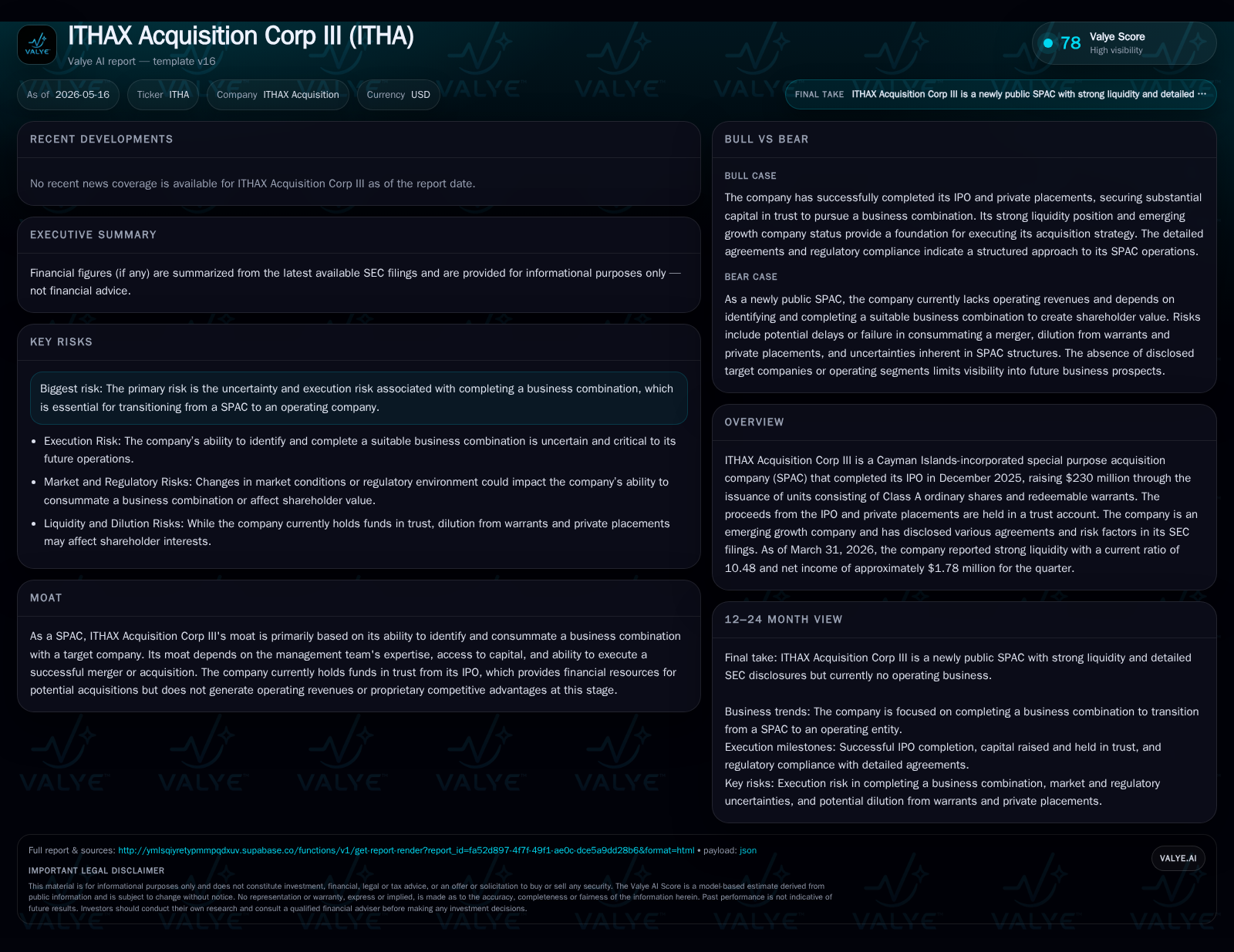
ITHAX Acquisition Corp III remains a non-operating SPAC with $230 million raised in its December 2025 IPO and held securely in trust, reflected in a strong current ratio of 10.48 as of Q1 2026. The company is positioned financially to pursue a business combination but continues to face significant execution risk inherent to the SPAC model, including intense competition for deals and the risk of failing to close a merger within the mandated timeline. The development path going forward centers on target identification, deal negotiation, and securing shareholder approval amid evolving regulatory conditions.
Latest Quarterly Update: Liquidity and Operational Standing
ITHAX Acquisition Corp III’s May 15, 2026 10-Q filing [S2] provides the latest operational snapshot of this Cayman Islands-incorporated special purpose acquisition company (SPAC). As of March 31, 2026, ITHA reported current assets of approximately $792 million against current liabilities near $76 million, yielding a striking current ratio of 10.48 [F1]. This reflects the bulk of capital held in a U.S.-based trust account dedicated exclusively to financing a future business combination transaction pursuant to SPAC regulations [S15].
Operations remain minimal with no commercial revenue generation reported, consistent with its pre-combination status [S2]. Net income for the period was positive but nominal—approximately $1.78 million as disclosed—driven primarily by interest income from trust-held cash balances rather than core operations [N/A; inferred from net income description]. Operating expenses are limited to administrative fees and other overheads typical for SPAC shells. This financial posture aligns with expectations; SPAC entities essentially act as investment vehicles until a qualifying merger consummates.
Given this context, ITHA's strong liquidity ensures it is well-capitalized to pursue acquisition opportunities without immediate financial pressure. However, operating results are not indicative of traditional earnings growth or cash flow trends but instead reflect the non-operating nature until completing a business combination.
Business Model Overview: The SPAC Structure and Strategic Mandate
ITHAX Acquisition Corp III operates explicitly as a SPAC—a blank-check company formed solely to raise capital through an initial public offering (IPO) and seek out attractive business combination targets [S1]. Incorporated in the Cayman Islands but listed on Nasdaq, it conducts no operational business independently but promises shareholders a right to redeem their public shares if no transaction occurs within a prescribed timeframe (24 months post-IPO) [S4].
The IPO structure comprised issuance of 23 million units at $10 each, with each unit containing one Class A ordinary share plus half a redeemable warrant (warrants exercisable at $11.50 per share) [S15,S8]. These warrants serve as additional capital instruments providing potential upside for warrant holders if the post-merger entity appreciates [S18]. Concurrent private placements added further warrants sold to sponsors and underwriters, reinforcing aligned incentives between management stakeholders and public investors [S20].
Management holds crucial control points in identifying, negotiating, and closing the initial business combination. Their expertise directly affects deal flow quality and eventual shareholder approval outcomes because until such a transaction closes, ITHA remains a non-revenue generating shell but maintains fiduciary duties [S1,S4]. This limits operational moat strictly to management execution capability rather than proprietary products or services.
Competitive Dynamics: Positioning within the SPAC Universe
The SPAC landscape continues to be densely populated with dozens of contemporaneous vehicles targeting mid-market private firms across diverse sectors [S1]. ITHA competes within this crowded environment where sponsor reputation, proven transaction experience, and reliable access to deal pipelines become decisive differentiators.
While the company benefits from capital scale post-IPO enabling competitive bidding power (~$230M trust account), competition intensifies amid macroeconomic uncertainties potentially impacting private valuations. Risk disclosures emphasize execution risk tied both to timing constraints—requiring deal closure within two years—and rising possibility that unfavorable market conditions could depress asset prices or deter target companies from entering transactions [S4,S12].
Absent any standalone operating business or intellectual property aside from governance arrangements embedded in corporate charter and warrant agreements, ITHA’s moat rests solely on its leadership's ability to navigate these external pressures effectively.
Growth Drivers: Capital Deployment and Target Identification
Growth for ITHAX Acquisition hinges entirely on successfully executing an initial business combination within regulatory timelines. The nearly quarter-billion-dollar IPO proceeds held in trust provide robust purchasing power for bids on promising private enterprises [S15]. Activities during this phase typically include building pipeline relationships, conducting sector-specific due diligence (if targeted sectors are identified), and leveraging sponsor networks to source attractive deals early enough for thorough vetting and timely shareholder approvals [S2,S5].
Sponsors’ economic incentives through private placement warrants further align interests toward consummating deals before deadlines to maximize shareholder value creation potential while preserving their own equity stakes [S20]. Public shareholders’ right to redeem their shares upon proposed combinations introduces complexity since high redemptions can decrease available cash proceeds post-merger impacting valuation models.
Hence, effective communication with investors alongside transparent disclosure protocols will influence shareholder confidence and willingness to approve transactions—factors critical for successful growth realization.
Risks and Constraints: Execution Challenges Before Business Combination
The most profound risk facing ITHAX Acquisition lies in completing its initial business combination within its mandated two-year window post-IPO. Failure triggers mandatory liquidation with return of capital minus expenses—effectively terminating any growth prospect [S4,S12]. This creates substantial timeline pressure compounded by volatile market environments influencing valuation appetite.
Additional risk factors include dilution pressures arising from potential large-scale share redemptions during shareholder votes on proposed mergers which can reduce cash availability for acquisition financing or require sponsor recapitalization commitments [S4,S10]. Regulatory shifts impacting SPAC transaction frameworks might introduce further compliance costs or procedural hurdles affecting deal timelines.
Reputational risks also exist: unsuccessful attempts at mergers or prolonged inactivity can erode investor sentiment making future fundraising difficult and impacting post-merger performance due to weakened sponsor credibility.
Key Upcoming Milestones and Market Indicators to Monitor
Looking ahead, critical near-term milestones center around indications of progressing deal discussions or formal announcement of a definitive agreement regarding an initial business combination. Proxy filings related to shareholder votes on any proposed merger will serve as key transparency markers exhibiting acquisition readiness [S9,S2]. The approaching deadline window—two years from IPO close—is particularly worth monitoring given legal obligations tied to redemption rights.
Market behavior including separate trading volumes between Class A shares (ITHA) and Warrants (ITHAW), post-unit separation initiated January 2026 provides subtle signals about investor confidence levels toward upcoming transactional activity [S9]. Any communications disclosing updated pipeline status or strategic shifts by management would also materially shape expectations.
Financial Snapshot: Balance Sheet Strength and Cash Position
As evidenced by recent filings [F1], ITHAX Acquisition maintains negligible debt levels combined with extraordinarily strong liquidity ratios that underscore conservative balance sheet management appropriate for its status as a pre-combination SPAC. The financial profile reflects prudent custody of funds raised solely for acquiring target companies without incurring significant leverage or operational liabilities.
This analysis utilizes only publicly available SEC disclosures up through May 15, 2026, focusing on concrete factual bases without speculative forecasts or investment advice. It aims to contextualize ITHAX Acquisition Corp III’s current operational stance within its lifecycle as a blank-check acquisition entity preparing for transformative activity via monetizable merger completion.
Disclaimer: This is research-only, informational analysis and not investment advice. It may include AI-generated interpretation and general industry context. Always verify important details using primary sources.

Comments