
IIOT-OXYS Q2 2026: Liquidity Crisis Deepens Amid Convertible Debt Extensions
IIOT-OXYS reports a severe working capital deficit and extended convertible note maturities in Q2 2026, highlighting critical liquidity challenges.
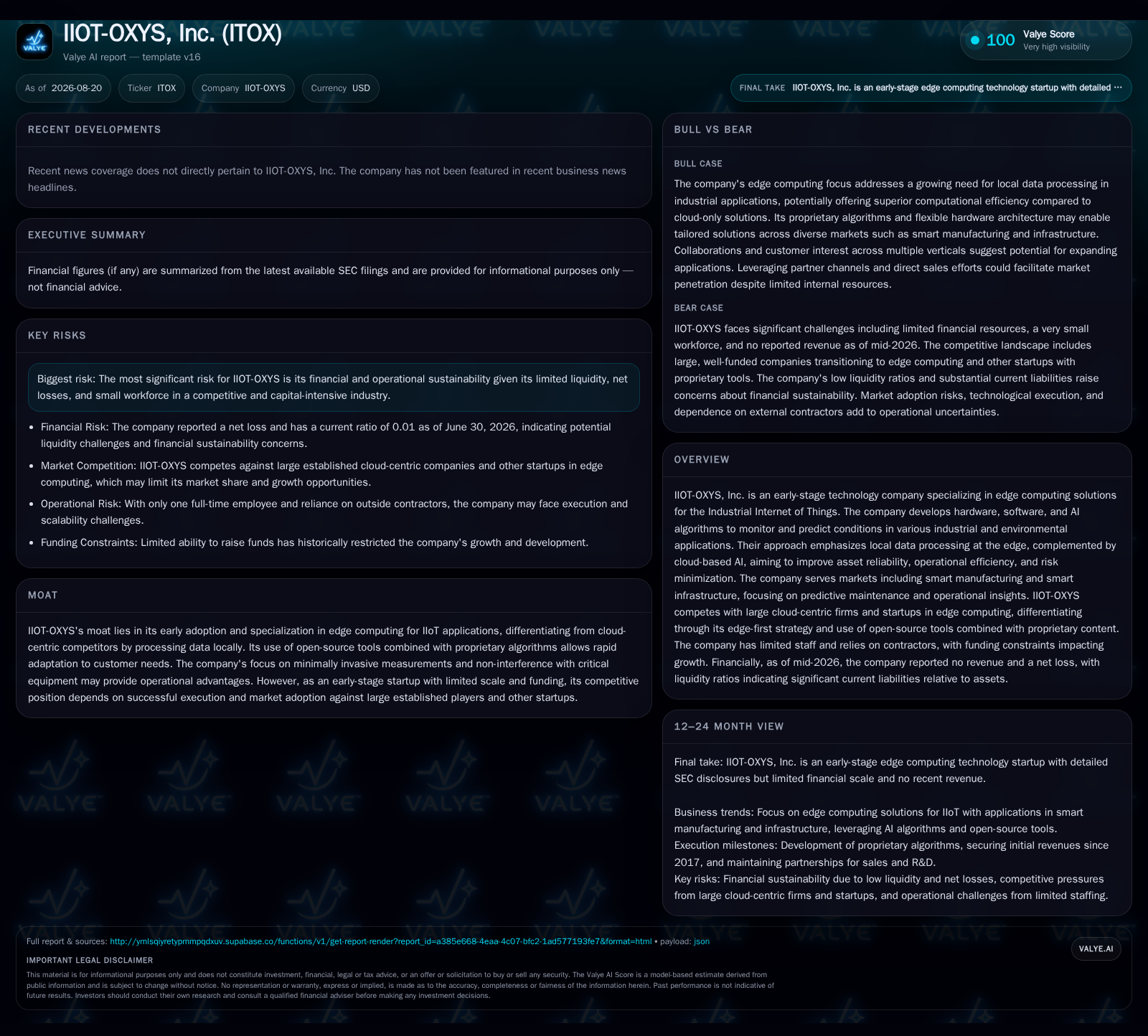
IIOT-OXYS, Inc., an early-stage edge computing startup, disclosed a critical liquidity crisis in its Q2 2026 filing, with a current ratio of 0.01 driven by a working capital deficit exceeding $3 million. The company’s secured convertible promissory note, held by a related party, was extended twice in 2026, reflecting ongoing financial distress and reliance on related party financing. These developments underscore the structural challenges IIOT-OXYS faces in sustaining operations without meaningful revenue growth or external capital infusion.
IIOT-OXYS, Inc. reported a critical liquidity situation in Q2 2026, with a current ratio of just 0.01 as of June 30, 2026, reflecting an extreme working capital deficit during current liabilities totaling $3,187,706 [S2]. Additionally, the company extended the maturity of its secured convertible promissory note twice during 2026, underscoring ongoing financial strain. These developments highlight significant structural challenges that jeopardize IIOT-OXYS's operational sustainability unless it secures new capital or achieves revenue growth, consistent with its status as an early-stage technology startup focused on edge computing solutions [S1].
Compounding the liquidity challenge, IIOT-OXYS’s secured convertible promissory note payable to a related party investor, with a principal balance of $13,942 and a 10% annual interest rate, had its maturity date extended twice in 2026—from October 29, 2025, to April 29, 2026, and then further to October 31, 2026 [S2]
Additionally, in Q2 2026, IIOT-OXYS changed its revenue recognition policy to treat shipping and handling activities as cost of sales and to record revenue net of sales and similar taxes [S2]. Its business model targets industrial and environmental customers who require real-time data processing and predictive analytics at the edge, reducing latency and bandwidth compared to cloud-centric solutions.
The company’s products combine off-the-shelf hardware components with a reconfigurable architecture adaptable to diverse customer needs. Its software leverages open-source tools but incorporates proprietary AI algorithms tailored for domain-specific challenges, aiming to reduce development time and cost while delivering actionable insights [S1].
Competition in this sector includes established cloud providers emphasizing cloud-centric models and startups focusing on proprietary edge computing tools. IIOT-OXYS’s approach of blending open-source software with proprietary algorithms represents a differentiated, though early-stage, positioning [S1].
Financial Sustainability and Capital Structure Risks
The extreme working capital deficit and minimal cash reserves highlight a structural liquidity crisis threatening IIOT-OXYS’s near-term operational viability [F1]
The repeated extensions of the secured convertible promissory note, coupled with waivers of prior defaults, suggest constrained access to external financing and a dependence on related party debt to sustain operations [S2]. This reliance raises refinancing risk and underscores the precariousness of the company’s capital structure.
Given the absence of disclosed revenue growth and the company’s early-stage development, the financial sustainability of IIOT-OXYS hinges on securing new capital or achieving meaningful revenue expansion. Without these, the risk of insolvency or forced restructuring increases materially.
Scenario Analysis: Pathways Forward
Several plausible scenarios emerge from IIOT-OXYS’s current financial and operational position:
Bear Case: Failure to raise external capital or generate meaningful revenue growth could lead to insolvency or restructuring. The severe liquidity shortfall and reliance on related party convertible notes create a high risk of cash exhaustion. Confirmation would come from further debt maturity extensions, liquidity warnings, or negative cash flow trends.
Base Case: The company continues as a pre-revenue startup, relying on related party financing and incremental debt maturity extensions while developing its technology. This scenario assumes slow or no revenue growth and stable or worsening liquidity ratios, confirmed by ongoing related party debt agreements and lack of material revenue improvement.
Bull Case: If IIOT-OXYS leverages its edge-first technology and proprietary algorithms to secure new customers and external funding, it could transition to revenue generation, improving liquidity and reducing debt reliance. The company’s early-stage edge computing business model faces significant financial constraints that threaten operational sustainability absent new capital or revenue growth.
Key watchpoints for investors and observers include quarterly revenue disclosures and customer acquisition updates, further convertible note maturity extensions or refinancing activities, changes in cash balances and liquidity ratios in subsequent filings, and announcements of new capital raises or strategic partnerships. Monitoring these indicators will be critical to assessing whether IIOT-OXYS can overcome its structural financial challenges or faces heightened risk of insolvency.
Disclaimer: This is research-only, informational analysis and not investment advice. It may include AI-generated interpretation and general industry context. Always verify important details using primary sources.

Comments