
iWallet Corp Advances Next-Gen Biometric Security Wallets Despite Financial Challenges
Recent quarterly disclosures reveal progress on prototype development and manufacturing readiness amid critical liquidity constraints.
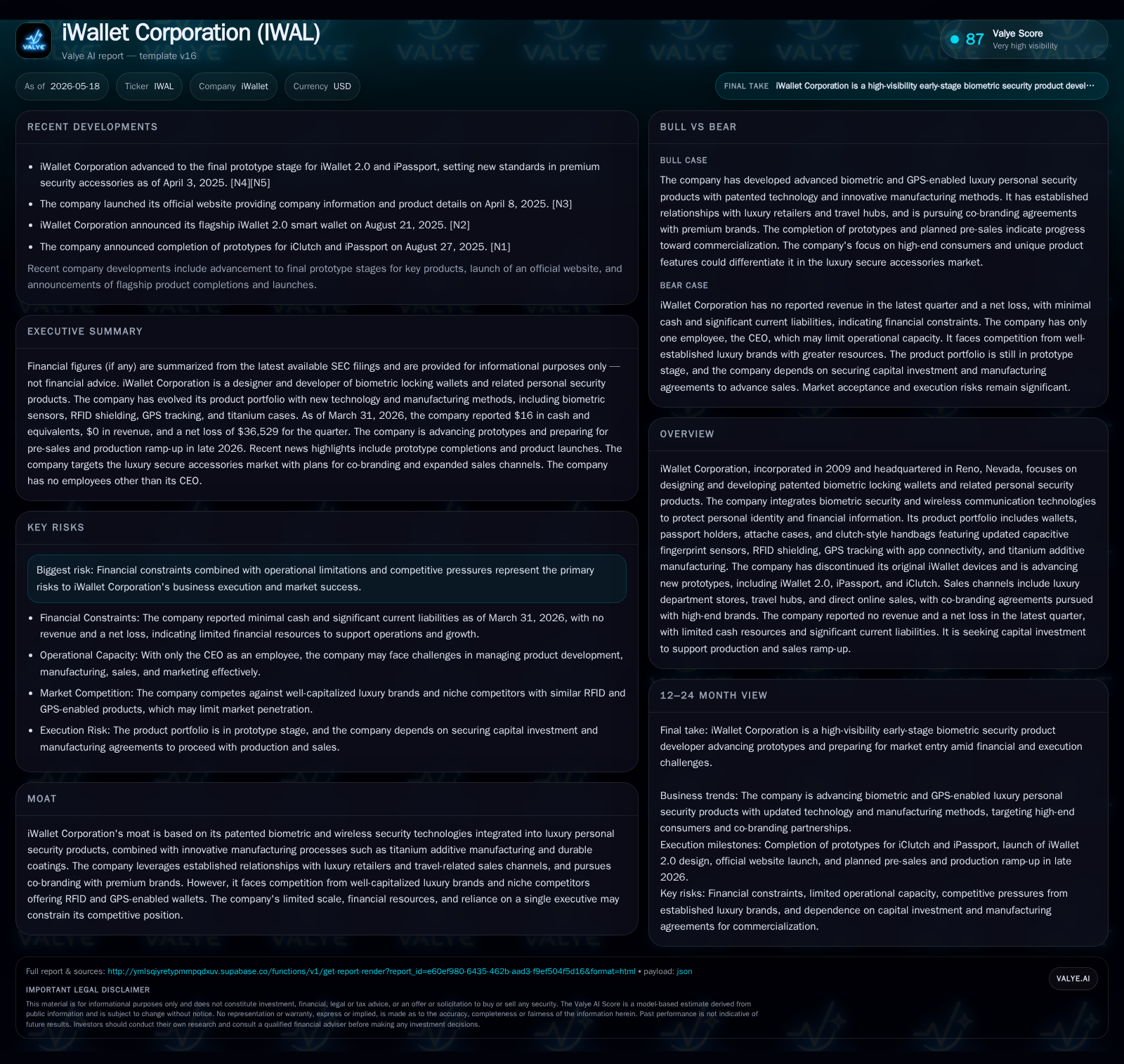
In its latest 10-Q filing, iWallet Corp detailed significant advancements in its next-generation biometric security products, including locked-down designs for the iWallet 2.0 and working prototypes of iPassport and iClutch. Contract manufacturers stand ready to begin production contingent on volume forecasts, signaling a shift towards commercialization after a prolonged R&D phase. However, the company faces severe financial stress, with near-zero cash reserves against substantial current liabilities and no revenues reported recently. Its strategic moat rests on patented biometric and wireless security technologies embedded in luxury personal security accessories, but competitive pressures and limited scale present notable execution challenges.
Q1 2026 Operational Update: Key Developments from the Latest Filing
The most recent quarterly report filed by iWallet Corporation on May 15, 2026 (Form 10-Q) surfaces pivotal progress as the company transitions from concept to commercialization phase. The company confirms that the detailed design for the second-generation flagship product iWallet 2.0 is finalized. Meanwhile, multiple working prototypes exist for newer devices — specifically the iPassport (passport holder) and the iClutch (clutch-style handbag) — which are actively being demonstrated to potential clients and investors [S2], [S1].
Crucially, contract manufacturers have been identified and remain prepared to initiate large-scale production lines conditioned upon receiving credible sales volume forecasts. This operational readiness underscores an inflection point where iWallet aims to shift from primarily R&D activities toward scaling supply chain execution in tandem with capital infusion [S1]. The filing also reflects ongoing efforts to refine alternate configurations of these devices, indicating flexibility to adapt final product offerings based on market feedback or co-branding requirements.
Business Model and Product Portfolio: Unique Features and Value Propositions
iWallet’s business model revolves around designing and selling high-end personal security "techcessories" that integrate patented biometric locking mechanisms with wireless communication features. Revenue generation depends primarily on unit sales of these smart containers — including wallets, passport holders, attache cases, and clutch bags — priced generally above $200 per unit targeting luxury consumers [S1], [S10].
Technologically distinctive aspects include an updated capacitive fingerprint sensor delivering enhanced sensitivity and reliability compared to previous iterations. Supplementary protective features comprise advanced RFID shielding materials aimed at thwarting electronic pickpocketing attempts. Device tracking is enabled through built-in GPS combined with an accompanying smartphone app offering real-time location recovery. A notable manufacturing innovation is exclusive use of titanium additive manufacturing for outer casings — facilitating rapid design iterations without costly tooling as well as ensuring superior durability coupled with lightweight construction [S10]. Complementary physical vapor deposition coatings provide vivid color finishes resistant to scratches or dirt accumulation.
This product portfolio addresses key customer concerns such as identity theft protection blended with premium aesthetics—offering both functional security enhancements and lifestyle appeal through luxury craftsmanship.
Competitive Context in the Luxury Personal Security Accessory Industry
Within a competitive set featuring luxury brands like Cartier, Montblanc, Gucci alongside niche innovators such as Ekster or Nomad offering RFID/GPS features, iWallet positions itself through patented biometric technology underpinning a differentiated product mix [S1], [S10]. Unlike many competitors reliant on add-on GPS modules or common RFID-blocking layers alone, iWallet embeds capacitive fingerprint sensors directly for physical locking – a relatively rare capability in this segment.
Distribution historically included prestigious outlets like Neiman Marcus (North America), Harrods (UK), and Highline Peak Group (Canada). Going forward, channels expand toward travel hubs including duty-free shops and airline catalogs alongside direct online platforms. Co-branding agreements are actively pursued with upscale brands such as Montblanc, Ducati, Gucci, Bugatti, Dunhill, TravelPro—intended to leverage partner brand equity while adapting designs quickly via additive manufacturing [S10].
Despite these strategic assets, the firm operates at limited scale without widespread brand recognition or extensive financial resources relative to incumbents. Switching costs are moderate; customers may shift brands if competing devices offer comparable tech integration or more established luxury credentials.
Growth Catalysts: Market Expansion and Co-Branding Initiatives
Growth hinges on several structural drivers: expanding consumer demand for advanced personal identity protection coupled with rising appetite for tech-enabled luxury accessories creates a sizable addressable market. Prospective deals reportedly under discussion include automotive dealership gift shops (General Motors, Mercedes-Benz, Porsche), travel hub retail placements across airports/cruise ships, and luggage manufacturers—a channel extension capitalizing on past collaboration success with Heys Luggage [S1], [S10].
Co-branding arrangements serve a dual purpose: extend geographic reach via partner distribution networks while fostering product differentiation through exclusive designs aligned with premium brand DNA. Titanium additive manufacturing accelerates customized SKU rollouts necessary for these OEM/co-brand partnerships.
Product calendar milestones targeting pre-sales start in Q3 2026 followed by direct deliveries envisaged for Q4 imply revenue scalability if execution aligns. Demonstrating tangible prototype quality to investors/clients remains vital for converting prospects into binding purchase agreements.
Risks and Headwinds: Financial Constraints and Competitive Pressures
iWallet confronts severe financial headwinds that threaten operational continuity absent capital injections. Latest balance sheet snapshots depict approximately $16 thousand in cash versus nearly $886 thousand in current liabilities—a current ratio effectively at zero—highlighting pronounced liquidity stress [F1]. Net losses exceeded $1.1 million most recently reported period performance reflecting burn from prolonged R&D absent meaningful revenue contributions [F1].
Operational risks center on transitioning from prototype demonstrations to full-scale production amid constrained resources. Dependence on a single executive intensifies governance concentration risk. Competitively, despite patent moats around biometric locking technologies, emerging entrants or incumbent luxury players could erode market share given their superior capital strength and brand awareness.
Execution requires timely signing of manufacturing contracts predicated on sales volumes plus successful fundraising rounds; failure here could stall commercialization indefinitely.
Milestones to Monitor in the Coming Quarters
Key near-term indicators warrant close attention:
- Formal contract signings with identified manufacturing partners initiating production lines.
- Volume forecast confirmations that unlock scale economies.
- Capital raises sufficing to finance additional prototype build-outs supporting sales efforts.
- Acquisition of pre-orders validating market demand ahead of official launches planned from Q3/Q4 2026.
- Progression or conclusion of co-branding agreements affecting channel penetration velocity. Monitoring these milestones will clarify transition status from R&D-centric firm toward commercial entity capable of generating sustainable revenues.
Brief Financial Overview: Liquidity Position and Investment Needs
Financially, iWallet reported zero revenues during the trailing periods as legacy products phased out due to obsolescence. Losses continue escalating above $1 million annually driven by investment in product development costs [F1]. As of quarter end March 31st 2026, cash resources stood at a precarious $16 thousand set against current liabilities totaling approximately $886 thousand—reflecting severe liquidity constraints which imperil near-term operating viability without immediate financing remedies [F1], [S2]. The recorded total debt figure dates back years ago at roughly $460 thousand but current debt details remain unreported; net debt implied minimal given nominal cash holdings [F1]. This financial backdrop necessitates urgent capital deployment centered on bridging development-to-production gaps.
This analysis synthesizes regulatory filings up to May 2026 alongside strategic industry context to profile iWallet Corporation’s evolving trajectory as it pursues commercialization of innovative biometric security "techcessories." While product innovation coupled with selective luxury partnerships cultivate differentiation within a niche market segment sensitive to identity theft concerns paired with premium design aspirations, persistent financial distress represents an existential challenge needing resolution during this critical growth inflection.
This document does not constitute investment advice or an offer but seeks to rigorously interpret publicly available information regarding operating strategy and industry positioning.
Disclaimer: This is research-only, informational analysis and not investment advice. It may include AI-generated interpretation and general industry context. Always verify important details using primary sources.

Comments