
Wright Investors Service Holdings’ Strategic Reset and Liquidity Position as a Shell Company
Wright Investors Service Holdings remains a public shell with a strong liquidity position, exploring acquisition opportunities while balancing operational and regulatory challenges.
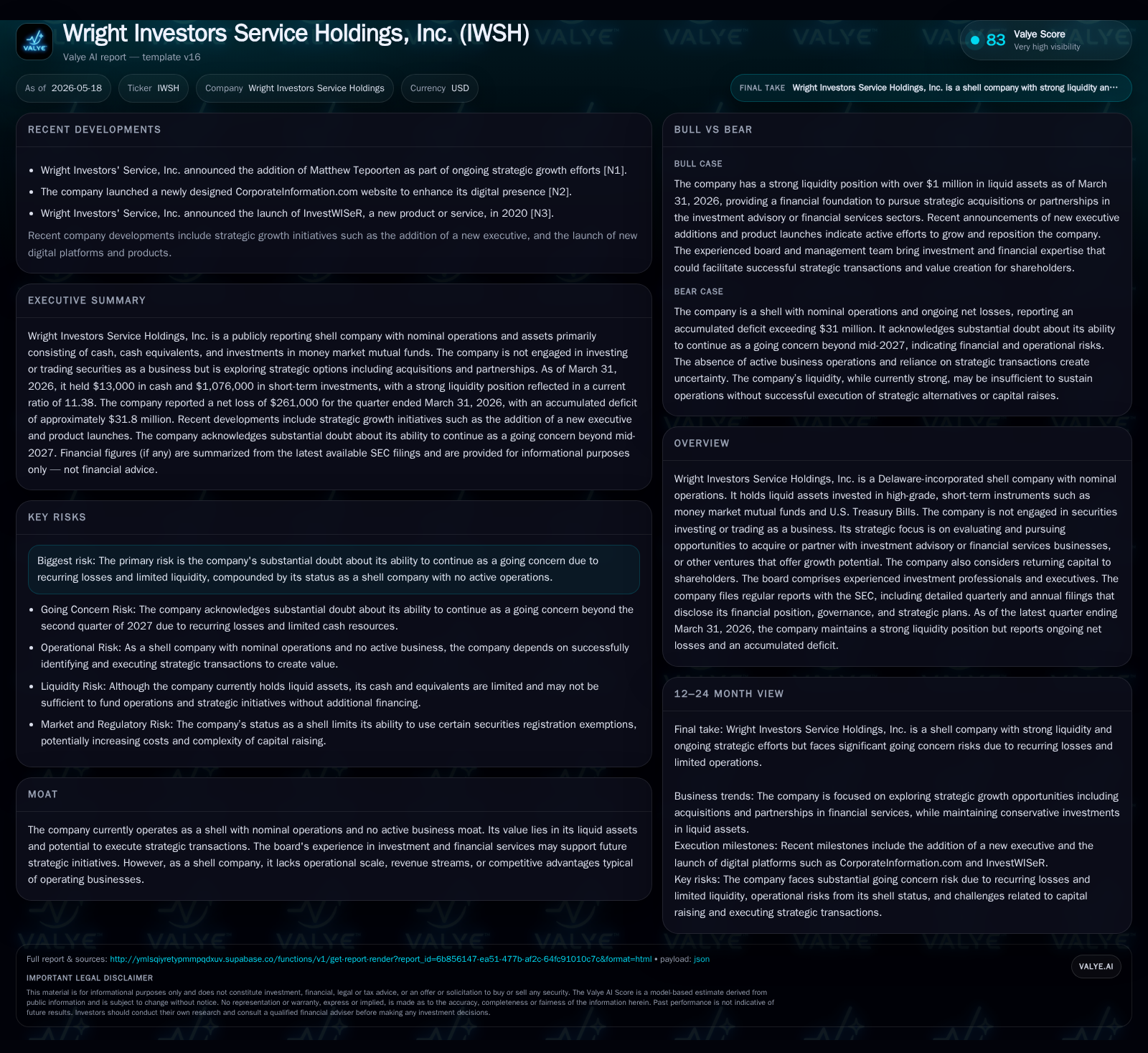
As of Q1 2026, Wright Investors Service Holdings, Inc. (IWSH) operates as a Delaware-incorporated shell company holding liquid assets mainly in short-term mutual funds and U.S. Treasury investments. The latest SEC 10-Q confirms nominal operations with no revenue generation, though the firm maintains a robust current ratio reflecting prudent capital preservation. The board is actively considering strategic acquisitions or partnerships within financial services sectors to transition toward operational growth. While cash liquidity is limited, investment holdings exceed $1 million, positioning the company for potential deals or shareholder distributions. However, ongoing operating losses and shell company regulatory constraints present liquidity and marketability risks that challenge near-term sustainability.
Latest Quarterly Operating Update and Implications
Wright Investors Service Holdings’ Q1 2026 filing (period ended March 31) reconfirms its status as a public shell company with nominal operations and no active revenue streams. Cash on hand declined markedly to $13,000 by quarter-end compared to prior periods, reflecting ongoing operating expenses despite cost containment efforts [S2][F1]. Nonetheless, the company retains substantial investments in high-grade short-term mutual funds totaling approximately $1.08 million, underscoring a conservative asset allocation focused on principal preservation and liquidity.
Operating expenses moderated year-over-year to approximately $149,000 from $172,000 driven by reductions in professional fees and travel-related costs. This was partially offset by increased maintenance fees associated with fully impaired dam properties—a legacy liability unlikely to generate revenue but still incurring expense [S2]. Interest income contracted sharply by more than two-thirds compared to Q1 2025 due to both diminished yields amid prevailing market conditions and reduced invested balances [S2].
Management’s MD&A highlights that working capital may not suffice past May 31, 2027 without successful strategic initiatives or alternative financing—signaling material liquidity risk despite a strong current ratio exceeding 11x [F1][S2]
Business Model Overview: From Liquid Asset Holder to Strategic Acquirer
IWSH functions primarily as a publicly traded shell holding liquid assets concentrated in U.S [S1][S5]. Treasury Bills and money market mutual funds. It does not engage as an active investor or trader but preserves capital in short-duration instruments designed to avoid speculation while maintaining readiness for deployment upon identifying strategic opportunities
Absent operating revenues, intrinsic value relies on asset valuations net of operating expenses rather than cash flow generation [S1]. Governance comprises seasoned investment professionals who evaluate acquisition or partnership targets mainly within financial services—particularly investment advisory firms—while maintaining sector flexibility to optimize growth prospects
The strategy focuses on transitioning from passive liquidity management toward operational relevance through mergers or acquisitions while retaining flexibility for shareholder returns if deal flow does not materialize promptly.
Regulatory and Competitive Context of Shell Status
As a shell company per SEC Rule 12b-2, IWSH faces regulatory constraints that restrict access to streamlined securities registration processes (Forms S-3 and S-8) for at least twelve months after ceasing shell status. This limitation increases the time and cost associated with capital raises and employee equity incentive issuance [S3][S7]. Furthermore, Rule 144 transfer restrictions impede holders’ ability to sell restricted stock efficiently, reducing secondary market liquidity and potentially depressing share attractiveness.
Compared with other shell entities pursuing transactional strategies or SPAC-like models, IWSH has yet to announce definitive deals but maintains sufficient liquid assets for measured strategic deployment. The absence of operational revenue emphasizes the importance of transparent communication regarding strategic intent amid these regulatory hurdles.
Growth Drivers: Acquisition Pipeline and Capital Deployment Flexibility
The Board has articulated clear intent to pursue growth through acquisitions or partnerships predominantly within financial services sectors where management possesses expertise. This includes investment advisory businesses or related financial service entities capable of generating operational revenues and enhancing shareholder value beyond passive holdings [S5][S13].
Additional pathways include joint ventures targeting synergistic businesses across broader industries when attractive opportunities arise. Concurrently, management contemplates returning capital via distributions should acquisition markets prove unviable—balancing growth ambitions against shareholder value preservation given uncertain deal pipelines.
Near-term expansion depends heavily on successful deal execution coupled with efficient integration and capitalization given the lack of direct revenue history.
Risks and Constraints: Liquidity Challenges Amid Shell Company Limitations
Despite an elevated current ratio above eleven times current liabilities [$F1], IWSH’s sustainability faces significant risks tied to its shell nature [S2]. Recurring operating losses driven by professional fees and non-revenue producing legacy costs create going concern uncertainties absent transformative strategic actions soon
Regulatory impediments complicate equity financing efforts needed for acquisitions at favorable terms. Restricted stock transfer limitations reduce market fluidity adversely impacting share price stability. The full valuation allowance on deferred tax assets eliminates potential tax shield benefits despite net operating losses recorded [S2]
Liquidity concerns are acute given management’s cautionary note that working capital sufficiency extends only through May 31, 2027 without new funding sources—establishing a critical timeline for executing strategic initiatives.
Key Milestones and Monitoring Points
Investors should watch forthcoming SEC filings for announcements regarding definitive acquisition agreements or partnerships signaling transition from passive shell status toward active operations. Capital deployment decisions—including possible dividend declarations—will serve as indicators of board confidence in deal flow versus preference for shareholder returns.
Quarterly reports will provide updates on liquidity dynamics—particularly cash equivalents and mutual fund balances—and expense trends reflecting cost discipline or preparatory ramp-ups for transactions. Management commentary clarifying strategic priorities amid evolving market conditions will be pivotal for investor sentiment assessment.
Any progress addressing regulatory constraints linked to shell company designations could materially enhance corporate finance flexibility enabling accelerated growth post-strategic transaction completion.
Financial Profile Summary
At March 31, 2026 quarter-end, Wright Investors Service Holdings held minimal cash reserves of roughly $13,000 alongside mutual fund investments near $1.08 million emphasizing conservative asset management prioritizing liquidity over yield generation [F1][S2]. The low cash position relative to total current assets ($1.138 million) reflects concentration in short-term instruments readily convertible if needed.
Operating expenses declined modestly year-over-year aiding loss containment; however interest income decreased substantially due to lower yields prevailing in financial markets reducing passive income capacity [S2]. No income tax expense was recognized owing to a full valuation allowance negating deferred tax asset utilization thereby limiting benefit from net operating loss carryforwards.
Balance sheet strength is evident in an elevated current ratio above eleven times current liabilities ($100,000), indicating solid immediate solvency though offset by limited recurring cash inflows necessitating operational transformation for sustained viability.
This analysis is based solely on publicly filed disclosures and does not constitute investment advice.
Disclaimer: This is research-only, informational analysis and not investment advice. It may include AI-generated interpretation and general industry context. Always verify important details using primary sources.

Comments