
Janus International’s Financial Evolution and Strategic Horizons in Self-Storage Solutions
Examining Janus International's recent profit contraction alongside its commanding position in self-storage infrastructure, highlighting growth vectors and disciplined capital management.
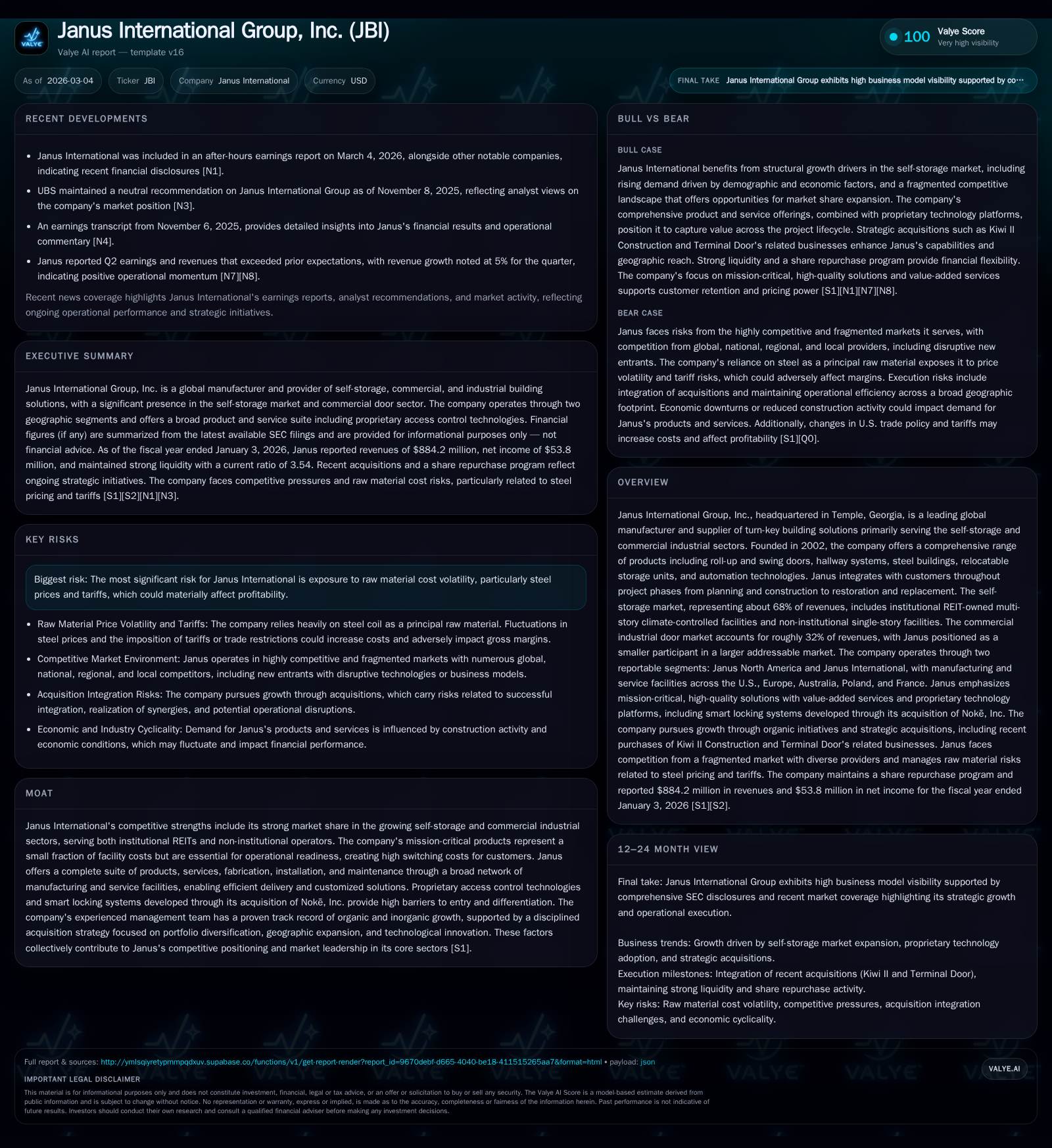
Janus International Group continues to dominate turnkey building solutions in the self-storage sector, with about 68% of its revenue derived from this market. While FY2025 saw a sharp decline in operating income and net income by nearly 24% year-over-year, the company sustained robust free cash flow and increased capex investments to support long-term growth. Janus's exposure to volatile steel prices poses margin challenges, but proprietary access control technologies and expansion within the commercial industrial segment offer meaningful growth upside. Capital allocation remained prudent, with dividends maintained and share buybacks sharply reduced compared to FY2024. Monitoring tariff developments, international segment profitability, and market penetration in commercial doors will be key near-term indicators.
Historical Growth Trajectory: Profit Peaks, Downturns, and Key Drivers
Janus International has experienced significant fluctuations in profitability over recent fiscal years. Operating income peaked at approximately $246 million in FY2023 before escalating external pressures contributed to declines thereafter. In FY2025, operating income contracted by 23.9% year-over-year to $111.5 million, a notable downturn following previous resiliency [F1]. Net income mirrored this trend, declining 23.6% YoY to $53.8 million.
Driving factors include rising raw material costs—particularly steel—coupled with tariff-related surcharges on zinc, energy, and freight that squeezed margins despite stable revenue levels. This margin pressure coincided with an increased capital expenditure allocation; capex rose nearly 27% year-over-year to $25.5 million in FY2025 as Janus invested to enhance its manufacturing footprint and technological capabilities [F1].
Operating cash flow declined moderately by 9.4% YoY but remained healthy at $139.5 million in FY2025, providing ample liquidity for ongoing investments and shareholder returns.
Historical performance (annual)
| FY | Net ($mm) | CFO ($mm) | OpInc ($mm) | Capex ($mm) | Net YoY |
|---|---|---|---|---|---|
| 2025 | 54 | 140 | 112 | 26 | -23.6% |
| 2024 | 70 | 154 | 147 | 20 | -48.1% |
| 2023 | 136 | 215 | 246 | 19 | +26.1% |
| 2022 | 108 | 88 | 187 | 9 |
Source: SEC companyfacts cache [F1].
Capital returns and efficiency (annual)
| FY | Buybacks ($mm) | FCF ($mm) | ROE% |
|---|---|---|---|
| 2025 | 16 | 114 | 9.4 |
| 2024 | 79 | 134 | 13.6 |
| 2023 | 196 | 26.1 | |
| 2022 | 80 | 28.7 |
Source: SEC companyfacts cache [F1].
Table reflects Janus International's financial volatility over four fiscal years stemming largely from cost pressures and strategic reinvestment cycles.
Sector Positioning: Core Markets and Competitive Dynamics in Self-Storage and Industrial Doors
Janus commands a leading position within the niche self-storage infrastructure market—approximately 68% of revenues stem from this segment—which serves both institutional REIT-owned multi-story climate-controlled facilities concentrated primarily within top U.S. MSAs and a fragmented base of single-story non-institutional operators mostly outside major city centers [S4],[S6],[N1]. The company's turnkey solutions portfolio integrates manufacturing capabilities with installation services extending through restoration and replacement (R3 retrofit), enabling Janus to function as a full-service partner throughout the project lifecycle.
Institutional REIT penetration lends predictability as these customers place a heavy premium on reliability given their scale and operational model; this creates elevated switching costs due to Janus’s mission-critical products representing a small but essential fraction of overall facility costs [S6]. The company’s extensive domestic network of eleven manufacturing facilities supports quick lead times which is critical for marquee contracts requiring customization.
The commercial industrial door segment constitutes approximately 32% of revenues; here Janus is a smaller but strategically positioned participant within a larger addressable market buoyed by underlying expansions driven by e-commerce logistics growth [S5],[S6]. This segment includes roll-up sheet doors favored for lower insulation needs as well as heavier rolling steel doors predominantly used in warehouses where durability and energy retention are paramount.
Competition across both segments is highly fragmented featuring global manufacturers alongside localized providers accompanied increasingly by entrants leveraging technology-driven business models or disruptive products; Janus maintains differentiation through strong customer relationships emphasizing delivery speed and comprehensive solutions including third-party installation management [S5].
Raw Material Volatility: Steel Pricing and Tariff Risks Impacting Margins
Steel coil represents the principal raw material input for Janus’s products; its dynamic pricing presents persistent risks given cyclical industry trends exacerbated recently by evolving U.S. trade policies resulting in tariffs impacting imports from key countries [S1],[S2],[S5].
Beyond base steel costs are surcharges levied by mills for zinc coating (critical for corrosion resistance), energy consumption escalations tied to fluctuating fuel prices impacting production costs, plus freight expenses influenced by global logistics challenges. Though most raw materials are sourced domestically mitigating some tariff-related risks directly on steel supplies themselves, components imported from foreign vendors remain exposed to reciprocal tariffs.
Management notes that these uncertainties may materially compress gross margins if steel costs rise unchecked or if tariff environments persist without resolution; cost pass-through mechanisms are limited given competitive pricing pressures [S2].[S1]
Emerging Growth Opportunities: Market Expansion and Technological Differentiators
E-commerce growth fuels industrial facility expansion translating into growing demand for commercial doors—a market where Janus holds a relatively smaller footprint—offering potential upside through increased penetration backed by broadening product sets beyond traditional door offerings [N1],[S6].
Janus’s acquisition of Nokē Inc. brought proprietary access control technologies integrating hardware smart locks with cloud-based software platforms enabling seamless wireless network management inside self-storage sites—a segment with fewer competitors providing high barriers owing to technical sophistication and intellectual property protections [S6]. These innovations underpin value-added service layers projecting improved ROI for customers via automation efficiencies.
International operations spanning Europe (including UK France Poland) and Australia represent newer geographies where scalable deployment of turnkey solutions combined with adaptation to local demands could propel future revenue streams as self-storage gains institutional traction abroad [N1],[S6].
Capital Allocation Strategy: Overview of Dividends, Buybacks, and Free Cash Generation
Janus generated approximately $114 million in free cash flow in FY2025 after subtracting capex from operating cash flow despite net income declines illustrating strong operational cash conversion capability [F1]. This liquidity supported maintenance of dividend distributions alongside more cautious share repurchase activity dropping sharply from nearly $79 million spent in FY2024 down to approximately $16 million in FY2025 as management curtailed buybacks amidst earnings headwinds [F1],[S10],[S20].
Equity rose modestly year-over-year reaching roughly $572 million with an approximate ROE near 9.4%, signaling steady shareholder equity efficiency though below prior peak levels paralleling profit contraction [F1]. The balance sheet remains robust with current ratio above 3.5x underscoring liquidity buffers against working capital volatility especially given concentration risk around single significant vendor supply arrangements totaling about 17% of raw materials purchases but mitigated by alternative sourcing options [S4],[F1].
This balanced capital discipline reflects an emphasis on preserving financial flexibility while supporting investment priorities focused on expanding manufacturing capabilities and accelerating technological innovation pipelines.
What to Watch: Upcoming Milestones, Financial Trends, and Industry Indicators
Looking forward analysts should closely monitor developments including the resolution or easing of U.S.-imposed tariffs potentially alleviating upward cost pressures enhancing margin recovery trajectories; these outcomes hinge on geopolitical factors beyond corporate control but materially impact Janus’s cost base dynamics [N1],[S3].
International segment profitability trends merit attention as management strives for operational scale while tailoring offerings across complex regional markets with structural differences relative to the North American base [N1].[S3]
Market share shifts within the commercial door sector driven by incremental wins amidst competition will provide early indicators of success capturing e-commerce induced demand growth beyond core self-storage verticals.
Capital allocation decisions also warrant observation particularly regarding any reversals or accelerations of share repurchase programs that could signal changing confidence levels vis-à-vis macroeconomic conditions or corporate outlook revisions.
Continued innovation progress expanding the Nokē platform footprint offers potential disruptive levers enhancing customer value propositions—updates on adoption rates or new product rollouts may reveal strengthening moat characteristics.
This analysis synthesizes detailed financial disclosures alongside company-specific SEC filings up to January 3rd, 2026 ([F1]–[S29]) complemented by recent earnings releases ([N1]) without speculation beyond cited information sources. Any forward-looking commentary is framed as contingent scenarios rather than projections or advice.
Disclaimer: This is research-only, informational analysis and not investment advice. It may include AI-generated interpretation and general industry context. Always verify important details using primary sources.

Comments