
JBT MAREL Transforms Global Food Tech: Growth, Integration, and Capital Strategy Unpacked
The 2025 Marel acquisition triggered substantial revenue growth and reshaped JBT MAREL’s operational and financial profile amid integration costs and rising leverage.
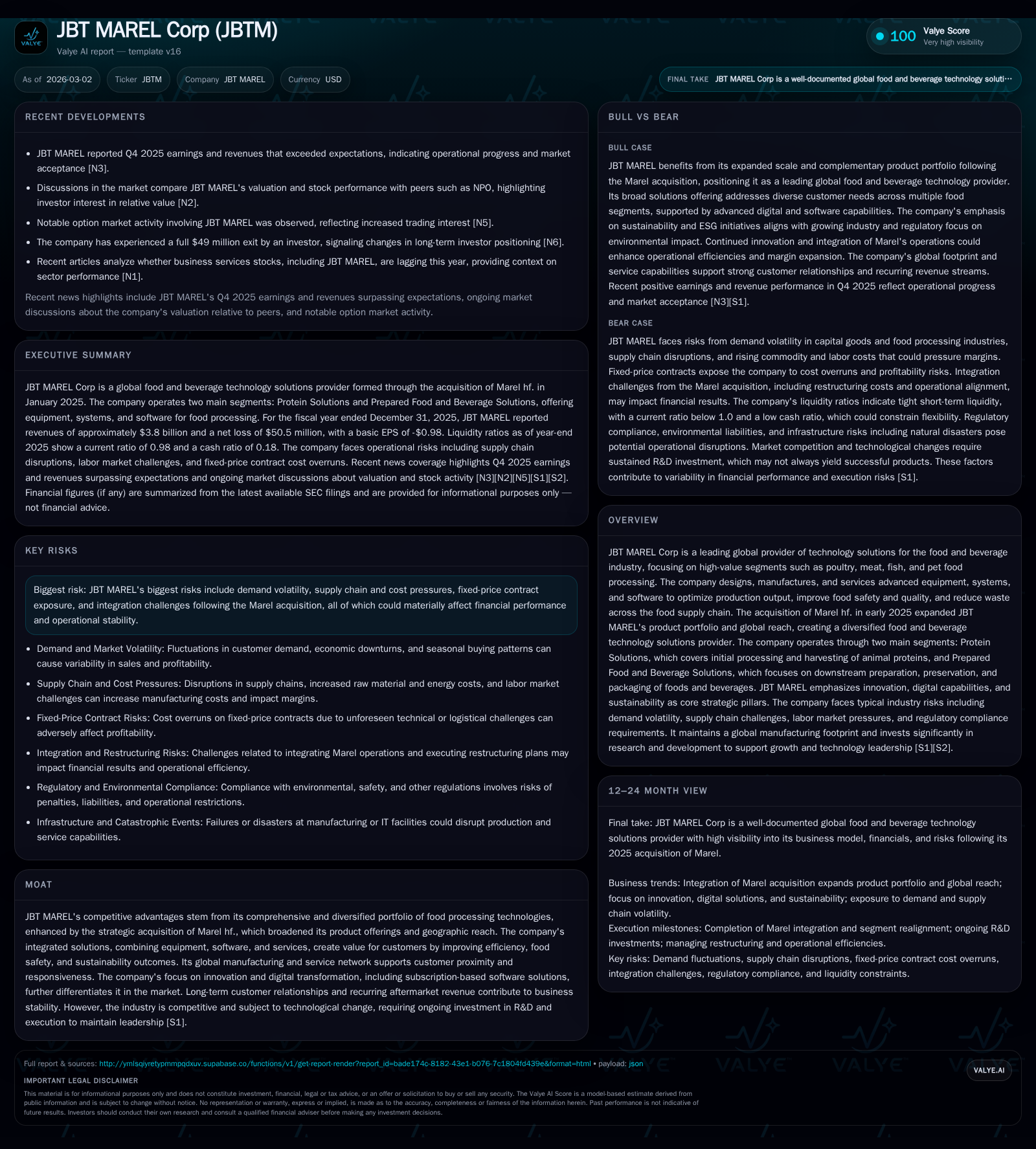
JBT MAREL Corp's acquisition of Marel hf. at the start of 2025 doubled its revenue, expanding its portfolio to cover protein processing through preparation and packaging technologies globally. While operating income rose significantly, net income swung negative due to integration expenses and increased financing costs. The company is navigating fixed-price contract risks, supply chain inflation, and regulatory compliance challenges while investing heavily in digital innovation and sustainability. Leveraging a multi-billion-dollar debt package including Term Loan B and convertible notes, JBT MAREL maintains liquidity to support ongoing integration and capital expenditures. Dividend payments increased but share buybacks ceased, reflecting capital allocation balance amid earnings pressure. Investors should monitor integration milestones, supply chain normalization, and margin recovery in 2026.
Surge in Revenue Catalyzed by Marel Acquisition
Historical performance (annual)
| FY | Rev ($bn) | Net ($mm) | OpInc ($mm) | Capex ($mm) | Rev YoY | Net YoY |
|---|---|---|---|---|---|---|
| 2025 | 3.8 | -50 | 189 | 104 | +121.3% | -159.1% |
| 2024 | 1.7 | 85 | 118 | 38 | +5.3% | |
| 2023 | 81 | 165 | 55 | -37.9% | ||
| 2022 | 2.2 | 131 | 168 | 88 | +15.9% |
Source: SEC companyfacts cache [F1].
Capital returns and efficiency (annual)
| FY | Div ($mm) | Buybacks ($mm) | ROE% |
|---|---|---|---|
| 2025 | 21 | 0 | -1.1 |
| 2024 | 13 | 0 | 5.5 |
| 2023 | 13 | 5 | 5.4 |
| 2022 | 13 | 8 | 15.2 |
Source: SEC companyfacts cache [F1].
JBT MAREL’s transformative year was defined by the strategic acquisition of Marel hf., consummated on January 2, 2025. This deal fundamentally reshaped the company’s scale and scope within the food technology industry. Revenue doubled from $1.716 billion in fiscal 2024 to $3.798 billion in fiscal 2025—an exceptional year-over-year increase of approximately 121.3% [F1]. The expanded global footprint is underscored by geography-specific data showing significant uplift not just in the United States (from $932 million to $1.439 billion) but more dramatically across all other countries combined (from $784 million to $2.36 billion) [S7]. This reflects Marel’s established international presence augmenting JBT’s traditional markets.
The expanded product suite now covers both Protein Solutions—primarily encompassing initial processing automation for poultry, meat, fish, and pet food—and Prepared Food & Beverage Solutions that address downstream preparation stages including preservation techniques and advanced packaging systems coupled with digital software layers that enhance throughput control and food safety standards [S7].
This broadening of offerings allowed JBT MAREL to penetrate high-value verticals more deeply while leveraging cross-selling opportunities across integrated customer accounts.
Shift in Profitability and Financial Performance Trends
Despite the robust top-line expansion, underlying profitability metrics present a layered picture. Operating income rose by approximately 60% year-over-year from $118 million to nearly $189 million in FY2025 [F1], signaling operational leveraging from scale benefits even as integration activities added expense.
However, net income swung sharply negative from a profit of $85 million in FY2024 to a loss of $50.5 million in FY2025—a change exceeding a negative 159% YoY shift [F1]. This divergence primarily reflects one-time costs related to transaction expenses, restructuring charges linked to the merger process, amortization of acquired intangibles (which notably jumped from approximately $44 million to over $150 million), as well as higher interest expense driven by significant new debt issuances including Term Loan B and convertible notes (0.375% coupon on the $575 million notes issued in late 2025) [N1][S3][S4][S6][S24].
Quarterly data release for Q4 2025 reported an earnings beat on adjusted EBITDA bases but acknowledged these transient margin erosions tied to synergies realization timelines [N1]. The key takeaway is that while core operations improved post-merger scale uplift, bottom-line remains under pressure from financial structuring expenses.
Segment Growth Drivers: Protein Solutions Meets Prepared Foods & Beverage
The company realigned reportable segments following full integration ambitions into two principal divisions: Protein Solutions (the front end processing technologies automating protein harvesting workflows) and Prepared Food & Beverage Solutions (handling value-added processing lines such as slicing, marinating, packaging machinery coupled with next-gen operational software) [S7].
In Protein Solutions, investments continue focusing on automation that reduces manual labor dependencies while enhancing traceability critical under global food safety regulations — an increasingly vital factor amid rising regulatory scrutiny worldwide.
In Prepared Foods & Beverage Solutions, digital innovations stand out through subscription-based platforms that enable ongoing monitoring of packaging line efficiency, shelf life extension via controlled atmosphere technologies, and rapid compliance reporting — these form sticky revenue streams complementary to hardware sales . This dual focus positions JBT MAREL as a leader providing end-to-end technology that spans raw material input through final packaged output.
Navigating Integration Challenges and Operational Risks
Despite promising synergies potential, JBT MAREL confronts pronounced risks stemming from multi-layered integration demands:
- Supply chain disruptions remain acute with longer lead times for critical raw materials like stainless steel components essential for heavy machinery fabrication; inflationary input cost pressures can compress margins if contract terms are rigid [S1][S16].
- Fixed-price contract exposure highlighted in risk disclosures signals vulnerability where raw material cost escalation cannot be passed onto customers promptly or at all—impacting project profitability unpredictably [S22].
- Regulatory compliance spans stringent environmental laws including CERCLA provisions dealing with hazardous substance releases posing potential liability regardless of fault; OSHA workplace safety mandates further add complexity given manufacturing intensity across multiple facilities globally with diverse labor markets [S1][S8].
- Operational disruptions from unforeseen natural disasters or cyber events pose additional risk vectors given the criticality of continuous production deployment across highly technical equipment lines [S8][S16].
Mitigating these requires careful project risk assessment processes, dynamic cost forecasting models inclusive of inflation adjustments where possible, enhanced supplier relationship management for just-in-time procurement reliability plus robust environmental health safety programs embedded across newly integrated sites.
Emerging Market Opportunities and Digital Innovation Pipeline
JBT MAREL has strategically emphasized evolving market demands such as sustainability imperatives within food manufacturing ecosystems with products engineered for energy-efficient operation consuming less water while extending equipment lifecycle – these ESG-aligned solutions resonate strongly with large food processors aiming for carbon footprint reductions alongside operational excellence [S19].
Further differentiation stems from their growing portfolio around subscription-based software models underpinning traceability platforms designed specifically for ensuring compliance across complex supply chains—a crucial advantage as customers face global transparency requirements concerning contamination handling or recalls uniquely addressed through SaaS offerings bolstered by data analytics capabilities [N1].
Expansion into high-growth categories like pet food manufacturing automation also diversifies revenue exposures beyond traditional protein sectors reducing cyclicality tied solely to meat or fish protein volumes.
Capital Structure Optimization Post-Acquisition
To finance the landmark Marel transaction totaling nearly $2 billion including purchase consideration plus refinancing outstanding Marel debt obligations along with transaction costs, JBT MAREL arranged a comprehensive capital structure:
- A senior secured Term Loan B facility amounting to $900 million carries a step-down interest pricing grid settling at SOFR plus a margin near 175 basis points following an August amendment; scheduled amortizations started quarterly at minuscule principal repayments (0.25% initial balance per quarter) extending maturity through January 2032 [S4][S6].
- The revolving credit facility was reset at amended terms providing up to $1.8 billion liquidity maturing in January 2030 with covenants tied closely to leverage ratios (initial secured leverage permitted up to 5x then stepped down over time) preserving financial flexibility amid integration phase risks; availability was approximately $1.7 billion drawn minimally late-year with leverage-sensitive margin spreads adjusted accordingly [S4][S5][S9].
- The issuance of $575 million zero-coupon convertible senior notes maturing September 2030 added fixed-rate low-cost debt tranche supporting liquidity without immediate cash interest burden though dilution considerations apply upon conversion; accompanying note hedge instruments reduce conversion impact dilution risk dynamically [S6][S18].
Covenant compliance stood intact at fiscal year-end despite elevated leverage typical post-major acquisitions; management indicated confidence continuing compliance aligning financing maturities prudently against projected integration cash flows [S9][S27].Cross-currency swaps further hedge foreign exchange rate risks related primarily to U.S.-dollar denominated term loan balances held by Iceland-based subsidiaries mitigating FX volatility impact on interest expense calculations [S6].
Dividend Policy, Buybacks, and Returns on Equity Analysis
Dividend distributions increased appreciably from approximately $13.1 million in FY2024 to about $20.9 million in FY2025—reflecting commitment toward steady shareholder returns despite challenging net income circumstances emphasizing cash flow operational stability over payout growth restraint prudence observed historically [F1].
Conversely, repurchase activity ceased entirely following consolidation-driven capital allocation prioritization leaving zero buybacks executed during FY2025 contrasting modest repurchases totaling roughly $5 million in preceding years illustrating strategic pause given incremental debt load post-acquisition.
Return on equity diminished markedly entering negative territory at about -1.1% given net loss versus substantially enlarged equity base ($4.46 billion post-merger compared to about $1.54 billion pre-merger), consistent with goodwill-related balance sheet expansion without immediate proportional earnings accretion yet viewed as transitional during value creation phase post-integration efforts [F1].
Key Forecasts and Milestones to Monitor in 2026 and Beyond
While explicit numeric guidance remains limited outside company commentary regarding capex range ($105–115 million) and forecasted integration-related spend ($45–55 million) for ongoing synergy execution in fiscal 2026 [S26], market observers should focus closely on:
- Order backlog evolution signaling demand sustainability post-acquisition ramp;
- Supply chain stabilization trends influencing gross margin progression;
- Progression of subscription software rollout across key segments enhancing recurring revenue quality;
- Regulatory compliance track record managing environmental liabilities without incurring unexpected charges;
- Refinement of leverage ratios consistent with covenant thresholds particularly surrounding scheduled incremental repayments affecting liquidity profile;
- Potential announcements regarding further bolt-on acquisitions leveraging strengthened global platform;
- Indicators from key end-markets such as global poultry production volumes or pet food processing capacity expansions which cue demand shifts benefiting targeted solutions.
Recent quarter earnings materially beat consensus expectations on revenues corroborating sustained demand strength yet cautious tone persists around timing full margin normalization reflective of overlapping cost factors related to Marel integration acknowledged by management disclosures during February financial update[N1][S3].
Disclaimer: This report synthesizes publicly available SEC filings up to March 2, 2026 ([F1],[S#]), supplemented by verified news sources ([N#]). It does not constitute investment advice or recommendations.
Disclaimer: This is research-only, informational analysis and not investment advice. It may include AI-generated interpretation and general industry context. Always verify important details using primary sources.

Comments