
Johnson Controls Strengthens Digital Building Solutions and Navigates Supply Chain Challenges in Q3 2026
Q3 2026 results highlight profit growth alongside ongoing investments in energy-efficient, integrated building systems and platform innovation.
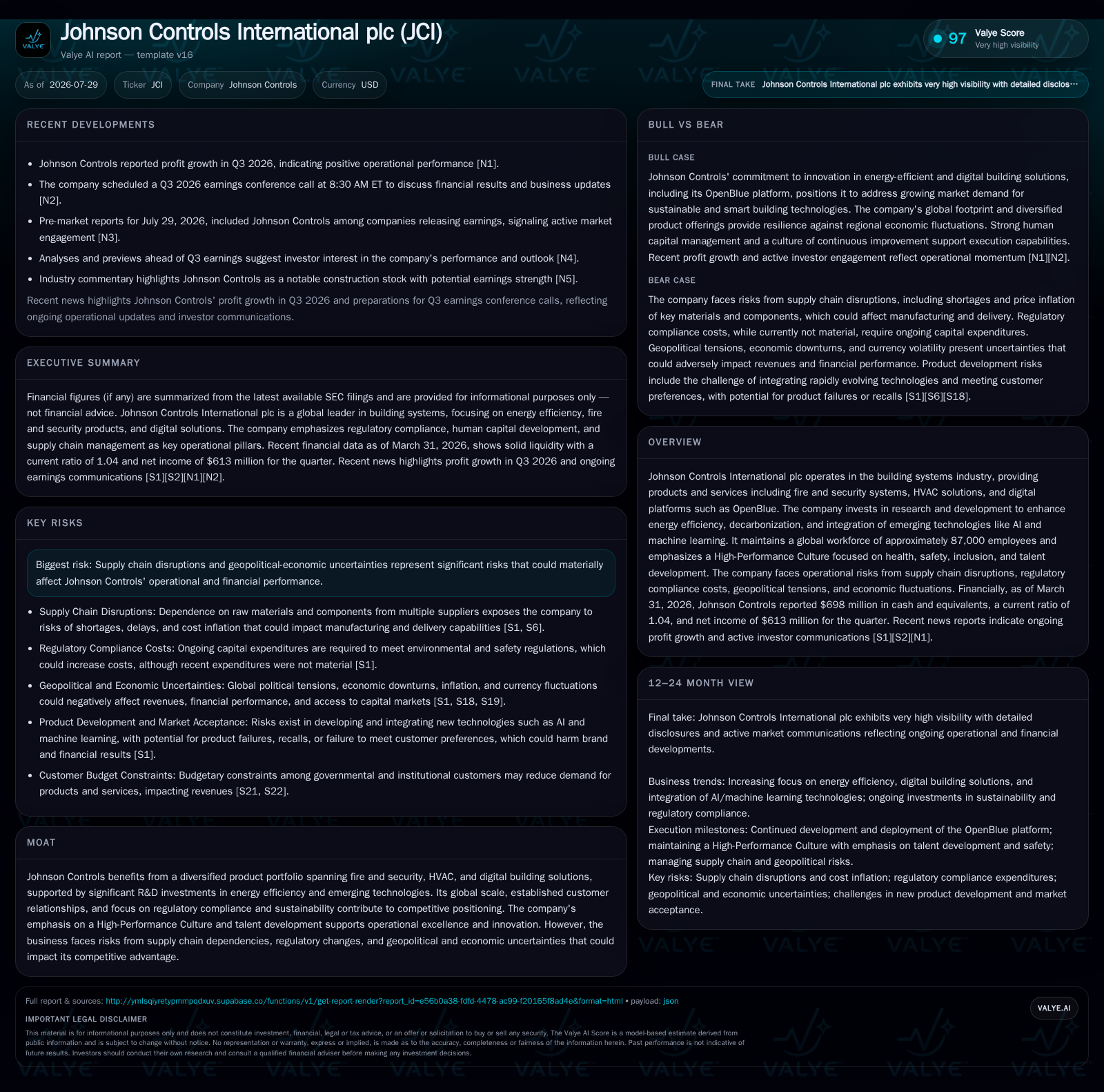
Johnson Controls International plc reported a net income of $613 million for the quarter ending June 30, 2026, supported by strong execution in its HVAC, fire and security systems, and digital platforms. The company continues to expand its OpenBlue digital ecosystem that integrates IoT and AI-driven building management with core product offerings. Despite persistent supply chain pressures and regulatory compliance costs, Johnson Controls sustains operational resilience backed by a high-performance culture and substantial R&D focused on decarbonization and energy efficiency. With a balanced capital structure and a current ratio just above parity, the firm faces sector-wide risks including geopolitical tensions and escalating raw material prices as it pursues growth in service contracts and smart building innovations.
Recent Operating Update
Johnson Controls International plc reported net income of $613 million for the quarter ending June 30, 2026, reflecting solid profitability despite ongoing macroeconomic headwinds including supply chain disruptions and inflationary pressures [S2][N10]. Revenue growth was supported by strong execution across its HVAC, fire and security hardware segments, complemented by expanding adoption of its OpenBlue digital ecosystem. This platform integrates IoT sensors and AI-driven analytics to deliver real-time building automation, energy management, and predictive maintenance capabilities, enhancing operational efficiency and sustainability outcomes for customers [S1][S2].
The company continues to invest heavily in R&D, focusing on energy-efficient HVAC technologies, low-global warming potential (GWP) refrigerants, and advanced building automation solutions that meet evolving regulatory standards and customer demands for decarbonization [S1][S17]. Despite persistent supply chain challenges, Johnson Controls manages cost inflation through strategic procurement and pricing adjustments, maintaining operational resilience supported by a High-Performance Culture that emphasizes innovation and execution excellence [S1][S20].
Business Model Insight
Johnson Controls operates a diversified business model combining manufacturing, installation, and service of integrated building systems with a growing digital platform component. Revenue streams include sales of HVAC equipment, fire detection and suppression systems, security hardware, and building automation products, alongside installation services for new construction and retrofit projects [S1]. Recurring revenue arises from long-term maintenance and service contracts that provide steady cash flow and customer retention, while software subscriptions and licenses tied to the OpenBlue platform contribute increasing annuity-like revenue
The OpenBlue platform leverages IoT connectivity and AI/machine learning to optimize building performance across energy consumption, indoor air quality, and system uptime. This digital layer enhances customer stickiness by enabling usage-based pricing models and longer contract durations, supported by measurable energy savings and predictive maintenance benefits that reduce downtime and operational costs [S17][S1]
Johnson Controls’ go-to-market approach involves direct sales teams and technical field experts who collaborate closely with diverse customer segments including commercial real estate owners, industrial operators, healthcare providers, and government entities [S1]. These customers prioritize compliance with increasingly stringent energy codes and safety regulations, driving demand for integrated, energy-efficient solutions
Industry Structure & Competitive Position
The building systems and solutions industry encompasses HVAC manufacturing, fire and security systems, and digital building management platforms. Johnson Controls competes with peers such as Carrier Global in HVAC equipment, Siemens Building Technologies in fire and security systems, and Schneider Electric or Honeywell in digital building automation platforms. The company’s OpenBlue platform positions it as a leader in digital transformation, integrating hardware and software to deliver smart building solutions that address energy efficiency and sustainability mandates.
Johnson Controls’ scale and geographic diversification across multiple industrialized markets provide resilience against localized construction cycles and regulatory shifts. However, this scale also introduces supply chain complexity, particularly for specialized HVAC electronics and fire suppression materials, which are vulnerable to geopolitical trade tensions and component shortages [S1][S20]. Competitors with more regionalized manufacturing or agile procurement may better mitigate such risks.
Growth Drivers
Structural growth drivers include tightening global regulations targeting decarbonization and energy efficiency, which compel building owners to upgrade or replace legacy HVAC systems using phased refrigerant phase-outs due to high GWP factors [S1]. Urbanization and new commercial and residential construction further increase demand for integrated building systems.
The retrofit and refurbishment market presents a significant opportunity as aging building stock requires modernization to reduce operational expenses. Advanced sensors and AI-enabled controls embedded in OpenBlue enable predictive maintenance, reducing downtime and extending equipment life, which supports expansion of recurring service contracts and enhances revenue visibility over multi-year horizons.
OpenBlue’s adoption is closely linked to customer-perceived value through validated energy savings and ROI models, facilitating cross-selling across Johnson Controls’ product portfolio. The platform’s incorporation of digital twin technology allows simulation of building performance under various scenarios, aiding capital expenditure decisions and deepening customer engagement.
Emerging markets offer incremental growth potential, albeit moderated by slower regulatory adoption and fragmented customer bases, which pose distribution and integration challenges.
Risks and Watchpoints
Supply chain disruptions remain a critical risk, with component shortages potentially delaying installations and increasing costs beyond what pricing adjustments can absorb, pressuring margins [S20]. Geopolitical tensions and trade disputes may restrict access to key supplier regions or impose tariffs, affecting procurement and production.
Regulatory compliance costs are significant, particularly related to refrigerant regulations and PFAS-related litigation stemming from legacy firefighting foam products containing per- and poly-fluoroalkyl substances. These environmental liabilities could escalate depending on legal outcomes, although current capital expenditures related to compliance have not materially impacted financial results [S1][S29]
Technological obsolescence is a concern as rapid innovation cycles require continuous investment in AI and machine learning capabilities within the OpenBlue platform. Failure to keep pace with digital advancements could erode competitive positioning against more specialized software-focused players.
Seasonality affects HVAC demand, typically peaking in summer months, but Johnson Controls’ diversified product mix mitigates this effect relative to pure-play HVAC manufacturers [S1]. Additionally, macroeconomic factors such as rising interest rates could delay customer capital projects, impacting backlog and revenue visibility.
What to Watch Next
Key indicators to monitor include quarterly revenue growth and expansion of the installed base, particularly through new recurring service contract bookings and OpenBlue subscription uptake. These metrics will signal progress in digital transformation and customer retention.
Execution of the Value Growth Incentive Program launched in mid-2026 will be important for talent retention and innovation capacity through 2030, supporting sustained R&D investment and operational excellence [S28]
Capital expenditure alignment with sustainability and regulatory compliance targets will reflect management discipline in balancing growth and cost control.
Potential developments in PFAS litigation and regulatory changes represent material event risks warranting close attention.
Financial Profile Discussion
Capital allocation priorities include sustained R&D investments critical for product innovation and regulatory compliance, alongside portfolio optimization and restructuring initiatives aimed at cost efficiencies [S17][S27]. Share repurchases continue under authorized programs, reflecting disciplined balance sheet management consistent with industry peers.
Overall, Johnson Controls effectively integrates its legacy strengths in mechanical building systems with advanced digital platform capabilities, positioning itself to address accelerating sustainability imperatives and evolving customer needs in the global building systems sector.
This analysis synthesizes publicly available SEC filings through Q3 2026 alongside relevant industry context without offering investment advice or speculative forecasts. It emphasizes documented operational developments supporting an objective assessment of Johnson Controls’ business fundamentals within the building systems industry.
Disclaimer: This is research-only, informational analysis and not investment advice. It may include AI-generated interpretation and general industry context. Always verify important details using primary sources.

Comments