
Global Crossing Airlines Q2 2026: Fleet Growth, ACMI Revenue Concentration, and Working Capital Deficit
Global Crossing Airlines expanded its fleet and maintained a dual ACMI and charter business model in Q2 2026 but faces significant liquidity constraints and working capital deficits.
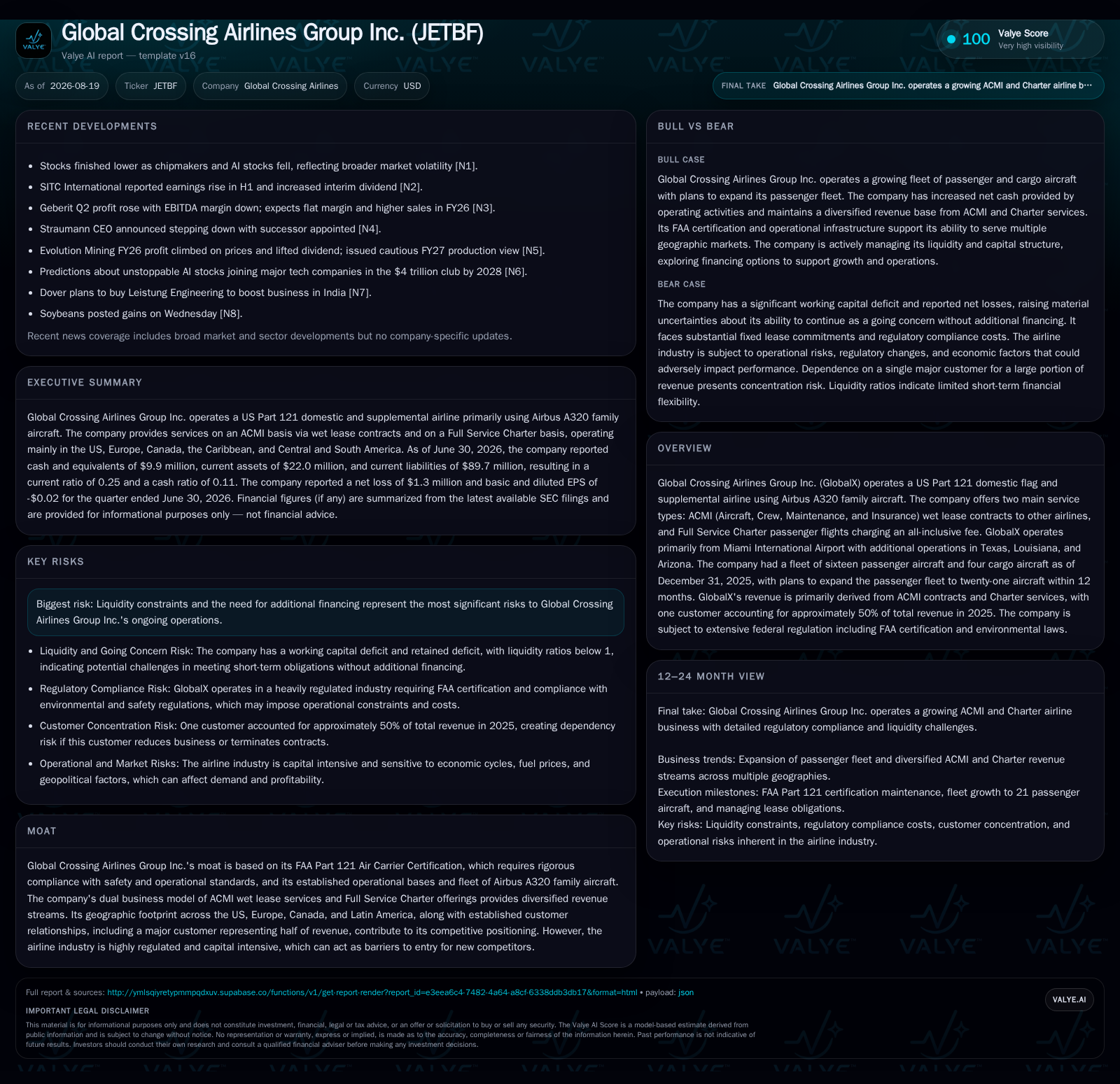
Global Crossing Airlines Group Inc. reported operational progress at the end of 2025 with a fleet of 16 passenger and 4 cargo aircraft and plans to increase its passenger fleet to 21 within the next 12 months. The company’s revenue remains concentrated, with one customer accounting for approximately 50% of total revenue in 2025. However, as of June 30, 2026, the company’s liquidity position is strained, with a current ratio of 0.25 and a working capital deficit, raising substantial doubt about its ability to continue as a going concern without additional financing.
Global Crossing Airlines Group Inc. reported its operating and financial results for the quarter ended June 30, 2026, highlighting a fleet expansion to 16 passenger Airbus A320 family aircraft and 4 cargo Airbus A321 aircraft as of December 31, 2025, with plans to increase the passenger fleet to 21 within the next 12 months [S2]. Despite this operational growth signaling business development, the company’s liquidity ratio stood at 0.25 as of June 30, 2026, reflecting a working capital deficit that raises material uncertainties about its ability to continue as a going concern without additional financing or sustained income generation [S2], [F1]. This financial condition impacts the company’s stability and operational sustainability amid its expansion efforts.
Business Model and Revenue Composition
Global Crossing Airlines operates a dual business model centered on ACMI (Aircraft, Crew, Maintenance, and Insurance) wet lease contracts and full-service passenger charter flights. Under ACMI contracts, the company provides aircraft, crew, maintenance, and insurance, while customers assume fuel and most operational costs. Full-service charter offerings involve fixed all-inclusive fees covering fuel, insurance, landing fees, navigation fees, and other operational expenses [S1].
Revenue generation is heavily reliant on ACMI and charter services, with one customer accounting for approximately 50% of total revenue in 2025 [S1]. This concentration exposes the company to customer-specific demand risks that could materially impact revenue stability if the relationship changes or contracts are not renewed.
The ACMI model allows Global Crossing Airlines to transfer fuel price and demand risks to its customers, which can help stabilize margins under volatile market conditions. Conversely, the full-service charter model involves the company bearing operational costs, which may introduce margin variability depending on fuel prices and other expenses. This dual revenue stream approach provides some diversification but also requires careful management of contract terms and operational efficiency to maintain profitability.
Liquidity and Capital Structure Analysis
The company’s liquidity profile as of mid-2026 underscores significant financial challenges [F1]. Current assets were $22.0 million, while current liabilities were $89.7 million, resulting in a current ratio of 0.25 and a net debt position of approximately $32.3 million [F1]. This working capital deficit signals a strained liquidity position that raises substantial doubt about the company’s ability to meet short-term obligations without additional financing or improved cash flow from operations.
The company’s balance sheet reflects the capital-intensive nature of the airline industry, with significant lease commitments and debt obligations related to fleet expansion. As of December 31, 2025, the company had $24.6 million due in the next 12 months for minimum lease payments under finance and operating leases, and $100.1 million due thereafter, alongside approximately $40.5 million in notes payable [S18]. These fixed commitments limit financial flexibility and increase refinancing risk.
The working capital deficit and retained deficit reported at year-end 2025 further emphasize the ongoing need for capital to support operations and growth [S1], [S18]. Without additional financing or sustained income generation, the company faces material uncertainties regarding its ability to continue as a going concern. This risk is heightened by the company’s reliance on a concentrated customer base and the capital-intensive nature of its business model.
Competitive Positioning and Industry Context
Global Crossing Airlines operates under FAA Part 121 Air Carrier Certification, which imposes rigorous regulatory compliance requirements and serves as a significant barrier to entry for potential competitors [S1]. This certification supports the company’s competitive positioning by limiting new entrants and ensuring operational standards.
The company’s fleet, based on the Airbus A320 family for passenger aircraft and Airbus A321 for cargo, provides operational commonality and efficiency advantages. Its geographic footprint spans the United States, Europe, Canada, the Caribbean, and Central and South America, enabling diversified market access and service offerings [S1].
However, the airline industry remains highly capital intensive and cyclical, with profitability sensitive to economic conditions, fuel prices, and regulatory changes. Global Crossing Airlines’ business model, combining ACMI wet lease and full-service charter services, allows it to serve a range of customers, including airlines and non-airline entities, but also exposes it to operational and market risks inherent in these segments.
Risks and Outlook
The most significant risks facing Global Crossing Airlines include liquidity constraints and customer concentration. The company’s current ratio of 0.25 and net debt of $32.3 million as of June 30, 2026, highlight the urgency of securing additional financing or generating sufficient operational cash flow to meet obligations and fund growth [F1]. Failure to address these liquidity challenges could impair the company’s ability to continue operations and fulfill fleet expansion plans.
Customer concentration risk is also material, with one customer accounting for approximately half of total revenue in 2025 [S1]. This dependence creates vulnerability to changes in customer demand or contract terms, which could materially affect revenue stability and profitability.
Monitoring points for investors and stakeholders include quarterly revenue and margin disclosures to assess operational profitability, progress in fleet expansion and related capital expenditures, and updates on FAA regulatory compliance. Additionally, any announcements regarding liquidity improvements, refinancing, or diversification of the customer base will be critical indicators of the company’s near-term financial health.
In summary, Global Crossing Airlines is advancing operationally with fleet growth and a diversified service offering but faces material financial challenges. The company’s ability to secure additional financing or generate sufficient income will be central to addressing liquidity constraints and sustaining its business model in a capital-intensive and competitive industry. The interplay of operational progress and financial constraints defines the near-term outlook for Global Crossing Airlines Group Inc.
Disclaimer: This is research-only, informational analysis and not investment advice. It may include AI-generated interpretation and general industry context. Always verify important details using primary sources.

Comments