
Johnson & Johnson Advances Innovation Amid Patent and Regulatory Challenges
In Q2 2026, J&J’s diversified portfolio and robust R&D pipeline underpin resilience against biosimilar pressures and ongoing legal risks.
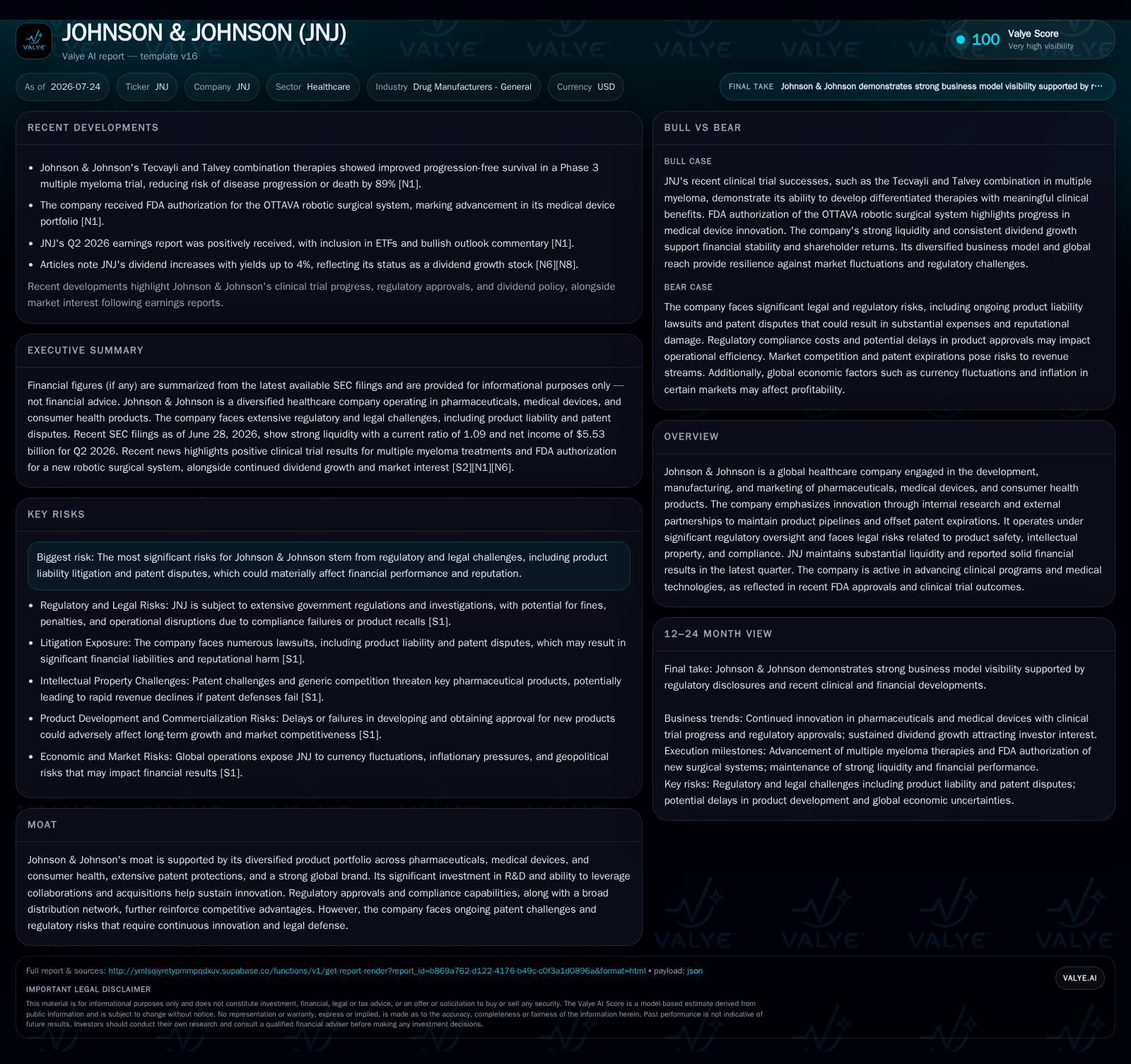
Johnson & Johnson’s latest quarterly report highlights the continued pressure on legacy pharmaceuticals like STELARA due to patent expirations and biosimilar competition, offset in part by growth in oncology and neuroscience drugs. Recent FDA approvals, including a key robotic surgical system, emphasize the company’s advancing pipeline and medical device innovation. Diversification across pharmaceuticals, medical devices, and consumer health supports revenue stability amid regulatory scrutiny and product liability risks. Ongoing acquisitions and emerging market expansions fuel growth prospects as clinical trials progress. Financially, J&J maintains strong liquidity and manageable leverage enabling sustained R&D investment and legal cost absorption.
Patent Expiries Pressure Traditional Pillars But Innovation Offers Offset
Johnson & Johnson’s Q2 2026 10-Q filing highlights a significant sales decline in STELARA, primarily driven by patent expirations and intensified biosimilar competition. This trend contributed to an approximate 10.4% reduction in worldwide Innovative Medicine segment operational sales in 2025 and continues to exert pressure into mid-2026 [S2], [S1]. The erosion of revenue from this legacy immunology blockbuster affects gross margins due to an unfavorable product mix shift. However, J&J’s strategic focus on replenishing its portfolio through sustained R&D investment and targeted acquisitions is mitigating these impacts. For instance, immuno-oncology and neuroscience drugs, including TECVAYLI—an immunotherapy for multiple myeloma—posted over 20% sales growth in the quarter, reflecting successful offsetting dynamics within key therapeutic categories [S2]. Monitoring the pace of biosimilar market entries and upcoming patent cliffs remains essential to assess the durability of flagship drug revenues and gross margin trends.
FDA Approvals Highlight Pipeline Maturation Driving Future Revenue
Regulatory milestones are critical to sustaining J&J’s innovation-driven growth model. The recent FDA clearance of the OTTAVA Robotic Surgical System marks a significant advancement in the MedTech segment, introducing state-of-the-art robotic automation into surgical procedures. This approval broadens market access potential beyond traditional device portfolios and aligns with the healthcare sector’s increasing adoption of robotics and digital integration in clinical care [S3], [N11]. Concurrently, clinical development programs are progressing robustly: Phase 3 data demonstrate that the combination of TECVAYLI plus TALVEY reduces the risk of disease progression or death by 89% in multiple myeloma patients, a clinical milestone that supports near-term commercial scaling and reimbursement discussions [N6], [N7]. These regulatory and clinical achievements reinforce J&J’s competitive moat by validating the efficacy and differentiation of its pipeline assets relative to large diversified pharmaceutical peers.
Portfolio Diversification Mitigates Biosimilar Impact and Pricing Pressures
J&J’s diversified business model spans innovative pharmaceuticals, medical devices, and consumer health products, providing a buffer against volatility concentrated in any single segment. The acquisition of Intra-Cellular Therapies, completed in April 2025, expanded the Neuroscience franchise with CAPLYTA contributing approximately $700 million in sales post-close, adding meaningful revenue and pipeline depth [S1], [S2]. This diversification reduces reliance on mature drugs vulnerable to biosimilar or generic competition, such as STELARA. Additionally, the consumer health segment’s well-established brands support pricing power despite global payor cost-containment pressures. Compared to peers with narrower portfolios or heavier exposure to generics, J&J benefits from cross-segment synergies and more stable cash flow streams, enhancing resilience against pricing and reimbursement headwinds.
Regulatory Compliance and Product Liability Risks Remain Key Vigilance Areas
Legal and regulatory risks continue to pose operational challenges. J&J remains engaged in extensive product liability litigation, notably related to talc-based baby powder claims. While the company has accrued substantial reserves, outcomes remain uncertain with potential adverse judgments exceeding current accruals as disclosed in filings [S1]. Regulatory compliance demands have intensified, requiring sophisticated internal controls and increased operating expenses, but these also serve as barriers to entry for smaller competitors. J&J’s strong cash position and comprehensive risk management frameworks enable it to absorb legal costs and maintain operational continuity despite these ongoing exposures.
Growth Drivers Rooted in Acquisitions, Emerging Markets Expansion, and Device Innovation
Strategic acquisitions and geographic expansion underpin J&J’s growth trajectory. The $14.5 billion acquisition of Intra-Cellular Therapies broadened psychiatric drug offerings and added pipeline assets with commercial upside [S1]. Emerging markets continue to deliver above-average operational sales growth, supported by demographic trends such as aging populations and rising chronic disease prevalence, with international sales up 4.6% in 2025 [S1]. Enhanced manufacturing capacity utilization supports scaling supply chain responsiveness, critical for global commercialization of novel therapies amid complex regulatory environments. The MedTech segment’s innovation, exemplified by the OTTAVA robotic system, also contributes to expanding addressable markets and revenue diversification.
Monitoring Milestones: What Upcoming Clinical Trials And Market Launches Could Unlock
Pipeline progression remains a key indicator of future growth potential. Ongoing Phase 3 trials evaluating TECVAYLI combined with TALVEY in multiple myeloma have demonstrated significant improvements in progression-free survival, which are pivotal for regulatory approvals, market access, and reimbursement negotiations [N6], [N7]. Additional investigational assets in immunology and oncology hold promise to offset revenue attrition from legacy biologics, although precise timelines for regulatory decisions and launches remain undisclosed. Close attention to clinical trial readouts, FDA approvals, and market uptake will be critical to gauge the trajectory of J&J’s innovation-driven revenue streams.
Financial Profile Discussion: Liquidity Intact Amid Strategic Investment And Legal Costs
As of June 28, 2026, Johnson & Johnson reported approximately $20.4 billion in cash and equivalents, with total debt near $41.4 billion as of December 28, 2025, resulting in net debt of about $21.0 billion—reflecting a manageable leverage profile supported by strong cash flow generation [F1]. The current ratio stood at approximately 1.09x, indicating adequate short-term liquidity [F1]. Operating income trends suggest resilience despite margin pressures from increased R&D spending necessary to sustain pipeline development and fluctuations in legal reserves [S2]. This financial strength underpins J&J’s capacity to maintain investment intensity in innovation and absorb legal and regulatory costs, which are critical to preserving long-term competitive advantage.
Johnson & Johnson’s Q2 2026 disclosures illustrate a complex dynamic between legacy product challenges driven by patent expirations and biosimilar competition and a robust pipeline supported by regulatory milestones and innovation, particularly in oncology and medical devices. The company’s diversified portfolio structure mitigates cyclicality typical among pharmaceutical innovators facing patent cliffs, while geographic expansion strategies emphasize emerging markets with accelerating healthcare demand. Vigilance around product liability litigation remains essential due to its potential earnings impact, but is mitigated by a strong compliance culture and ample liquidity reserves enabling financial flexibility for sustained R&D funding.
Against peers such as Pfizer and Novartis, which also navigate portfolio aging and pipeline renewal, J&J leverages scale in manufacturing capacity and successful deal-making—exemplified by the Intra-Cellular Therapies acquisition—as strategic differentiators enhancing operational durability. Clinical trial advances in immuno-oncology represent tangible catalysts, offering a pathway to replace revenue lost from older biologics facing biosimilar competition.
This multifaceted approach underscores J&J’s positioning as an industry leader managing inherent sector risks—including regulatory complexities, legal disputes, and pricing pressures—with a coherent strategy aligning innovation cadence and diversified value chain exposure across pharmaceuticals, medical devices, and consumer health.
Disclaimer: This analysis is based solely on publicly available information as cited without endorsement or research view regarding Johnson & Johnson securities or investments.
Disclaimer: This is research-only, informational analysis and not investment advice. It may include AI-generated interpretation and general industry context. Always verify important details using primary sources.

Comments