
Jushi Holdings Inc. Confronts Operating Losses and Liquidity Pressures with Strategic Refinancing
The cannabis company reports revenue gains offset by sustained net losses, managing capital through debt amendments and executive agreements.
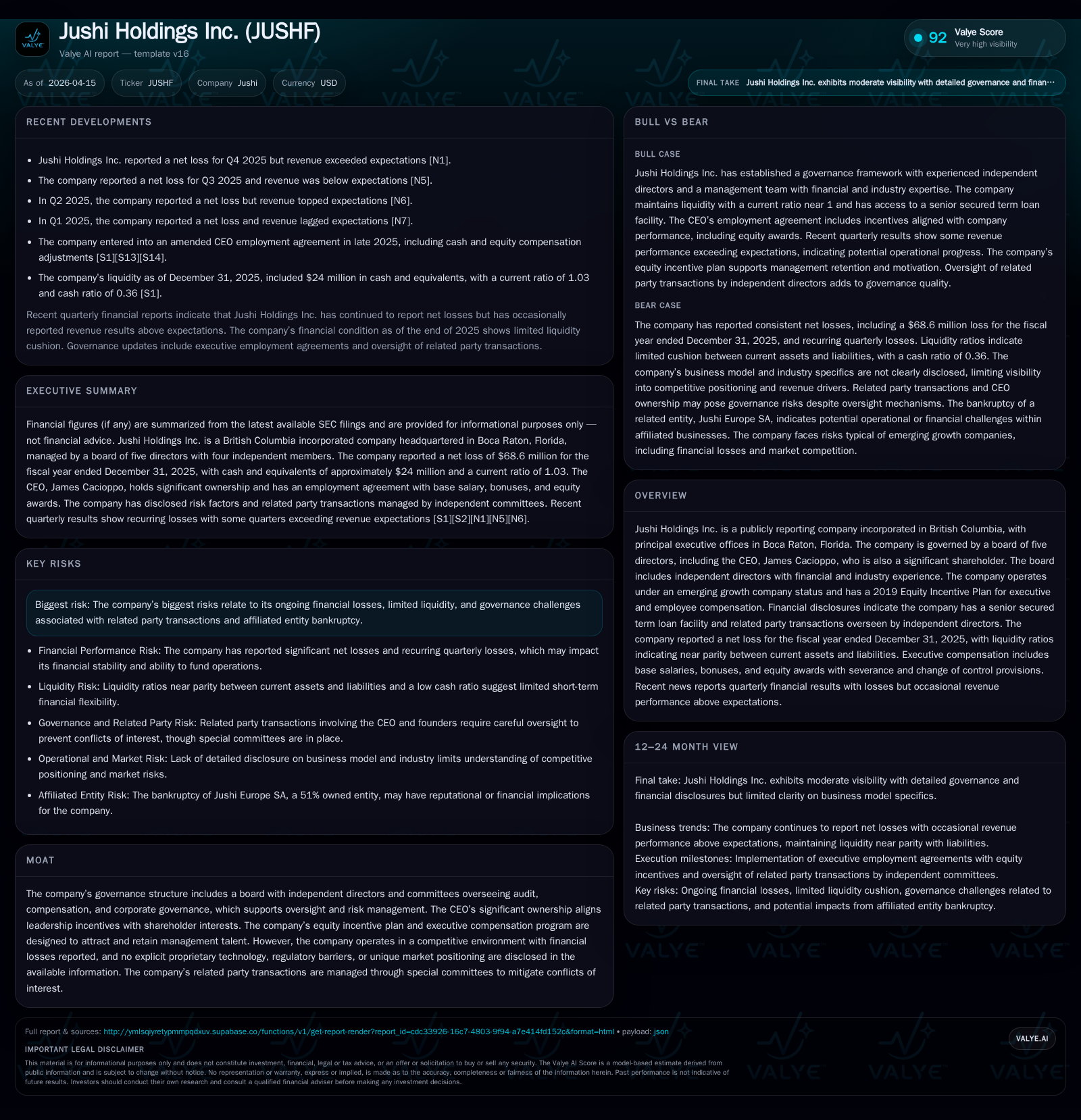
Jushi Holdings Inc., an emerging growth company incorporated in British Columbia with primary operations in Florida, has demonstrated revenue growth in recent years but continues to face significant net losses and liquidity challenges. The company achieved positive operating income in 2025 after prior years of operating losses but reported a widening net loss year-over-year. Jushi has actively managed its capital structure via refinancing its senior secured loans and related party transactions overseen by independent directors. Future growth hinges on operational efficiencies and navigating competitive market pressures while stabilizing liquidity conditions.
Historical Financial Performance
Jushi Holdings Inc.'s fiscal trajectory exhibits a nuanced recovery pattern marked by substantial prior losses offset by recent operational improvements. The company reported an operating income of approximately $4.85 million for the fiscal year ended December 31, 2025, a significant turnaround from operating losses recorded in preceding years (notably -$2.82 million in 2023 and -$220.3 million in 2022) [F1]. This improvement was accompanied by a steep increase in revenues as indicated in filings and quarterly releases signaling top-line strength.
However, despite becoming operationally profitable on an EBIT basis, the company's net income remained negative at -$68.6 million for 2025, expanding from a net loss of -$48.8 million in 2024 [F1]. The difference highlights ongoing challenges such as interest expenses, depreciation tied to heavy capital investment, and other non-operating costs.
Financial Summary Table
Historical performance (annual)
| FY | Net ($mm) | CFO ($mm) | OpInc ($mm) | Capex ($mm) | Net YoY |
|---|---|---|---|---|---|
| 2025 | -69 | 18 | 5 | 16 | -40.6% |
| 2024 | -49 | 22 | 11 | 5 | +25.1% |
| 2023 | -65 | -3 | -3 | 11 | +67.8% |
| 2022 | -202 | -21 | -220 | 57 |
Source: SEC companyfacts cache [F1].
Capital returns and efficiency (annual)
| FY | FCF ($mm) | ROE% |
|---|---|---|
| 2025 | 2 | 59.5 |
| 2024 | 17 | 97.1 |
| 2023 | -14 | 1044.6 |
| 2022 | -78 | -427.9 |
Source: SEC companyfacts cache [F1].
Operational improvements underpin the positive shift in operating income; however net losses persist due to high non-operating expenses.
Growth Drivers and Outlook
Jushi’s strategic investments primarily focus on scaling cultivation and manufacturing capabilities evident from the sharp increase in capital expenditures during fiscal year 2025 relative to past periods [F1]. This aligns with industry trends where vertical integration provides cost advantages amid intensifying retail competition.
The company’s future growth could be supported by the maturation of these assets leading to operational leverage and improving margins if cost control measures mature alongside revenue growth [N1]. However risks abound such as potential regulatory changes—common in this sector—that could affect market access or product categories.
Competitive pressures remain intense as Jushi lacks disclosed proprietary technology or unique regulatory protections that would constitute a durable moat according to governance disclosures [S1]. This highlights reliance on scale and operational execution.
Capital Structure and Liquidity Management
In response to liquidity strains evidenced by near parity current ratios (~1.03x at year-end) and ongoing operating losses at the net level [F1], Jushi has actively refinanced debt obligations to extend maturities and reduce immediate cash interest burdens:
- A senior secured term loan facility was negotiated providing $160 million with maturity extended to September 2030 and adjusted interest rate floors (from a previous effective rate above minimum thresholds) [S4], [S7].
- Related party investors including CEO James Cacioppo participated lending approximately $28 million under this arrangement enhancing insider alignment with creditor interests [S7].
- The CEO amended his compensation arrangements converting substantial bonuses into restricted shares to ease short-term working capital demands without diluting operational focus [S6], [S13].
Despite these steps Jushi’s equity position was negative at roughly -$115 million as of December 31 reflecting accumulated deficits from prior years' significant losses [F1]. There are no reported dividends or share buybacks as the company conserves cash amid growth investments.
Executive Compensation and Governance
Governance practices encompass an audit committee overseeing related party transactions which are substantive given CEO ownership stakes and historic affiliated entity bankruptcies requiring special committee reviews [S16], [S19]. Compensation is heavily weighted toward equity incentives under the company’s equity incentive plan reflected by nearly 30 million outstanding options supporting retention among executives and directors alike [S25], [S28].
What to Watch
Absent explicit annual guidance or detailed medium-term milestones from filings or news releases [N1], future catalysts likely rest upon:
- The pace of operational profitability improvement measured by narrowing net losses.
- Efficacy of capex projects translating into consistent free cash flow expansion beyond the modest $1.6 million estimated for fiscal year-end based on CFO minus capex metrics [F1].
- Continued management of leverage through refinancing or equity fund raises if necessary.
- External regulatory developments impacting cannabis markets where Jushi is active.
- Progress on formalizing policies around related party transactions reducing governance risks.
Conclusion
Jushi Holdings Inc.’s financial narrative is emblematic of many emerging operators balancing rapid expansion with the fragility of sustained profitability and liquidity risk management. While the company now generates operating profits bolstered by strong revenue growth efforts deployed into asset-heavy cultivation infrastructures, net results reflect continuing structural costs that will take time to overcome.
Proactive capital restructuring activities paired with executive alignment measures evidence management’s responsiveness but caution persists given large cumulative deficits and ongoing governance complexities tied to related entities.
This analysis synthesizes publicly filed financial statements and regulatory disclosures up through April 14th, 2026 without offering investment advice.
Disclaimer: This is research-only, informational analysis and not investment advice. It may include AI-generated interpretation and general industry context. Always verify important details using primary sources.

Comments