
Kentucky First Federal Bancorp Gains Operational Latitude Following OCC Agreement Termination
The company’s release from OCC agreements in early 2026 marks a pivotal shift, enhancing its regulatory and capital management flexibility within a concentrated Kentucky mortgage market.
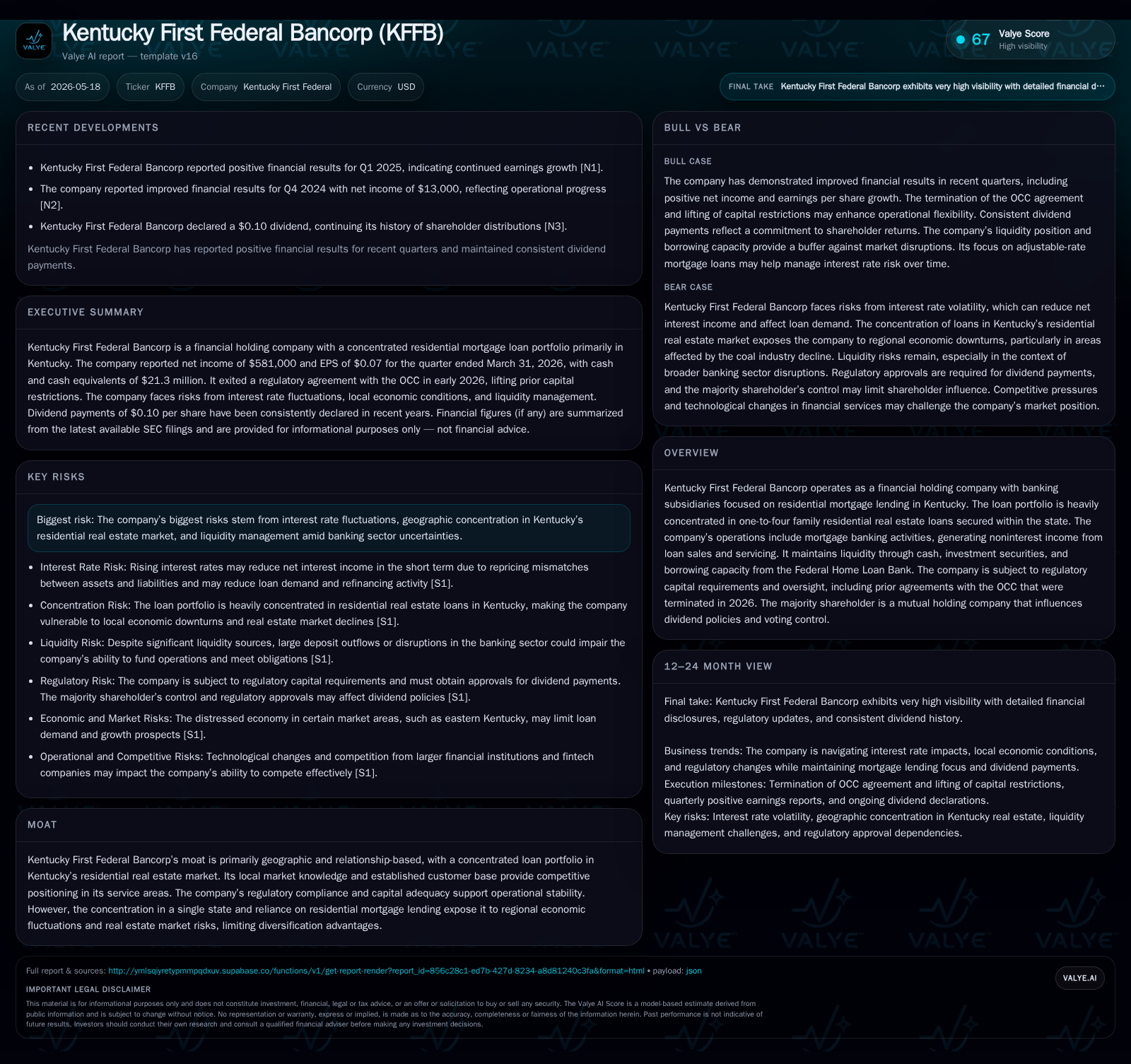
Kentucky First Federal Bancorp (KFFB) concluded the formal written agreement with the OCC in February 2026, lifting individual minimum capital requirements and troubled condition designations that had constrained its operations. This regulatory relief allows the bank subsidiary to operate with greater strategic freedom after a period of oversight that mandated enhanced capital cushions and compliance actions. The business remains tightly focused on one-to-four family residential mortgage lending in Kentucky, relying heavily on adjustable-rate loans that expose it to interest rate risk but also enable dynamic repricing. Growth opportunities hinge on local market penetration and mortgage banking activities, while risks persist from interest rate fluctuations and geographic concentration. Monitoring loan demand trends and capital ratios will be critical as KFFB navigates expanded operational latitude. The company maintains notable liquidity with $21.3 million cash on hand as of March 31, 2026.
Regulatory Relief Signals New Operating Latitude
Kentucky First Federal Bancorp marked a significant inflection point in February 2026 when the Office of the Comptroller of the Currency (OCC) terminated its formal written agreement dated August 2024. This agreement had designated its banking subsidiary—First Federal Savings Bank of Kentucky—as being in "troubled condition" under banking regulations [S4]. Concurrently, individual minimum capital requirements (IMCRs) imposed alongside that agreement were lifted. This removal signals improved regulatory confidence and enhances operational freedom for KFFB's bank subsidiary.
Previously, KFFB was subject to stringent capital adequacy demands aimed at fortifying financial strength amid supervisory concerns [S1], [S14]. The regulatory relief reduces compliance burdens linked to corrective action mandates embedded in the formal agreement. With the subsidiary restored as an "eligible savings association," management gains discretion to pursue strategic initiatives potentially constrained under elevated oversight [S4].
This development reshapes KFFB’s near-term risk profile by alleviating external pressures requiring robust capital buffers beyond standard minimums. Traditional risks remain, notably exposure to economic fluctuations and interest rate dynamics.
Business Model Centered on Residential Mortgage Lending in Kentucky
Kentucky First Federal Bancorp operates primarily through its banking subsidiaries focused on originating and managing one-to-four family residential mortgage loans secured within Kentucky. As of June 30, 2025, approximately 83.6% of its loan portfolio is concentrated in this segment within the state [S23]. This geographic concentration creates a localized business model deriving revenues mainly from interest income on these loans.
A defining feature is the predominance of adjustable-rate mortgages (ARMs), comprising about 93.8% of residential real estate loans at mid-2025 [S1]. These ARMs reset annually after initial fixed periods ranging from one to seven years. This structure imbues net interest income with sensitivity to prevailing interest rates but also provides channels for spread expansion as rates adjust upward.
Beyond traditional mortgage lending, KFFB engages in mortgage banking activities including loan sales and servicing rights that generate noninterest income primarily through gains on loan sales and servicing fees [S1], [S26]. Notably, net gains on sales nearly doubled year-over-year ending June 30, 2025, reflecting active management of origination flow and secondary market engagement.
Customer retention benefits from deep ties within local Kentucky communities fostering switching costs that sustain recurring business; however, this focus limits diversification compared to larger peers operating across multiple regions or product lines.
Industry Positioning: Geographic Moat and Regulatory Environment
KFFB holds a niche position anchored by its Kentucky-centric footprint. Its moat derives largely from geographic concentration combined with longstanding client relationships cultivated over decades. While this creates competitive insulation against national banks less attuned to local nuances, it amplifies vulnerability to cyclical challenges endemic to specific areas—for example, economic headwinds linked to coal industry declines affecting parts of eastern Kentucky served by one subsidiary branch [S23].
Regulatory supervision aligns with federal standards for savings bank holding companies regulated principally by the OCC. Elevated scrutiny culminating in August 2024’s formal agreement reflected concerns about capital adequacy and risk management controls [S11]. With resolution achieved by early 2026, KFFB re-enters an environment permitting strategic flexibility rather than reactive compliance—a competitive advantage relative to peers still under heightened orders.
Growth Catalysts Driven by Local Market Penetration and Mortgage Banking Activities
Growth prospects hinge on expanding residential mortgage lending volumes within core Kentucky markets alongside enhancing yield capture via mortgage banking channels.
Post-OCC agreement termination aligns with potential strategic renewal allowing optimized deployment of capital previously sequestered under IMCR obligations [S4], [S6]. Improved home financing demand driven by favorable local economic factors or affordability shifts could lift loan originations—a principal earnings lever given net interest income's dominance.
The sizable adjustable-rate loan book offers scope for margin improvement should prevailing rates stabilize or increase moderately—new repricing lifts yields on existing assets faster than liabilities reprice—expanding spreads [S1]. This repricing capability partially offsets margin compression observed during earlier Fed tightening phases.
Mortgage servicing rights (MSRs) provide additional growth levers tied to servicing fees on loans sold into secondary markets. MSR valuations fluctuate inversely with prepayment speeds affected by interest rate changes: slower prepayments increase MSR values while accelerated refinancing depresses them [S26]. Maintaining a balanced pipeline with disciplined expense control supports sustainable noninterest income growth.
Deposit base expansion depends on recaptured depositor confidence following recent national banking sector stress; liquidity inflows underpin funding stability enabling asset growth without costly wholesale borrowing reliance.
Key Risks from Interest Rate Exposure and Regional Concentration
Interest rate fluctuations represent a dominant risk given nearly 94% adjustable-rate composition of the portfolio [S1]. Rising rates increase borrower payments upon resets after initial fixed periods; this may elevate delinquencies if repayment capacity weakens amid inflationary pressures persisting into 2026.
Rates rising can initially compress net interest margins since liabilities often reprice faster than assets; however, longer-term repricing of ARMs acts as a natural hedge mitigating prolonged margin erosion—a structural nuance important in community bank balance sheet management.
Geographic concentration exclusively within Kentucky restricts diversification benefits; regional economic headwinds such as coal industry contraction or slower employment growth could disproportionately impair credit quality or dampen loan demand locally [S23]. Limited product diversity increases cyclical earnings volatility tied directly to local real estate cycles.
Liquidity risks stem from potential depositor flight triggered locally or systemically amid ongoing uncertainties post notable U.S. bank failures; maintaining diverse funding sources including FHLB advances mitigates but does not eliminate these risks entirely [S22]
Federal Reserve Board regulations require sustained vigilance regarding allowance adequacy for credit losses given possible upticks amid economic stress; periodic regulator reviews may necessitate provisioning increases adversely impacting earnings [S27].
Monitoring Points: Loan Demand, Capital Adequacy, and Regulatory Developments
Key metrics include quarterly loan origination volumes closely influencing net interest income ramp-up amid evolving rate environments [S2], [S3]. Deposit flow stability will signal funding health necessary for growth investments assuming no renewed regulator constraints.
Capital ratios comfortably exceed prior enhanced thresholds per last filings; maintaining these levels without supervisory encumbrances is critical if economic conditions deteriorate regionally or nationally [S14], [F1]. Dividend policy remains suspended indefinitely since early 2024 due to regulatory approvals needed under mutual holding company shareholder controls [S9], [S20].
Regulatory landscapes warrant attention for reversals triggered by macroeconomic shocks or supervisory findings given historic OCC intervention precedents. Management execution controlling operating expenses aligned with fluctuating origination volumes will affect profitability resilience.
Financial Overview: Liquidity Position and Profitability Snapshot
As of March 31, 2026 quarter-end data shows KFFB holds $21.3 million in cash & equivalents supporting operational needs plus contingencies amid evolving banking sector dynamics [F1]
The most recent reported net income was $181 thousand as of June 30, 2025 illustrating recovery following compressed results during peak Fed hiking cycles [F1]. This aligns with moderate improvement trends reported through nine months ended March 31, 2026 reflecting incremental margin expansion facilitated by partial easing after aggressive hikes abated earlier phases [S5], [S6].
With common equity Tier 1 ratio above 16%, KFFB appears financially well positioned absent new disruptions though caution remains warranted due to regional dependence risks highlighted earlier. Cash holdings enhance resilience but profitability improvements must track normalized net interest margin performance without excessive noninterest expense growth.
Disclaimer: This analysis is for informational purposes only and does not constitute investment advice or research views.
Disclaimer: This is research-only, informational analysis and not investment advice. It may include AI-generated interpretation and general industry context. Always verify important details using primary sources.

Comments