
Classover Holdings Confronts Liquidity Challenges While Advancing AI-Driven K-12 Online Education
Recent quarterly results reveal growing operating losses and working capital deficits amid continued investment in platform and curriculum expansion.
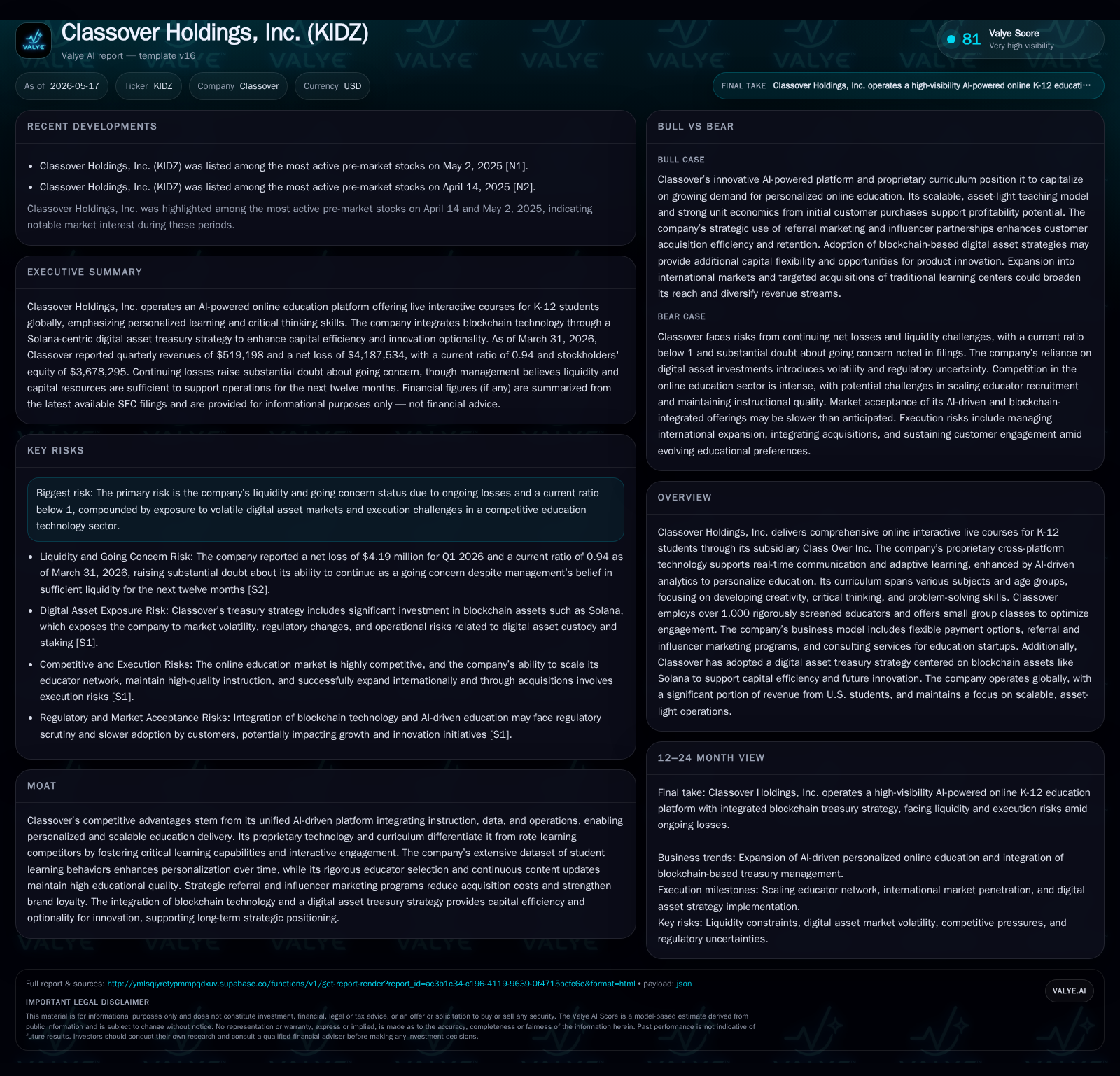
Classover Holdings, Inc., which offers AI-enhanced live online courses for K-12 students via its Class Over Inc. subsidiary, reported a sharp increase in net losses for Q1 2026 alongside a working capital deficit and current ratio below one. The company’s business model leverages proprietary cross-platform technology, data analytics, and a rigorously selected educator network to provide personalized interactive learning. Its competitive moat rests on scalable, AI-powered curriculum delivery and blockchain-based treasury management but remains vulnerable to liquidity constraints and execution risk. Growth is driven by expanding student enrollment, enhanced data monetization, and strategic use of digital asset financing, though sustaining operational cash flow and improving profitability will be critical near-term challenges.
Recent Operating Update
Classover Holdings’ latest quarterly filing (10-Q dated May 15, 2026) underscores intensifying financial pressures despite business progress. The company reported a net loss of approximately $4.19 million for Q1 2026 compared to just $297 thousand in Q1 2025, reflecting substantial expansion of operating expenses tied to scaling pedagogy technologies and content enrichment [S2][F1]. Cash reserves stood at around $2.12 million at quarter-end versus current liabilities of $2.26 million, resulting in a working capital deficit near $125 thousand and a current ratio below the critical threshold at 0.94 [S2][F1]. This continued negative cash flow scenario amplifies concerns over Classover’s ability to sustain operations without additional financing.
The balance sheet reveals deferred revenue classified wholly as short-term liabilities since the longest subscription extends only twelve months or less with expected session delivery within that horizon—showcasing a subscription-driven revenue model subject to renewal cadence [S2]. Cost of revenue centers on streaming service fees, third-party payment processing costs, and compensation paid to the teaching workforce integral to delivering live interactive classes [S2]. Referral incentives issued as course credits form a core customer acquisition driver though no uncertain tax positions were noted for this period.
Alongside the quarterly results, a recent Form 8-K filing from May 14 highlighted limitations under the sales agreement restricting share issuance within authorized amounts—suggesting management’s cautious approach around capitalization given current liquidity constraints [S3]. Additionally, the company initiated an equity repurchase program authorized up to $2 million earlier in the year indicating efforts to stabilize market perceptions despite tight cash flow situations [S13].
Business Model Overview
Classover operates through its wholly owned subsidiary Class Over Inc., specializing in comprehensive K-12 online education delivered via live interactive courses encompassing both interest-led subjects and exam/test preparation segments across multiple age groups [S1]. Revenue primarily emerges from direct course subscriptions paid by students or their guardians who benefit from high engagement small-group settings led by more than 1,000 vetted educators [S1]. Referral credits incentivize organic growth through word-of-mouth uptake.
What differentiates Classover is its proprietary cross-platform technology architecture that enables real-time communication between instructors and students combined with AI-powered adaptive learning analytics aiming to personalize each student's educational journey based on performance data collected during sessions [S1]. This integration allows continuous refinement of course content aligned with evolving academic demands and student feedback loops.
Besides teaching services, Classover generates revenue through ancillary consulting targeted at education startups leveraging its instructional data insights and operational expertise. Its digital asset treasury strategy incorporating blockchain tokens such as Solana underpins capital management efforts to achieve liquidity efficiency while positioning for future innovation funding options in emerging fintech realms related to education technology autonomy [S1].
Industry Structure and Competitive Position
The online K-12 education industry is competitively fragmented but featuring rising technological sophistication where firms blend pedagogy with advanced data science tools. Classover contends with traditional offline tutoring services like Kumon or Mathnasium which appeal via physical classrooms and local presence but lack real-time scalability provided by platforms like Classover’s.
On technology fronts, competitors such as Coursera or Duolingo emphasize asynchronous self-paced formats leveraging AI but do not fully replicate Classover’s synchronous interactive model which fosters deeper engagement essential for foundational K-12 education success [S1].
Classover’s competitive advantage is anchored on holistic integration: proprietary platform harmonizing instruction delivery with dynamic content updates plus enriched learner analytics continuously enhancing personalization accuracy based on experimentally gathered behavioral data sets. This capability creates high switching costs compounded by rigorous teacher recruitment protocols ensuring quality standards remain resilient over time.
Additionally, Classover's blockchain-centric treasury approach introduces an unconventional capital structure element rarely seen among edtech peers—potentially affording financial flexibility albeit introducing volatility risk inherent in crypto asset holdings.
Growth Drivers
Expanding Global K-12 Addressable Market
Classover targets not only U.S.-based students but also international markets where demand for quality English-language educational content is rapidly growing due to parental preferences and education system gaps. The platform's multilingual support capabilities enhance penetration potential across diverse regions.
Increasing Student Lifetime Value Through Personalization & New Offerings
By harnessing AI to tailor learning paths uniquely per student using accumulated datasets, Classover aims to improve retention rates mitigating churn risks prevalent in subscription models. Bundling advanced test prep courses alongside creative skill development widens product mix increasing average revenue per user (ARPU).
Referral & Influencer-Led Customer Acquisition Reducing CAC
Referral incentives funded as course credits encourage organic marketing dynamics while influencer partnerships targeting parent communities bolster brand credibility efficiently relative to traditional advertising spend levels.
Digital Asset Treasury Fueling Capital Efficiency & Innovation Funding
Strategic acquisition of Solana tokens financed through convertible notes provides latent optionality for deploying blockchain solutions such as tokenized incentive schemes or expanded decentralized content marketplaces potentially unlocking new monetizable channels.
Risks and Constraints
Liquidity and Going Concern Doubts
The latest filings explicitly state substantial doubt about continuing as a going concern due to persistent losses outpacing cash generation leading to working capital deficits placing pressure on operational continuity without successful capital raises or improved margins [S2][F1].
Volatility from Digital Asset Exposure
While blockchain assets offer innovation leverage they pose valuation fluctuation risks impacting balance sheet stability especially if forced liquidations occur amid market downturns.
Execution Risk in Competitive Edtech Landscape
Market incumbents investing heavily in technology could erode differentiation if Classover fails timely course enhancements or cannot recruit/retain expert teaching staff maintaining pedagogical excellence critical for customer satisfaction driving renewals.
Dependence on Subscription Renewal Cycles & Student Performance Outcomes
Retention hinges partly on academic progress influenced by factors beyond controllable instructional quality including student motivation/community norms raising unpredictability in revenue stability.
What To Watch Next
- Quarterly enrollment metrics signaling ability to grow paying student base sustainably beyond initial COVID-era surge tailwinds.
- Deferred revenue changes reflecting prepayments indicative of future session bookings offering visibility into top-line trajectory.[S2]
- Product roadmap announcements elaborating advancements in AI-driven personalization features that can enhance competitive positioning.
- Execution progress against note financing drawdowns ensuring liquidity runway extension managing going concern risks.[S6]
- Updates on digital asset portfolio valuations considering broader crypto market movements influencing overall financial health.
- Outcomes from marketing strategies including efficacy of referral programs and influencer partnerships gauged through CAC trends.
Financial Profile (Brief)
Latest financial snapshot
| Metric | Value | Period |
|---|---|---|
| Current assets | $2mm | |
| 2026-03-31 | ||
| Current liabilities | $2mm | |
| 2026-03-31 | ||
| Current ratio | 0.94x | |
| 2026-03-31 |
Source: SEC companyfacts cache [F1].
Classover reported total current assets of approximately $2.13 million against current liabilities close to $2.26 million at March 31, 2026 yielding a current ratio of about 0.94—a signal often interpreted as liquidity tightness requiring monitoring especially alongside accelerating quarterly operating losses surpassing $4 million [S2][F1]. Stockholders’ equity remains positive at roughly $3.68 million but the company continues generating substantial negative EBITDA impacting cash flows implying need for fresh capital infusions or operational scaling efficiencies soon.[F1]
| Metric | Value | Period |
|---|---|---|
| Cash | $2,116,631 | 3/31/2026 |
| Current Assets | $2,134,745 | 3/31/2026 |
| Current Liabilities | $2,260,061 | 3/31/2026 |
| Current Ratio | 0.94 | 3/31/2026 |
| Net Loss (Quarter) | $(4,187,534) | Q1 2026 |
Further financial disclosures confirm no recorded uncertain tax positions while employee stock compensation expense rose materially consistent with growth initiatives activating broader workforce incentive plans.[S7]
This analysis is based solely on publicly filed SEC documents and related disclosures as of May 2026. It does not constitute investment advice or recommendations.
Disclaimer: This is research-only, informational analysis and not investment advice. It may include AI-generated interpretation and general industry context. Always verify important details using primary sources.

Comments