
Classover Holdings Q2 2026: Sustained Investment in Live K-12 Courses with Robust Liquidity
Classover Holdings narrowed its operating loss in Q2 2026 while maintaining a strong liquidity position, reflecting ongoing investments in its subscription-based online K-12 education platform.
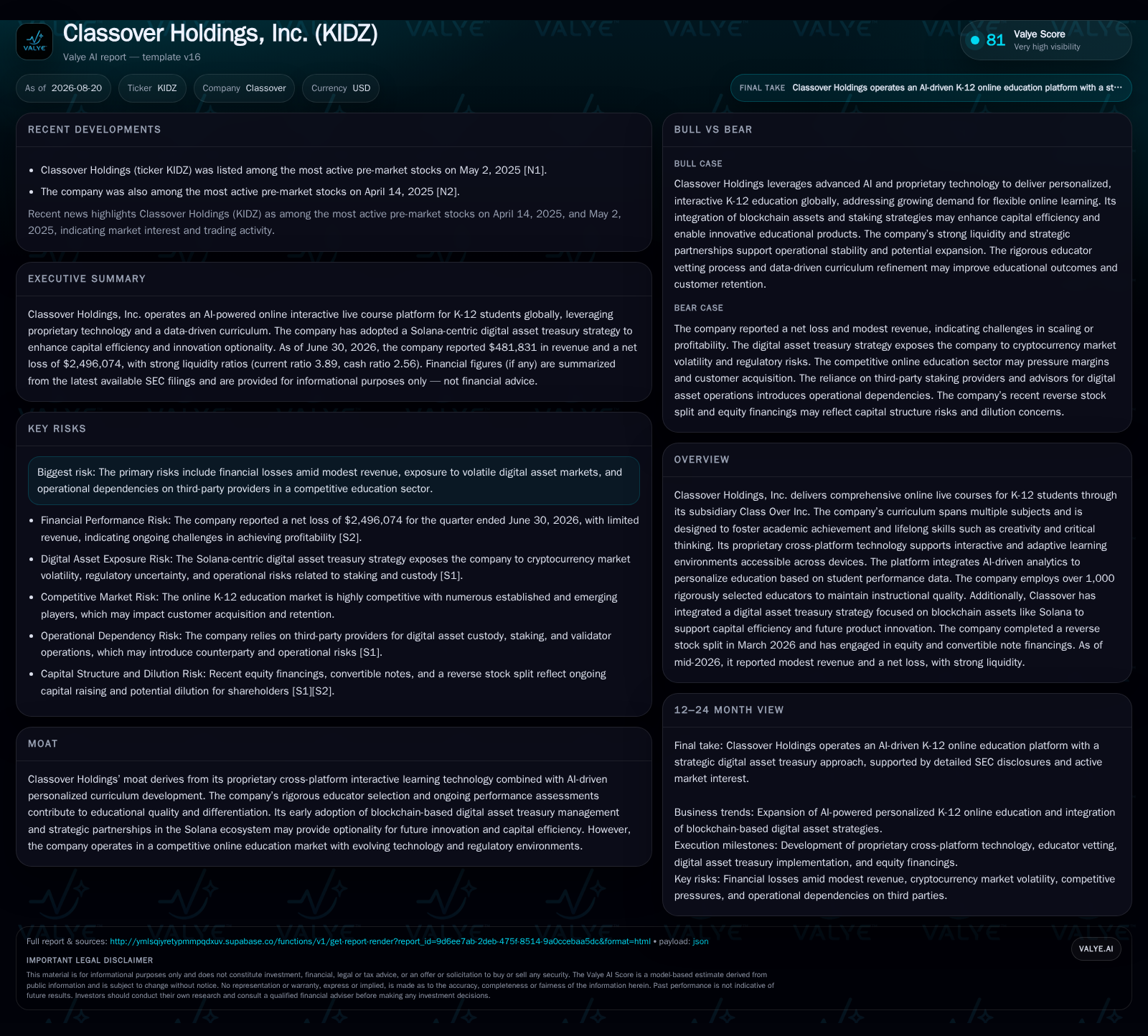
Classover Holdings reported a net loss of $2.50 million for Q2 2026, down from $3.87 million in Q2 2025, indicating improved operational efficiency. The company held $5.88 million in cash and a working capital surplus of $6.62 million as of June 30, 2026, supporting near-term liquidity. Revenue is recognized over subscription periods or as class sessions are delivered, consistent with its role as principal in transactions. These results suggest progress in managing costs while investing in streaming services and educator wages amid competitive pressures.
Q2 2026 Operating Performance and Loss Reduction
Classover Holdings, Inc. reported a net loss of $2,496,074 for the quarter ended June 30, 2026, representing a reduction from a $3,866,169 loss in the same period of 2025 [S2]. This narrowing of operating losses suggests improvements in operational efficiency or revenue growth. Despite the persistent net loss, the company continues to invest in streaming services and wages for educators and employees directly engaged in course delivery, reflecting the cost structure associated with its role as principal in the transaction with end users [S2]. This cost structure includes third-party payment processing fees and streaming costs, which are essential to delivering live, interactive K-12 courses.
The reduction in net loss may be indicative of better cost control or scaling benefits, but the company remains in a loss position, highlighting the ongoing challenge of balancing growth investments with profitability in the competitive online education market.
Liquidity and Balance Sheet Strength
As of June 30, 2026, Classover held cash and cash equivalents of $5.88 million and reported a working capital surplus of $6.62 million, supported by current assets of $8.92 million against current liabilities of $2.29 million [S2][F1]. Stockholders’ equity stood at $9.95 million, reflecting the company’s capital structure post recent equity and convertible note financings, including a reverse stock split earlier in 2026 [S2].
Business Model and Revenue Recognition
Classover operates a subscription-based business model offering comprehensive live online courses for K-12 students. Customers, primarily students and their families, purchase subscriptions or prepay for courses that cover a wide range of subjects, including interest-oriented classes and test preparation [S1][S2].
Revenue recognition aligns with the delivery of educational services: revenue is recognized over the subscription period or as pre-purchased class sessions are delivered [S2]. Deferred revenue, representing payments received in advance, is classified as a short-term liability since the longest subscription plan is twelve months, and remaining sessions are expected to be delivered within that timeframe.
The company acts as principal in these transactions by controlling, hosting, and integrating the delivery of virtual educational content, which justifies recording gross revenue and treating third-party payment platform fees as cost of revenue [S2]. This approach reflects the economics of the business, where streaming services, educator wages, and payment processing are integral to service delivery and directly impact margins.
Additionally, Classover offers referral incentives in the form of course credits to customers who refer new students, which affects customer acquisition costs and revenue recognition dynamics [S2]
Competitive Positioning and Industry Context
Classover operates in the online education services sector, competing with both traditional offline tutoring providers and AI-driven self-paced learning platforms. Its proprietary technology leverages data analytics and process automation to recruit and validate expert instructors, aiming to deliver high-quality instruction at scale [S1].
Key sector performance indicators include student enrollment and retention rates, average revenue per student, deferred revenue levels as a subscription backlog proxy, and operating margins influenced by streaming and educator costs. Maintaining high teaching quality and student engagement is critical to customer retention and organic growth through referrals.
The company faces structural growth drivers from increasing digital adoption and personalized learning demand but must navigate cyclical factors such as regulatory changes, competitive innovation, and consumer spending variability.
Analytical Conclusions and Watchpoints
The narrowing net loss in Q2 2026 compared to Q2 2025 suggests operational improvements or better cost management, which could enhance the company’s sustainability if the trend continues [S2]. This improvement is notable given ongoing investments in streaming and educator wages, indicating potential operational leverage or revenue growth.
The company reported a working capital surplus of $6.62 million and a current ratio of 3.89 as of June 30, 2026, which indicates that current assets exceed current liabilities by this amount [S2][F1]. This liquidity position may provide the company with capacity to meet short-term obligations and continue investing in its live course offerings despite ongoing operating losses.
Key watchpoints for future periods include monitoring quarterly revenue growth and deferred revenue trends to assess subscription momentum, operating margin progression to evaluate cost control effectiveness, cash flow from operations, and changes in working capital. Additionally, student enrollment and retention metrics, if disclosed, will provide insight into customer engagement and competitive positioning. The impact of digital asset market volatility on the company’s treasury and capital allocation strategies also warrants attention given sector risks.
Scenarios
One possible positive scenario is that Classover continues to reduce operating losses while growing its subscription base and leveraging AI-driven personalization, potentially achieving profitability and scale in the competitive online education market. Confirmation would come from quarterly revenue growth outpacing cost increases, improved margins, and increasing deferred revenue balances.
Conversely, a bear scenario involves intensified competitive pressures or volatility in digital asset markets affecting capital efficiency, which could lead to sustained losses and liquidity challenges. Indicators would include widening operating losses, declining cash balances, and negative commentary on digital asset exposure or regulatory hurdles.
Overall, Classover’s Q2 2026 results demonstrate progress in narrowing losses and maintaining liquidity, providing a foundation for continued investment in its subscription-based live K-12 education platform amid a dynamic competitive environment [S2]
Disclaimer: This is research-only, informational analysis and not investment advice. It may include AI-generated interpretation and general industry context. Always verify important details using primary sources.

Comments