
Kinder Morgan Expands Natural Gas Pipeline Capacity on Fee-Based Contracts Amid Capital Discipline
Latest quarterly results highlight stable cash flow growth driven by natural gas throughput and strategic capex focused on long-term fee arrangements.
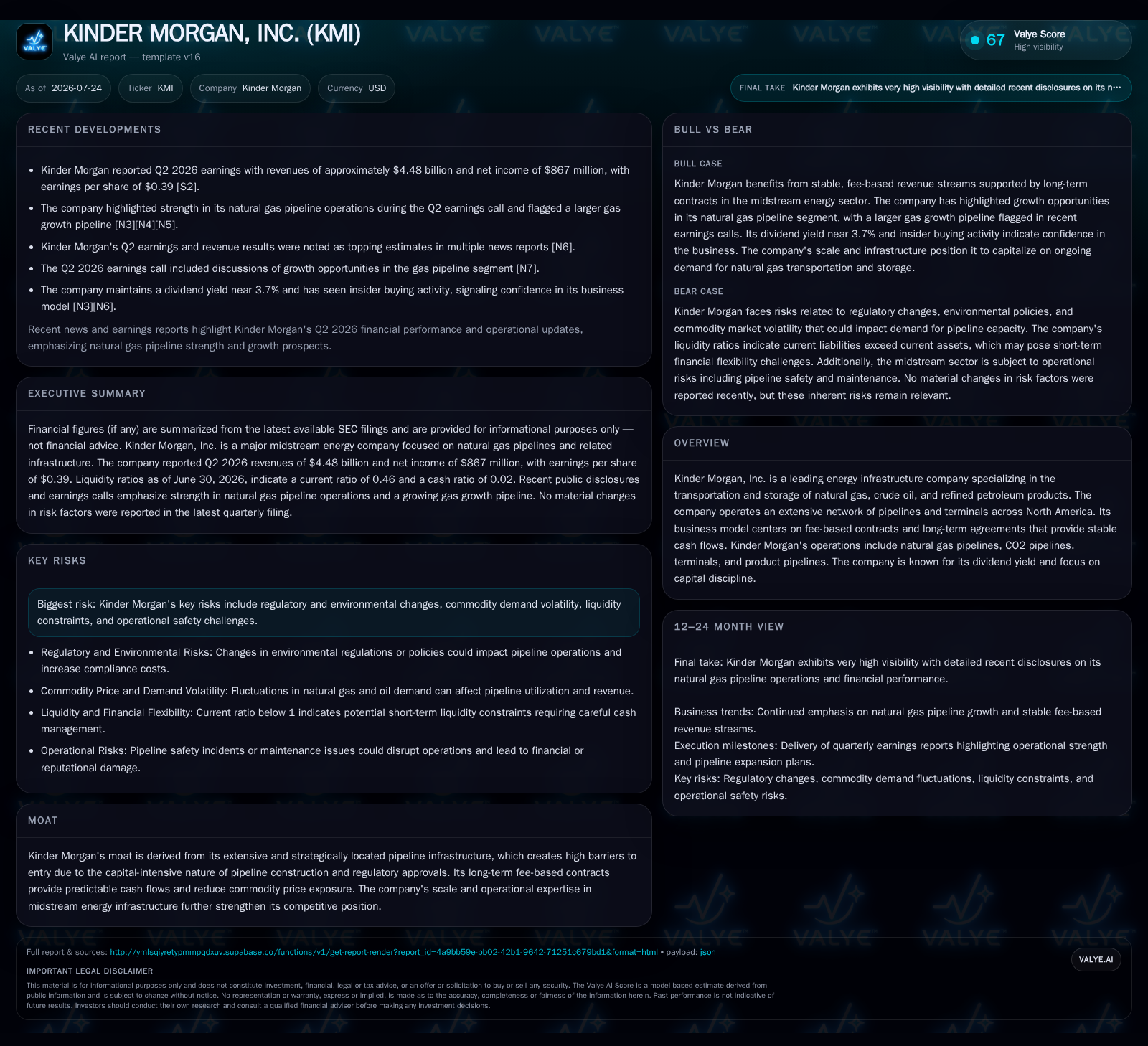
Kinder Morgan’s Q2 2026 report underscores the company’s continued emphasis on midstream fee-based contracts, which underpin its revenue stability and dividend policy. The firm reported strength in natural gas pipeline throughput and flagged an expanded pipeline growth opportunity relying on take-or-pay agreements. Capital discipline remains a focal point as Kinder Morgan balances infrastructure modernization with debt management amid a complex regulatory environment. The company’s competitive moat is supported by scale, geographic positioning, and long-lived assets that create high barriers to entry.
Recent Operating Update: Stable Growth Fueled by Natural Gas Segment
Kinder Morgan’s Q2 2026 quarterly report highlights sustained operational strength, particularly within its natural gas pipelines segment. The company reported robust throughput volumes driven by persistent demand across key North American gas markets, supporting revenue growth and fee-based contract stability [S2][N4]. Kinder Morgan’s portfolio predominantly consists of long-term fee-based contracts, including take-or-pay agreements and minimum volume commitments, which provide predictable cash flows largely insulated from commodity price volatility. This contract structure enables monetization of pipeline capacity regardless of commodity price fluctuations, underpinning the company’s stable dividend policy and financial resilience [S1].
The quarter showed no material changes in risk factors compared to the prior annual filing, indicating consistent regulatory and operational risk profiles without new significant headwinds [S2][S13]. This regulatory stability, combined with disciplined operational execution, reinforces Kinder Morgan’s ability to navigate the complex midstream environment.
Business Model: Fee-Based Midstream Infrastructure with Contractual Revenue Durability
Kinder Morgan operates an extensive midstream energy infrastructure network comprising natural gas pipelines, CO2 pipelines, crude oil pipelines, refined product pipelines, and storage terminals. The company’s business model centers on fee-for-service revenue generation, charging customers for the transportation and storage of energy commodities rather than commodity ownership or price exposure [S1]
Revenue generation depends on contracted capacity utilization rates, pipeline tariff structures, system reliability, and contract renewal or new contract bookings [S1]. The company’s long-term take-or-pay contracts obligate customers to pay for agreed minimum volumes, ensuring revenue stability even if actual throughput fluctuates. Throughput volumes, measured in million cubic feet per day (MMcf/d) for gas or barrels per day for liquids, directly influence operating margins and cash flow generation
Capital expenditures (capex) are strategically allocated to capacity expansions, infrastructure modernization, and regulatory compliance upgrades. These investments are aligned with anticipated contracted volume growth to optimize returns and maintain system integrity. The diversified asset base serves upstream producers requiring transportation solutions and downstream refiners and distributors needing reliable feedstock supply, enhancing utilization across multiple North American hydrocarbon basins.
Industry Structure and Competitive Positioning
The midstream oil and gas sector is characterized by high capital intensity, regulatory complexity, and significant barriers to entry. Kinder Morgan’s competitive moat is supported by its scale as one of the largest U.S.-based midstream operators and the strategic geographic positioning of its pipeline systems connecting prolific production regions with major consumption hubs [S1]
New pipeline construction faces lengthy permitting processes and regulatory scrutiny, which can delay projects by several years, reinforcing incumbents’ market positions. Competitors such as Enterprise Products Partners, Enbridge Inc., Williams Companies, TC Energy, and Energy Transfer LP operate with similar business models but differ in geographic focus and asset specialization. Kinder Morgan’s emphasis on fee-based contracts and long-term take-or-pay agreements reduces commodity price sensitivity relative to peers with more spot-exposed portfolios.
Operational expertise in project execution and system reliability further differentiates Kinder Morgan, enabling it to maintain high capacity utilization rates and pursue incremental expansions backed by contracted cash flows [S1][N5]
Growth Drivers: Contract-Backed Pipeline Capacity Expansion
Natural gas continues to gain market share due to its lower emissions profile compared to coal and growing industrial demand. Kinder Morgan is positioned to capitalize on this trend through targeted pipeline expansions supported by long-term customer commitments, as highlighted in its Q2 2026 earnings call referencing a "bigger gas growth pipeline" opportunity [N5]. These expansions are structured around take-or-pay contracts, mitigating investment risk by securing predictable revenue streams.
Geographic expansion into emerging shale basins enhances logistical advantages and customer access, while infrastructure modernization efforts improve operational efficiency and system reliability—key factors influencing contract renewal rates. Capital discipline remains a priority, with management balancing growth investments against maintaining a strong balance sheet [S1].
Operational safety and regulatory compliance are critical risk factors given the capital-intensive nature of pipeline assets. Maintenance and safety expenditures are carefully managed to protect margins and corporate reputation.
Commodity demand fluctuations can impact throughput volumes, particularly if upstream producers adjust production or if economic conditions reduce demand. Contract renewal risk exists if customers seek alternative transportation options or if regulatory changes affect pipeline operations.
Financial Position and Capital Structure
As of June 30, 2026, Kinder Morgan reported cash and cash equivalents of $89 million against total debt of approximately $29.7 billion, resulting in net debt near $29.6 billion. This reflects the capital-intensive nature of the midstream sector, where large infrastructure investments are primarily funded through debt financing [F1]. The company’s current ratio stood at 0.46, consistent with industry norms where liquidity is supported by stable operating cash flows rather than high current asset levels [F1].
Dividend sustainability is underpinned by free cash flow generated from fee-based revenues, tariff structures embedded in long-term contracts, and stable operating margins driven by contracted throughput volumes [S3][N6]. Interest coverage ratios based on adjusted operating income indicate manageable debt servicing capacity, though refinancing risks and interest rate fluctuations remain important to monitor.
Key Metrics and Monitoring Points
Critical operating KPIs include pipeline throughput volumes (MMcf/d for natural gas), capacity utilization rates, contract renewal rates, and tariff trends. Monitoring throughput growth in core pipeline segments provides insight into demand dynamics and revenue trajectory. Contract renewal timing and success rates are essential to assess medium-term revenue visibility.
Capital expenditure pacing relative to contracted demand growth signals the company’s ability to balance expansion with capital discipline. Regulatory approval progress for new projects is a key milestone affecting capacity additions and future cash flow potential.
Operational safety metrics and incident disclosures are important given their potential impact on financial performance and regulatory standing.
Financially, adjusted EBITDA margins, free cash flow generation, and leverage ratios should be tracked to evaluate dividend sustainability and balance sheet flexibility.
Summary
Kinder Morgan’s Q2 2026 results reaffirm its position as a leading midstream operator with a business model anchored in fee-based contracts and long-term take-or-pay agreements. The company’s extensive natural gas pipeline network benefits from stable throughput volumes driven by North American energy demand trends. Capital discipline guides its expansion strategy, focusing on contract-backed capacity growth while managing regulatory and operational risks.
The capital-intensive nature of the business is reflected in a leveraged balance sheet typical of the sector, with financial metrics supported by predictable cash flows from fee-based contracts. Key watchpoints include throughput volume trends, contract renewals, regulatory approvals, capex execution, and operational safety.
This analysis is based on Kinder Morgan’s publicly filed documents through July 24, 2026, including the latest quarterly report [S2], recent event filings [S3], annual disclosures [S1], and corroborative industry news sources [N4][N5]. It does not constitute investment advice.
Disclaimer: This is research-only, informational analysis and not investment advice. It may include AI-generated interpretation and general industry context. Always verify important details using primary sources.

Comments