
Knight-Swift’s Fleet Strategy and Margin Expansion Amid Shifting Freight Dynamics
Knight-Swift’s July 2026 quarterly report highlights improved truckload margins and LTL network growth amid persistent leverage challenges.
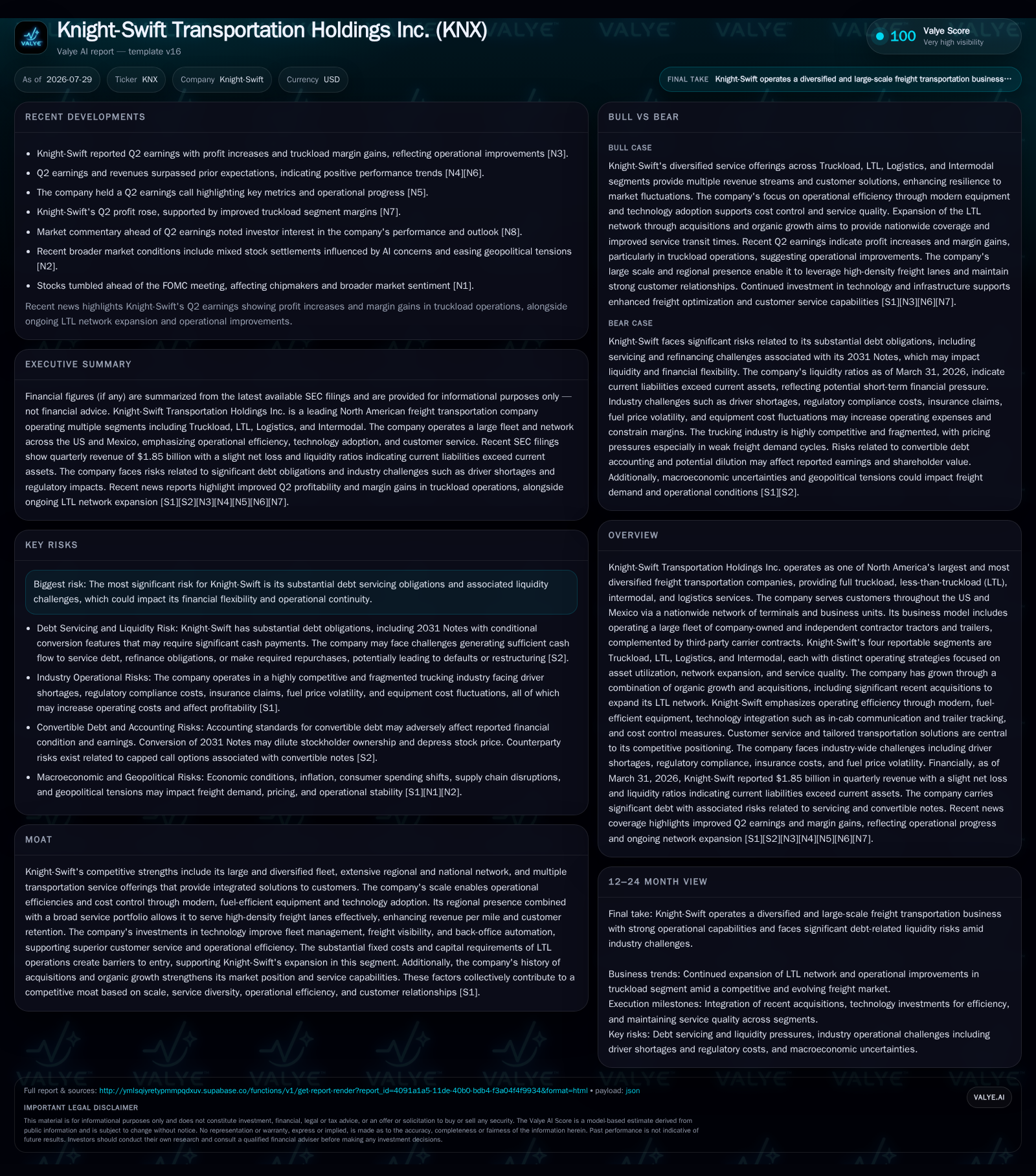
In Q2 2026, Knight-Swift Transportation Holdings demonstrated operational momentum driven by enhanced fleet utilization and revenue per mile gains in its truckload segment, contributing to a notable margin beat. The company continues to expand its less-than-truckload (LTL) footprint through acquisitions, aiming to leverage scale benefits in this capital-intensive niche. Despite these operational advances, Knight-Swift faces substantial debt servicing obligations that constrain financial flexibility. Technology investments and cross-border logistics initiatives bolster growth potential alongside organic expansion. Monitoring the evolution of fleet utilization rates, operating ratios, and debt management will be critical to assessing trajectory.
Q2 Operational Momentum: Fleet Utilization Driving Profit Margins
This operational leverage underscores how Knight-Swift successfully monetizes its fleet through both company-owned assets and contracted independent tractors. Fleet utilization rate improvements indicate more effective matching of capacity to demand without incurring proportionate incremental fixed costs such as depreciation or insurance on idle equipment. Correspondingly, revenue per mile rose modestly driven by selective contract renewals and spot market pricing dynamics favoring carriers with sufficient scale or service breadth [S2]. This outperformance in core truckload contrasts with some softness persisting in the intermodal segment due to rail congestion easing but competitive pricing pressure [S2].
Integrated Service Model: How Knight-Swift Captures Value Across Segments
Knight-Swift’s business model integrates four primary operating segments—Truckload, Less-Than-Truckload (LTL), Logistics, and Intermodal—enabling a diversified freight offering that addresses varying shipper needs across North America [S1]. The Truckload segment emphasizes asset turnover through a large company-owned fleet supplemented by independent contractor participation. It is generally less capital intensive per shipment than LTL but requires scale to maintain competitive revenue per mile on dense freight lanes.
The LTL segment is more capital intensive given the need for extensive terminal networks and local pickup/delivery resources but offers higher barriers to entry that protect margins once scale density is achieved. Knight-Swift’s recent acquisitions notably expanded its LTL footprint with a strategic intent to integrate service centers under a unified brand for improved network effect economies of scale [S1][S2]. This also provides cross-selling opportunities whereby customers with varying shipment sizes can consolidate freight volumes within one integrated supplier.
Intermodal services combine trucking with rail transport to optimize cost efficiency over long hauls but are subject to rail carrier capacity constraints which can dampen throughput growth despite rising demand for sustainable freight solutions. The Logistics segment provides value-added services including freight brokerage, supply chain consulting, and inventory management that typically generate lower margins but contribute steady fee-based revenues [S1]. Each segment faces distinct operating ratios reflective of their cost structure; Truckload aims for lower ratios through fleet efficiency while LTL leverages network density and service quality.
Fleet Composition & Network Scale: A Competitive Moat in Freight Transport
Knight-Swift operates one of the largest fleets among North American trucking carriers with approximately 21,319 average tractors in the Truckload segment during Q2 2026 comprising roughly 19,000 company tractors and over 2,000 independently contracted units supported by nearly 90,000 trailers [S19]. This significant asset base enables superior fleet utilization via advanced routing technologies and modern fuel-efficient trucks–crucial factors driving lower deadhead percentages and improved revenue per mile compared to smaller regional players.
The company’s terminal network spans multiple hubs across the US and Mexico facilitating high-frequency service on key corridors enhancing load density—a critical determinant in reducing unit costs per shipment [S1]. Such infrastructure scale allows Knight-Swift to negotiate favorable procurement terms on equipment leases and maintenance while offering shippers end-to-end visibility enabled by IT systems investments.
Compared with integrated peers like J.B. Hunt Transport Services, Knight-Swift maintains similar national footprint coverage though it differentiates itself through a more diversified mix spanning LTL acquisitions alongside traditional truckload offerings. This breadth creates stickier customer relationships due to bundled freight services across modes, which can increase switching costs.
Competitive Pressures: Positioning Against Peers in Truckload & LTL
Within truckload operations, competition is intense around access to qualified drivers, pricing on commodity routes, and fuel cost management. Knight-Swift leverages scale advantages akin to J.B. Hunt allowing it to absorb wage inflation better than smaller carriers lacking bargaining power or diversified load boards.
On the LTL front—which Old Dominion Freight Line exemplifies as a niche specialist—Knight-Swift’s comparatively recent expansion exposes it to integration risks but also provides upside via consolidation of fragmented regional networks into larger systems benefiting from network density effects driving higher operating margins long-term [S1]. The substantial fixed costs typical of LTL operations create natural barriers deterring new entrants; however, Knight-Swift must manage claims exposure prudently since high-value cargo handling entails elevated insurance liabilities impacting adjusted operating ratios.
Intermodal competition is moderated by relationships with railroads; Schneider National operates with strong intermodal emphasis optimizing modal mix for cost efficiency. Knight-Swift’s balanced mix reduces single-segment exposure but requires continued rail partnership sophistication.
Growth Trajectories: Acquisitions, Technology, And Cross-Border Expansion
M&A activity remains central to Knight-Swift’s strategy especially evident in the expansion of its LTL segment through multi-brand consolidations under flagship names improving route economics [S1][S2][S3]. Such acquisitions boost terminal density accelerating volume growth nonlinear to incremental capital deployed due to hub efficiencies. Simultaneously, technology investments focusing on route optimization algorithms reduce deadhead mileage occurrences enhancing fuel efficiency—a critical margin driver given volatile diesel prices. Customer-facing platforms offering real-time shipment visibility increase retention levels.
Cross-border logistics leveraging US-Mexico trade corridors have grown steadily benefiting from robust manufacturing supply chains; Knight-Swift operates terminals strategically located near border crossings enhancing transit times for exporters/importers [S1]. Organic growth projects hinge on ongoing driver recruitment success where industry-wide shortages elevate wage costs yet solidify service reliability premiums commanding stronger rate adjustments.
Risks & Red Flags: Fuel Volatility, Driver Turnover, And Regulatory Factors
Key operational risks include fluctuations in fuel prices which directly amplify variable expenses though mitigated partly via newer fuel-efficient equipment adopting aerodynamic designs [S8]. Driver retention is an industry-wide challenge exacerbated by demographic shifts requiring continuous wage increases or incentives impacting unit economics if not managed prudently. Regulatory compliance encompassing safety mandates limits operational flexibility affecting scheduling or load consolidation efforts forcing higher empty miles. Unexpected claims exposure especially within LTL insurance coverage categories could materially affect adjusted margins as illustrated by past arbitration rulings indemnifying sizable claims [S20].[S8] Cybersecurity also represents an evolving risk vector affecting operational continuity given reliance on IT infrastructure. Liquidity constraints elevate risk if organic cash generation falters compromising capability for needed capex or debt payments [S17]. Supply chain disruptions or geopolitical shifts impacting trade policies further pose uncertainty on volume growth assumptions.
What To Watch Next: Guidance Updates, Capacity Signals, And Strategic Moves
Upcoming milestones include management's release of updated earnings guidance reflecting integration status of recent LTL acquisitions providing clarity on margins sustainability [S2].[N3] Monitoring load-to-truck ratio trajectories offers early signals on capacity utilization trends crucial to margin resilience. Contract renewals or new customer wins particularly those leveraging multimodal solutions could validate cross-selling strategy efficacy while worsening driver shortage metrics would highlight capacity bottlenecks curbing organic volume growth. Further technology deployment results such as reduced deadhead rates or improved delivery reliability metrics will test productivity enhancements promised thus far. Management commentary around refinancing flexibility amid sensitive interest-rate environments will influence risk assessment frameworks going forward. Overall, the interplay between operational execution excellence against structural leverage burdens frames Knight-Swift's near-term outlook.
Disclaimer: This is research-only, informational analysis and not investment advice. It may include AI-generated interpretation and general industry context. Always verify important details using primary sources.

Comments