
Karyopharm Therapeutics Q2 2026: Liquidity Pressures Intensify Amid Ongoing Net Losses and Clinical Development
Karyopharm’s Q2 2026 results reveal tightened liquidity with a cash runway through September 2026, sustained revenue from XPOVIO sales, and critical upcoming debt obligations.
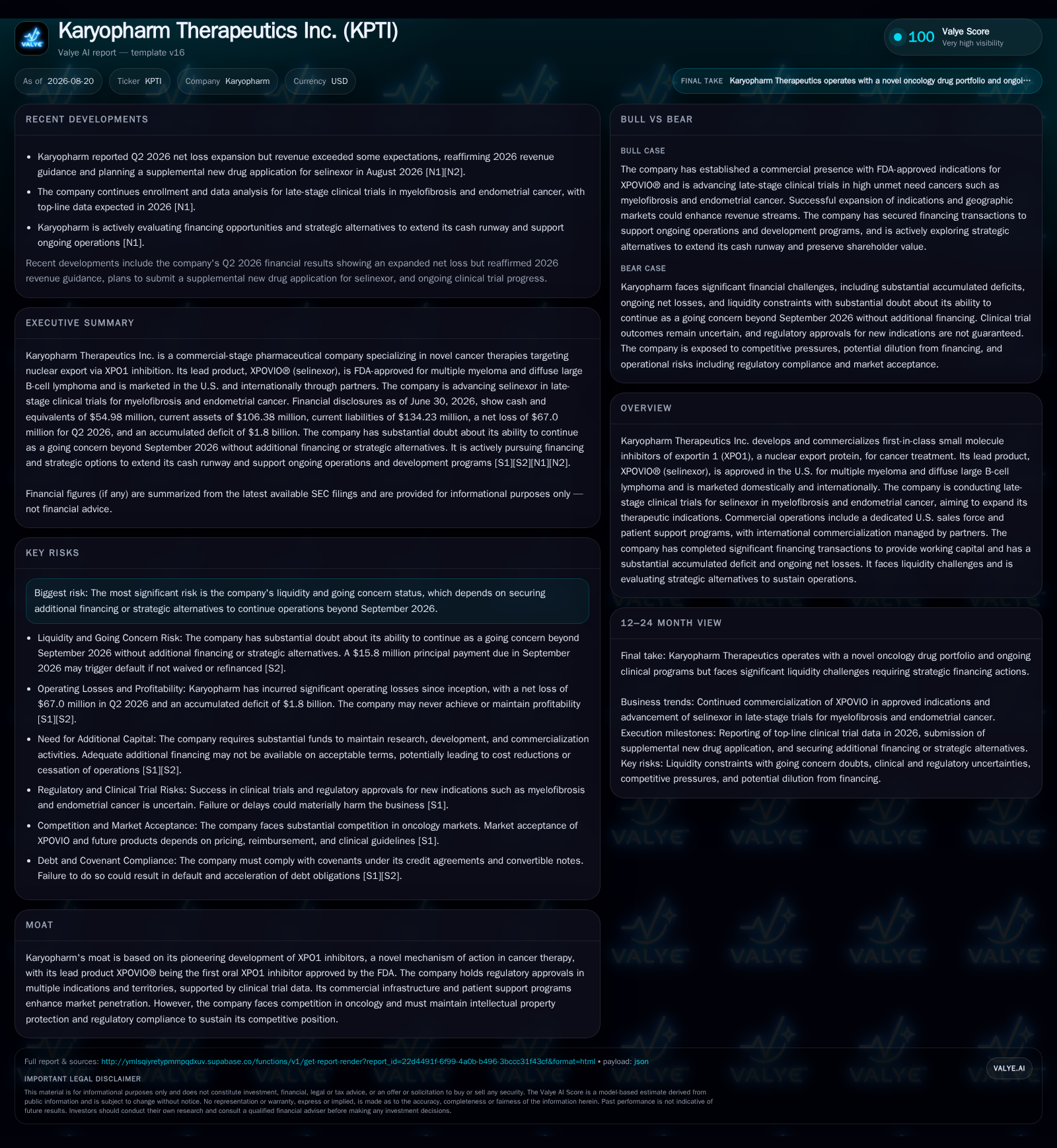
Karyopharm Therapeutics reported Q2 2026 financial results showing an expanded net loss but revenue exceeding estimates, primarily driven by sales of its oncology drug XPOVIO (selinexor). The company’s liquidity is critically constrained, with cash and current assets insufficient to cover current liabilities, including a $15.8 million principal debt payment due in September 2026. Without additional financing or strategic alternatives, Karyopharm faces material risks to its ongoing operations and clinical development programs. The company continues late-stage trials for selinexor in new indications, though recent results in endometrial cancer have been disappointing.
Q2 2026 Financial and Liquidity Update
Karyopharm Therapeutics Inc. reported financial results for the quarter ended June 30, 2026, revealing a challenging liquidity position that poses significant risks to its near-term operations [F1]
This liquidity imbalance is further exacerbated by substantial upcoming debt service requirements. A principal payment of $15.8 million on the senior secured term loan facility is due on September 10, 2026, followed by approximately $10.1 million in aggregate interest payments due by September 30, 2026 [S2]. Management’s disclosures indicate that if the principal payment is made without additional financing or lender waivers, the company’s cash reserves would fall below the $10 million minimum liquidity covenant, triggering a default and severely constraining operational funding [S2].
Given these factors, Karyopharm’s existing liquidity and cash flow from net product and license revenues are expected to fund operations only through September 2026, underscoring the pressing need for new capital or strategic alternatives to sustain ongoing activities [S2]
Commercial Performance and Clinical Development
Despite the liquidity pressures, Karyopharm’s commercial performance in Q2 2026 demonstrated resilience [S2][S3]. The company reported revenue that exceeded market estimates, primarily driven by sales of its lead product, XPOVIO (selinexor), which is approved for multiple myeloma and diffuse large B-cell lymphoma indications
Karyopharm is actively advancing selinexor’s clinical development in additional indications, including myelofibrosis and endometrial cancer. However, recent phase 3 trial results in endometrial cancer were disappointing, missing the primary endpoint and negatively impacting clinical outlook for that indication [S1][N7]. These mixed clinical outcomes highlight the ongoing challenges in expanding the drug’s label and market potential.
The company’s business model centers on generating revenue through net product sales of XPOVIO, supplemented by license and collaboration revenues [S1][S2]. Margins and cash flow are influenced by manufacturing costs, sales and marketing expenses, and substantial research and development investments necessary for clinical trials and regulatory submissions.
Risks and Going Concern Considerations
Karyopharm’s financial condition raises substantial doubt about its ability to continue as a going concern beyond the third quarter of 2026 [S2][F1]. The combination of negative working capital, significant upcoming debt repayments, and ongoing net losses creates a material risk that the company will be unable to sustain operations without additional capital infusion or strategic transactions.
Failure to secure new financing or enter into strategic alternatives could force Karyopharm to implement severe cost reductions, including workforce layoffs, delays or cancellations of research and development programs, and scaling back commercialization efforts. In the worst case, the company may be compelled to cease operations entirely [S2].
The company’s ability to maintain compliance with debt covenants and avoid defaults will be closely monitored by investors and creditors alike.
Scenario Analysis and Investor Considerations
Looking ahead, several scenarios could shape Karyopharm’s trajectory:
Bear Case: If Karyopharm fails to secure additional financing or strategic partnerships by September 2026, it may be forced to drastically reduce operations or cease business [S2][F1]. This scenario is plausible given the cash runway constraints and debt maturities, and would be confirmed by announcements of cost-cutting measures or defaults in upcoming SEC filings
Base Case: The company successfully raises capital or restructures debt, allowing it to continue clinical development and commercialization [S2][S3]. Stable revenue from XPOVIO and no major clinical setbacks would support this outcome. Confirmation would come from financing announcements and improved liquidity metrics in subsequent quarters
Bull Case: Positive clinical trial results and regulatory approvals in new indications such as myelofibrosis could expand XPOVIO’s market, driving revenue growth and improving cash flow [S1][N2]. This would reduce liquidity risk and potentially lead to margin expansion. Evidence would include positive trial data releases and regulatory milestones
Business Economics and Industry Context
Karyopharm operates in the biotechnology therapeutics sector, focusing on the development and commercialization of novel small molecule oncology drugs. The company’s revenue mechanics rely heavily on net product sales, supported by regulatory approvals and ongoing clinical development to expand indications.
Margins in this industry are typically pressured by high fixed costs related to research and development, manufacturing, and sales and marketing. For Karyopharm, operating losses reflect these investments alongside the challenges of commercial scale-up and competitive oncology markets. Cash conversion is constrained by the need for continuous financing to fund clinical trials and regulatory processes.
These factors will be critical in determining whether Karyopharm can navigate its current financial challenges and continue advancing its clinical and commercial objectives.
Disclaimer: This is research-only, informational analysis and not investment advice. It may include AI-generated interpretation and general industry context. Always verify important details using primary sources.

Comments