
KKR Real Estate Finance Trust Expands Non-Mark-to-Market Financing Amid Elevated Volatility
Recent quarterly disclosures show KREF’s strategic shift towards durable financing structures cushioning against market mark-to-market volatility.
KKR Real Estate Finance Trust Inc. (KREF) reported a continued emphasis on diversifying its capital structure with 77% of its total financing sourced from non-mark-to-market instruments as of Q1 2026, up from 74% at year-end. This approach supports stability against market valuation swings despite challenges in the commercial real estate sector, particularly office and life sciences. The company’s business model revolves around originating senior floating-rate CRE loans with institutional-quality collateral, supported by KKR’s global real estate platform. Key growth considerations include credit risk management in unsettled sectors and maintaining liquidity through robust financing facilities, while watch points center on loan origination trends and asset performance in volatile macro conditions.
Recent Operating Update
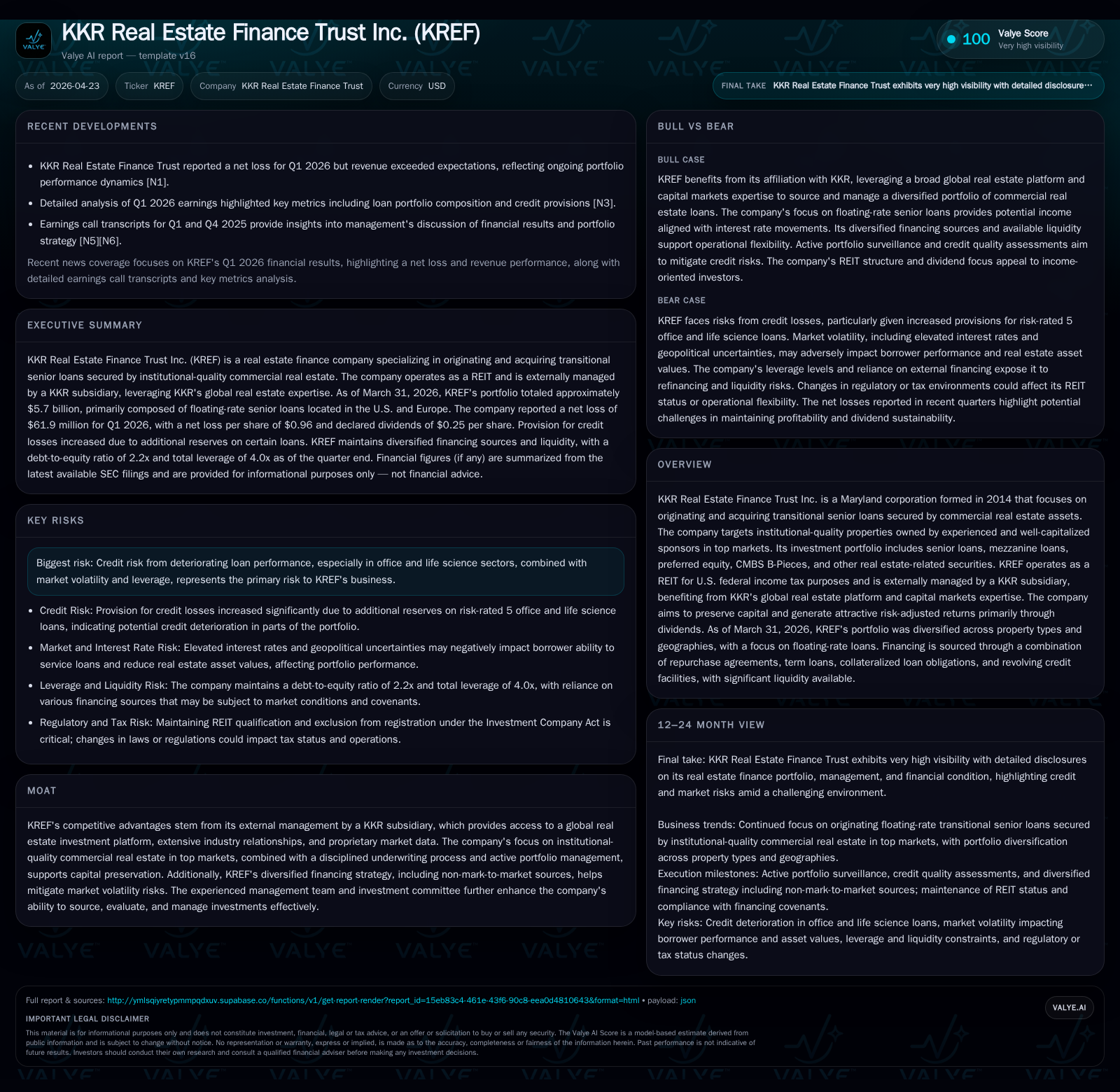
KKR Real Estate Finance Trust Inc. filed its latest Form 10-Q on April 22, 2026 [S2], providing a detailed snapshot of its portfolio management and capital structure amidst ongoing commercial real estate (CRE) market volatility. The dominant theme is an incremental increase in non-mark-to-market financing sources, which now represent approximately 77% of total borrowings compared to 74% at the end of 2025 [S2]. This shift underscores management’s intent to insulate liquidity and reduce exposure to adverse mark-to-market fluctuations inherent in repurchase agreements.
KREF reported slowing loan originations during Q1 2026 with gross originations totaling approximately $180 million but loan repayments outpacing fundings by over $200 million [S18]. This reversal from a positive net funding quarter reflects continued caution among borrowers in office and life science sectors where vacancy rates and tenant demand remain challenged. Concurrently, additional reserves were established on risk-rated 5 loans within these sectors indicating increasing credit risk provisioning [S9].
Liquidity metrics demonstrate a solid position as of March 31, 2026: cash balances stand at $135 million complemented by approximately $500 million available capacity on the corporate revolving credit facility [S20]. The company also holds over $530 million in unencumbered assets available for future financing or sale [S20]. Cash flows from operating activities remain positive though lower relative to prior periods consistent with reduced interest income driven by lower portfolio yields as some assets transition through workout or repayment.
Business Model
KKR Real Estate Finance Trust operates as a public REIT specializing in originating and acquiring floating-rate transitional senior loans secured by high-quality commercial real estate across major U.S. and select European markets [S2][S18]. Its strategy centers on lending to well-capitalized sponsors managing institutional-grade properties characterized by strong underlying fundamentals. The portfolio composition includes senior loans predominately floating rate (~100% by principal), mezzanine loans, preferred equity interests, CMBS B-Pieces, and other real estate-related instruments offering diversified exposure [S18].
The company is externally managed by KKR Real Estate Finance Manager LLC—a KKR subsidiary—granting it access to KKR’s extensive global real estate platform along with robust underwriting capabilities, proprietary data sets, and broad capital markets relationships [S2][S1]. This external management provides sourcing advantages in competitive markets while aligning underwriting discipline focused on capital preservation and risk-adjusted returns primarily delivered via dividends.
KREF finances its assets primarily through secured borrowing facilities involving master repurchase agreements, term lending agreements, collateralized loan obligations (CLOs), term loan facilities, warehouse financing arrangements, asset-specific financings, and a substantial corporate revolving credit line [S2][S4]. Notably, the use of non-mark-to-market instruments (e.g., CLOs and term lending agreements) reduces periodic mark-to-market earnings volatility common in securitized financings tied directly to market price fluctuations.
Industry Structure and Competitive Position
KREF operates within a competitive real estate finance industry comprising various REITs, specialty finance companies, private funds (including KKR-advised funds), banks and other lenders [S1]. Unlike many competitors subject solely to market-driven cost-of-funds swings or deposit base constraints, KREF mitigates sensitivity through layered financing structures featuring partial recourse terms and match-term asset-based lending.
Its affiliation with KKR—a global alternative asset manager with over $700 billion AUM—furnishes meaningful advantages not widely accessible to pure standalone lenders: scale economics in origination platforms; deeper borrower relationships; ability to co-invest alongside sponsor partners; access to bilateral debt markets; and enhanced risk transfer capabilities via CLO securitizations [S1][S2]. These strategic moats support disciplined underwriting even amid cyclical dislocations affecting office occupancy rates and CRE transaction volumes.
Nonetheless, competition persists intensely for senior transitional loans secured by top-tier properties as other REITs have raised significant equity pools post-pandemic seeking yield-enhancing placements. Pricing compression has been observed industry-wide due to alternative capital availability with some peer players exhibiting higher risk appetites or longer hold horizons [S1]. Regulatory changes impacting bank lending could also alter competitive dynamics over time.
Growth Drivers and Constraints
Drivers:
- Floating-Rate Loan Demand: As interest rates normalize post-Fed easing phases seen since mid-2024, demand for floating-rate CRE debt instruments remains structurally supported among sponsors seeking rate reset features matching asset cash flows.
- Repayment Recycling: Loan repayments provide ongoing capital recycling opportunities into new originations contingent on stable market conditions.
- Strategic Financing Expansion: Increasing reliance on non-mark-to-market financings offers both expanded capacity and earnings stability enhancing incremental leverage potential without commensurate volatility.
- Sponsor Equity Support: Long-tenured relationships with experienced borrowers often translate into equity recapitalizations that underpin asset performance stabilization.
Constraints:
- Credit Risk Concentration: Office properties—particularly suburban assets—and life science facilities face elevated vacancy trends translating into provisioning needs which may dampen near-term earnings while elongating workout timelines [S9].
- Macroeconomic Uncertainty: Geopolitical tensions escalating in early 2026 coupled with trade policy risks inject systemic uncertainties that could forestall project commencements or lengthen lease-up phases.
- Competitive Pricing Pressures: Rivalry from other institutional lenders including some with lower cost bases creates challenges maintaining attractive risk premiums.
- Regulatory Compliance: Maintaining REIT tax status alongside exemption from Investment Company Act registration imposes operating constraints limiting certain investment strategies or capital deployment modes.
What to Watch Next
Investors should monitor several execution milestones closely:
- Loan Origination Pace: Continued shifts in net funding trends quarter-over-quarter will reveal if borrower demand is recovering or further subdued against macro headwinds [S18].
- Credit Allowance Movements: Changes in CECL reserves will signal whether underlying asset quality deteriorates or improves especially across sensitive property types like office/life sciences [S9].
- Financing Extensions/Renegotiations: Updates regarding renewal terms on master repurchase agreements or term lending sources are critical given potential repricing or advance rate adjustments impacting liquidity dynamics [S4][S19].
- Dividend Sustainability: Dividend declaration trends relative to distributable earnings will reflect operational earnings health amidst loan loss provisioning volatility.
- Market Dynamics: Broader CRE transaction volume data alongside interest rate trajectory will help contextualize KREF’s sourcing environment going forward.
Financial Profile
KKR Real Estate Finance Trust’s financial profile illustrates the interplay of credit cycle impacts balanced against portfolio scale gains:
Historical performance (annual)
| FY | Net ($mm) | CFO ($mm) | Net YoY |
|---|---|---|---|
| 2025 | -26 | 72 | -229.6% |
| 2024 | 20 | 133 | +257.2% |
| 2023 | -13 | 156 | -163.4% |
| 2022 | 20 | 141 |
Source: SEC companyfacts cache [F1].
Capital returns and efficiency (annual)
| FY | Div ($mm) | Buybacks ($mm) | ROE% |
|---|---|---|---|
| 2025 | 67 | 43 | -2.2 |
| 2024 | 82 | 10 | 1.5 |
| 2023 | 119 | 0 | -0.9 |
| 2022 | 115 | 36 | 1.3 |
Source: SEC companyfacts cache [F1].
Net income swings negative primarily due to credit loss provisions related to workouts/foreclosures within challenged asset classes predominantly incurred over recent periods [F1][S1]. Nevertheless, operating cash flow remains positive reflecting effective income generation from performing portfolio components less financing expenses.
The company's leverage ratios stood steady at approximately 2.2x debt-to-equity with total leverage near 4x as of Q1 2026 [S21], maintaining covenant compliance across diverse secured borrowing facilities providing ample liquidity cushions indicated earlier.
Capital return programs persist but have moderated share repurchases during recent quarters as management prioritizes balance sheet flexibility amid uncertain recovery signals [F1]. Dividend levels have been maintained but warrant watching as distributable earnings fluctuate given credit loss variability.[F1]
Conclusion
KKR Real Estate Finance Trust’s latest operating update reveals an active recalibration toward capital structure resilience amid ongoing market headwinds affecting commercial real estate credit quality. Its strategy leveraging non-mark-to-market financing sources effectively dampens volatility inherent in mark-to-market debt markets while external management by KKR delivers differentiated sourcing capability across major markets targeting institutional-grade loan opportunities.
Core risks remain pronounced around certain property sectors grappling with elevated vacancy rates and economic uncertainty which amplify credit loss provisioning needs translating into short-term earnings pressure despite robust cash flows overall. The evolution of loan origination momentum combined with continued execution on diversified funding sources will be pivotal for growth prospects going forward.
As such, monitoring portfolio quality trends alongside liquidity management efforts will be key indicators signaling whether KREF can sustainably navigate these cyclical challenges while leveraging its unique platform advantages for long-term shareholder value creation.
Disclaimer: This report is for informational purposes only and does not constitute investment advice or recommendations.
Disclaimer: This is research-only, informational analysis and not investment advice. It may include AI-generated interpretation and general industry context. Always verify important details using primary sources.

Comments