
Mueller Industries Strengthens Margins and Portfolio with Q1 Asset Disposition Amid Raw Material Volatility
Q1 2026 filings highlight Mueller Industries’ strategic sale of Sherwood to bolster operating focus while navigating raw material cost pressures through pricing and hedging strategies.
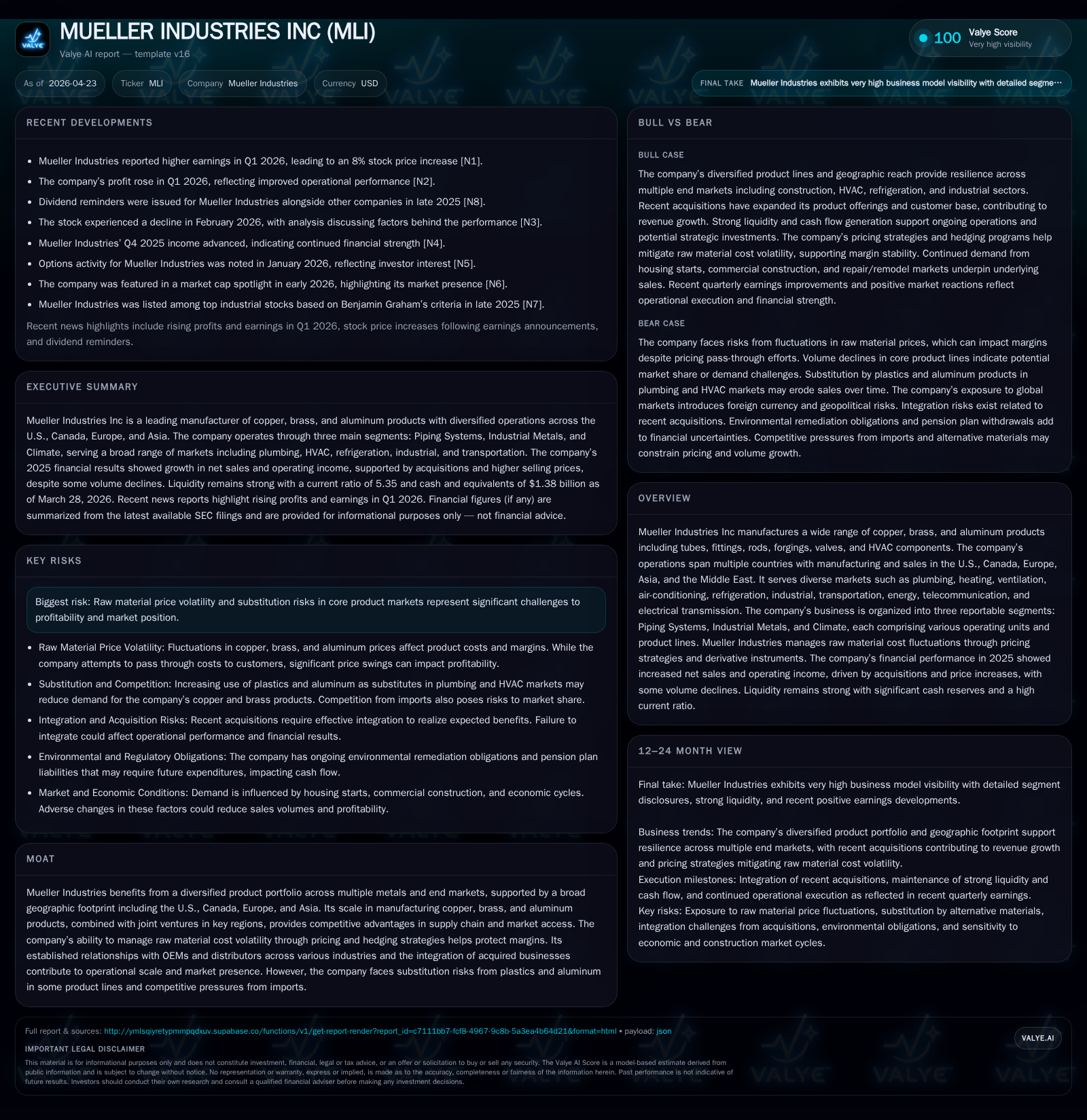
Mueller Industries showcased operational resilience and strategic asset reallocation in the first quarter of 2026, marked by the $41.4 million gain from divesting Sherwood assets. Driven by a diversified global product portfolio across piping, industrial metals, and climate segments, the company leverages pricing flexibility and hedging to mitigate input cost volatility. Growth prospects hinge on sustaining pricing power amid competitive substitution threats and managing environmental liabilities. Capital allocation remains disciplined with ongoing share repurchases and planned capex aimed at maintaining manufacturing effectiveness.
Recent Operating Update
Mueller Industries’ latest quarterly report (10-Q filed April 22, 2026) centers on a significant portfolio move: the sale of Sherwood’s outstanding membership interests generating a recognized gain of $41.4 million within the Industrial Metals segment before its disposition [S2][S7]. This divestiture aligns with management’s strategy to streamline operations and focus on higher-value segments during ongoing raw material price volatility.
The company’s comprehensive risk management regarding commodity exposures remains unchanged: derivatives are accounted for at fair value but only used for hedging forecasted transactions or mitigating economic exposure without engaging in trading activity [S2]. The protective stance reflects the increasing unpredictability of base metal prices.
Noteworthy also was Mueller’s continued denial of liability related to the Lead Refinery NPL environmental site while funding required remedial studies per EPA demands, backed by financial assurances totaling $1 million [S2]. Such environmental contingencies underscore ongoing regulatory risks inherent in metals manufacturing.
Business Model Overview
Mueller Industries manufactures an extensive range of products primarily made from copper, brass, aluminum, and other alloys. Its diversified business model is segmented into three reportable areas:
Piping Systems: Includes copper tube, fittings, line sets distributed domestically (U.S., Canada) and internationally (Europe and Middle East), serving plumbing wholesalers, HVAC OEMs, manufactured housing distributors [S1][S4][S6].
Industrial Metals: Comprises brass rod/bar/shapes, aluminum forgings and extrusions, specialty tubing, compressed gas valves and assemblies serving OEM customers in diverse sectors—industrial machinery, transportation, construction etc. The acquisition of Nehring in mid-2024 boosted this segment’s scale significantly [S1][S21].
Climate: Focuses on refrigeration valves/fittings, insulated ducting, HVAC components delivered primarily to North America’s heating/cooling markets [S7][S21].
Revenue recognition strategies emphasize intersegment sales eliminations but allow clear visibility into each sector’s contribution; FY2025 net sales totaled approx. $4.18 billion split roughly 64% Piping Systems, 24% Industrial Metals, and 12% Climate [S4][S7].
The company also supplements product lines with resale items including plastic valves and malleable iron fittings enabling broader market coverage. Strong OEM/distributor relationships create switching costs that underpin customer retention although pricing power can be challenged by import competition.
Industry Structure and Competitive Position
Mueller operates within highly competitive commodity-based metals manufacturing sectors where both raw material availability/pricing and substitute materials create persistent headwinds.
Copper tubing faces substitution threats primarily from plastic piping systems which continue capturing share due to lower cost and ease of installation—a structural trend placing pressure on Mueller's Piping Systems growth potential [S13][S23]. Similarly, aluminum alternatives challenge certain HVAC/refrigeration applications traditionally served by copper alloys.
The company mitigates these risks through scale advantages: broad manufacturing footprint spanning multiple countries enables supply chain flexibility. Joint ventures (e.g., Jungwoo-Mueller in South Korea; Mueller Middle East) enhance regional market access [S1][S4]. Acquisitions like Nehring expanded product breadth into value-added specialty metals used extensively by industrial OEMs.
Pricing mechanisms that link raw material costs with selling prices preserve margins to some extent despite volatile commodity markets [S13]. Hedging arrangements further cushion earnings against short term spikes though cannot fully neutralize macroeconomic shocks or tariff impacts.
However, industry consolidation among customers has shifted some pricing leverage downstream; larger buying groups can negotiate terms increasingly favorably potentially squeezing supplier margins especially during high raw material inflation.
Growth Drivers and Constraints
Drivers:
- Acquisitions: Strategic purchases such as Nehring have extended product offerings into higher margin specialty brass/forgings augmenting Industrial Metals revenue streams.
- Global Footprint Expansion: Continuation of joint ventures expands sales outside North America creating incremental growth avenues.
- Pricing Pass-through Capability: Flexible contracts tying prices to inputs allow timely adjustment protecting profitability when raw material costs rise.
- Demand from Infrastructure/Construction: Sustained residential/non-residential building activity supports steady demand for piping systems despite substitution trends [S23].
Constraints:
- Raw Material Volatility: Copper/aluminum price swings materially affect input costs requiring continuous recalibration of pricing; margins sensitive when pass-through lags or contract mix favors fixed prices [S13][S16].
- Substitution Risk: Growing adoption of plastics in plumbing plus aluminum in refrigeration limit unit volume gains.
- Trade Policy Uncertainty: Tariffs introduced or changed on metals sourced globally inject unpredictability affecting cost structure and customer demand cycles [S13].
- Environmental Liabilities: Ongoing remediation obligations can constrain capital deployment; new regulations targeting emissions may force additional spending on controls or carbon credits [S2][S16].
What to Watch Next
Key upcoming milestones include:
- New credit facility negotiation outcome replacing expiring $400 million revolver (matures March 31, 2026) will affect liquidity flexibility beyond Q2 2026 [S5][S15][S29].
- Execution details around reinvestment in manufacturing modernization as guided capex for 2026 targets $80–90 million capital spend emphasizing process upgrades for efficiency gains [S8][F1].
- Market response to raw material trends amid evolving tariff regimes around metals imports impacting contract renegotiations or volume recoveries.
- Progress on environmental remediation projects tied to EPA orders including any new claims affecting reserves reported as liabilities [S2].
- Pricing environment stability especially pass-through effectiveness seen in subsequent quarters impacting margin sustainability.
Financial Profile Synopsis
Historical performance (annual)
| FY | Net ($mm) | CFO ($mm) | OpInc ($mm) | Capex ($mm) | Net YoY |
|---|---|---|---|---|---|
| 2025 | 765 | 755 | 959 | 69 | +455.9% |
| 2024 | 138 | 646 | 770 | 80 | +15.4% |
| 2023 | 119 | 673 | 756 | 54 | -14.2% |
| 2022 | 139 | 724 | 877 | 38 |
Source: SEC companyfacts cache [F1].
Capital returns and efficiency (annual)
| FY | Buybacks ($mm) | FCF ($mm) | ROE% |
|---|---|---|---|
| 2025 | 244 | 687 | 23.8 |
| 2024 | 49 | 566 | 5.0 |
| 2023 | 19 | 619 | 5.1 |
| 2022 | 38 | 686 | 7.8 |
Source: SEC companyfacts cache [F1].
Mueller Industries finished fiscal 2025 displaying solid topline growth (+10.9% YoY) reaching $4.18 billion supported by acquisitions plus price increases offsetting volume softness from substitution impacts [F1]. Operating income jumped impressively +24.4% YoY to approx. $959 million underscoring margin expansion aided by improved pricing strategy execution.
Net income soared +455% YoY partly due to a low comparable base effect but also reflecting operational efficiencies and one-time gains including asset sales realized early in 2026 [F1]. Free cash flow remained healthy (~$686 million after capex) bolstering balance sheet strength which showed zero net debt entering 2026 alongside over $1.38 billion cash equivalents giving substantial liquidity headroom [F1][S5][S24]. Current ratio stands robust at ~5.35x reflecting conservative working capital management exceeding typical industrial peers [F1].
The company maintains an active capital return program highlighted by dividend hikes (quarterly increased each year since 2023 ending at $0.25 per share per quarter in 2025) coupled with significant share repurchase activity amounting to $243.6 million deployed last year reflecting confidence in intrinsic value creation via buybacks [F1][S9][S15].
Operational investments continue within manageable limits evidenced by controlled capex moderation (-14% YoY) prioritizing upgrades over expansion illustrating prudent stewardship given cost uncertainties [F1]. Overall return on equity approximates a robust ~24%, indicative of attractive profitability relative to equity base stabilized by growing retained earnings post-acquisition integration efforts [F1].
Disclaimer: This analysis is based solely on publicly available data up to April 23, 2026. It is intended for informational purposes without providing investment advice or recommendations.
Disclaimer: This is research-only, informational analysis and not investment advice. It may include AI-generated interpretation and general industry context. Always verify important details using primary sources.

Comments