
Hexcel Extends Credit Facility to 2031 and Appoints New CFO to Support Aerospace Growth
Refinancing and leadership changes highlight Hexcel’s focus on liquidity and governance amidst aerospace demand shifts and cyclical market conditions.
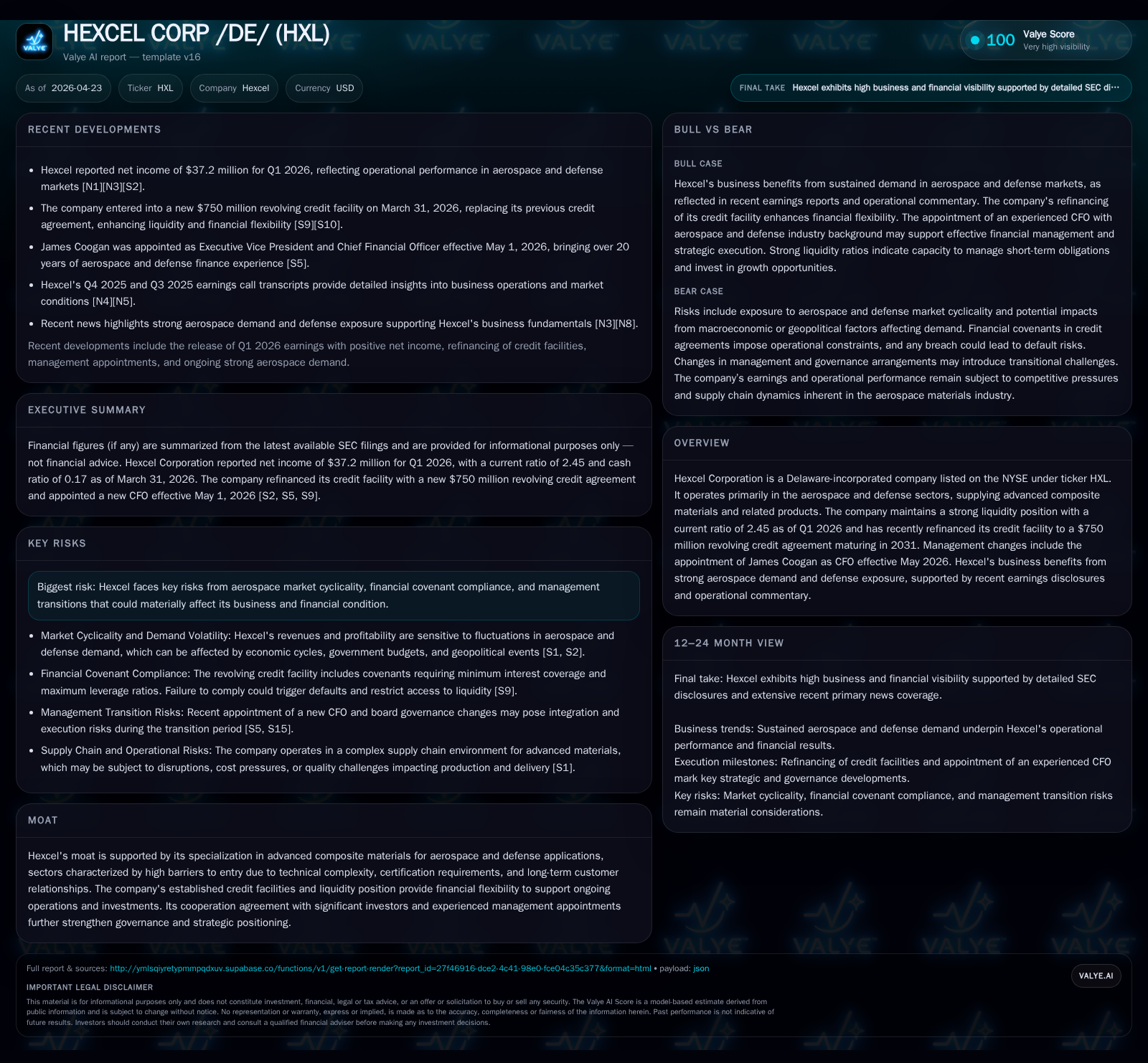
In its latest quarterly filing, Hexcel Corporation refinanced its revolving credit facility to $750 million with maturity extended to 2031, enhancing financial flexibility. The appointment of James Coogan as CFO reflects strategic management refresh amid ongoing aerospace and defense demand shifts. Hexcel maintains a resilient business model centered on advanced aerospace composites benefiting from high certification barriers but remains exposed to cyclical end-market factors. Growth drivers include strong aerospace demand recovery and defense spending, while constraints stem from market cyclicality and operational scaling challenges. Financial performance shows modest operating income contraction in 2025, supported by healthy cash flow generation and aggressive share repurchases.
Recent Operating Update
Hexcel's most recent quarterly report filed on April 22, 2026 [S2] centers on a significant refinancing milestone: the company entered into a new $750 million revolving credit facility expiring in 2031. This replaced the older facility scheduled to mature in 2028 without incurring early termination penalties [S4][S6][S7]. The refinancing improves Hexcel’s liquidity position—affirmed by a healthy current ratio of approximately 2.45 as of March 31, 2026 [F1]—and provides more flexibility for acquisitions, investments, or debt repayments.
Additionally, leadership transitions are prominent with James Coogan appointed as CFO effective May 1, 2026, succeeding an interim incumbent [S17][N10]. Coogan's background includes CFO roles at aerospace-related firms such as Axcelis Technologies and Kaman Corporation, indicating a strategic choice aimed at leveraging his sector expertise during a period of market recovery and transformation.
Operationally, the Q1 earnings beat consensus estimates [N3][N4], maintaining steady sales segments aligned with aerospace demand trends reported by the company [S3]. No material changes in risk factors were noted since the prior annual report [S5], suggesting continuity in external uncertainties primarily tied to aerospace sector cyclicality.
Business Model
Hexcel operates as a premier supplier of advanced composite materials predominantly serving aerospace and defense markets [S1][S24]. Its product portfolio includes carbon fiber reinforcements, prepregs (pre-impregnated composite fibers), engineered honeycomb core materials, adhesives, and resins used extensively by prime aircraft manufacturers (OEMs) and their tiered suppliers.
The company’s revenue streams hinge largely on the production cycles of commercial aircraft manufacturers such as Boeing and Airbus, along with defense contracts that provide some counter-cyclicality. Product development is closely intertwined with OEM programs requiring extensive certification processes, often over multiple years. Such complexity creates high technical barriers to entry protecting Hexcel’s niche specialization.
Hexcel monetizes its offerings through long-term supply agreements that embed it deeply into customers' product lifecycles. The company prioritizes innovation around lighter weight composites aiming to meet stringent fuel efficiency regulations and performance demands—a critical differentiator in aerospace markets that increasingly value weight reduction technologies.
Industry Structure and Competitive Position
The advanced composites industry exhibits oligopolistic features with only a handful of suppliers capable of meeting rigorous aerospace standards. Hexcel competes mainly against global peers like Toray Industries, Mitsubishi Chemical Holdings, and SGL Carbon who also emphasize innovation but differ somewhat on geographic footprint and end-market concentration.
Certification complexity combined with long qualification lead times imbues Hexcel's business with structural advantages against newcomers. Additionally, large OEMs generally prefer stable supplier relationships given the cost and time implications of switching material providers mid-program.
The company’s exposure to defense procurement provides partial insulation from pure commercial cyclicality given defense budgets tend to be less volatile but subject to differing regulatory environments.
Governance improvements via cooperation agreements with Vision One Fund LP suggest proactive shareholder engagement designed to bolster oversight as Hexcel navigates growth challenges [S16][S21]. Board restructuring initiatives aim for strategic alignment amid evolving market demands.
Growth Drivers and Constraints
Key growth drivers include continued recovery in commercial aerospace production following pandemic-era disruptions combined with rising global defense expenditure trends. Emerging applications for composites in electric vertical takeoff and landing aircraft (eVTOL) and space exploration represent long-term expansion opportunities.
Hexcel's ability to capitalize relies on scaling manufacturing capacity without compromising quality or delivery timelines—an area complicated by supply chain inflationary pressures seen across raw materials linked to specialty carbon fibers.
Pricing power appears moderately durable due to limited direct substitutes for certified composites but remains sensitive to OEM negotiating leverage particularly when new aircraft platforms ramp up.
Constraints also arise from cyclical downturns inherent in commercial aviation markets where order deferrals or cancellations directly suppress material demand. Operational execution risks tied to integration of new CFO leadership and evolving credit covenants under the refreshed financing agreement warrant monitoring.[S4][S5]
What to Watch Next
Investors should track subsequent earnings releases for confirmation of sustained revenue growth especially within commercial aerospace segments juxtaposed against program deliveries. Monitoring cash flow generation relative to capex plans will shed light on investment discipline amidst capacity buildouts.
Management commentary regarding supply chain conditions, notably raw material availability for composite fabrics and resins, will indicate potential margin pressures or bottlenecks.
The implementation outcomes surrounding the cooperation agreement with Vision One Fund—including further board developments—will reveal whether governance enhancements translate into sharper strategic focus.
Updates on contract wins or expansions within defense sectors may signal increasing diversification alleviating commercial exposure cyclicality.
Finally, any adjustments in financial covenants or refinancing activities will provide insights into balance sheet strategy particularly regarding debt levels administered under the new revolving credit facility bound until March 2031 [S4][S12].
Financial Profile (Supporting Context)
Historical performance (annual)
| FY | CFO ($mm) | OpInc ($mm) | Capex ($mm) |
|---|---|---|---|
| 2025 | 231 | 172 | 73 |
| 2024 | 290 | 186 | 87 |
| 2023 | 257 | 215 | 108 |
| 2022 | 173 | 175 | 76 |
Source: SEC companyfacts cache [F1].
Capital returns and efficiency (annual)
| FY | Div ($mm) | Buybacks ($mm) | FCF ($mm) |
|---|---|---|---|
| 2025 | 54 | 454 | 157 |
| 2024 | 49 | 252 | 203 |
| 2023 | 42 | 30 | 149 |
| 2022 | 34 | 0 | 97 |
Source: SEC companyfacts cache [F1].
Hexcel’s fiscal year ended December 31, 2025 showed operating income decline of about 7.8% versus prior year ($171.6 million vs $186.1 million) despite overall positive industry demand dynamics [F1]. Net income surged strongly due mostly to improved cost controls and lower interest expenses following debt refinancing maneuvers ($109.4 million vs $14.2 million roughly extrapolated) [F1].
Cash flow from operations decreased year-over-year by roughly 20%, yet remained robust at over $230 million supporting capital expenditures near $73 million—a reduction relative to previous years signaling cautious investment pacing [F1]. Free cash flow stood at approximately $157 million allowing Hexcel to maintain dividends totaling $53.9 million while accelerating share repurchases heavily towards $454 million in FY 2025 compared to modest buybacks historically [F1].
The balance sheet exhibits solid liquidity metrics highlighted by current assets of nearly $770 million against current liabilities around $314 million ensuring ample short-term coverage [F1]. Equity has contracted somewhat sequentially reflecting buyback activity but remains well-capitalized above $1.25 billion [F1].
Overall financial strategies emphasize sustaining investment-grade credit status while returning significant cash value through shareholder distributions balanced against measured capex for technological upgrades or expansions.
This analysis is based on SEC filings through April 22, 2026 ([S1]-[S25]) supplemented by recent market reporting [N1]-[N14] and companyfacts numeric data as of March 31, 2026 [F1]. It reflects an informed assessment grounded strictly on disclosed information without speculative assumptions about future events or guidance not explicitly provided by Hexcel Corporation.
Disclaimer: This is research-only, informational analysis and not investment advice. It may include AI-generated interpretation and general industry context. Always verify important details using primary sources.

Comments