
Mesabi Trust Faces Royalty Volatility with Falling Bonus Payouts
Recent SEC filings reveal notable declines in Mesabi Trust’s bonus royalties, reflecting challenges linked to iron ore pricing and mine production strategies.
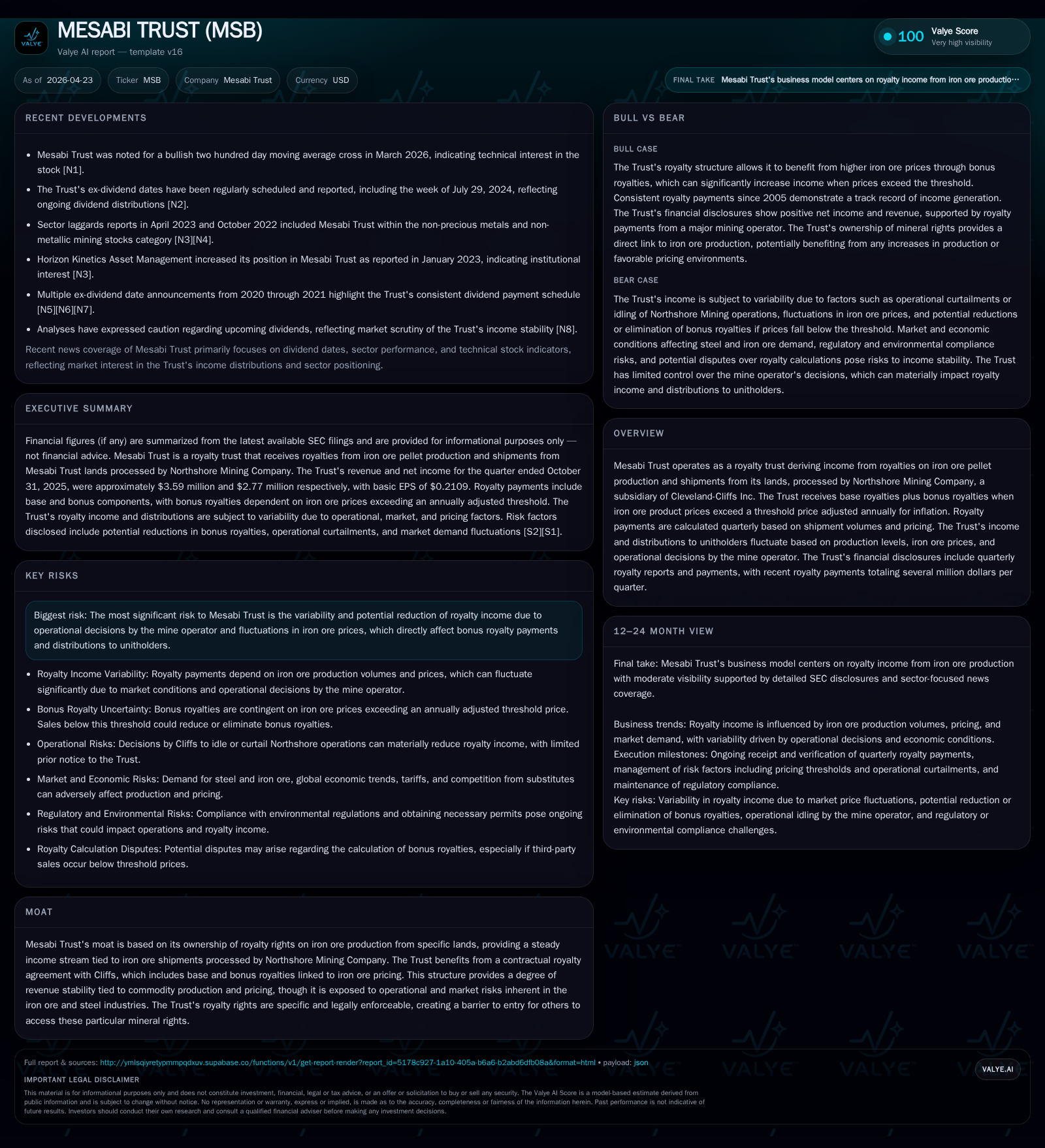
Mesabi Trust’s latest quarterly 10-Q and recent 8-K filings disclose a sharp reduction in bonus royalty distributions resulting from lower iron ore prices relative to contractual thresholds. This decline underscores the inherent volatility of the Trust’s cash flows, tightly linked to third-party transaction prices and Northshore Mining's production decisions. While the Trust benefits from exclusive royalty rights with structured base and tiered bonus payments, its income remains vulnerable to external commodity pricing and operational risks by Cleveland-Cliffs’ subsidiaries.
Latest Royalty Income Decline Highlights Near-Term Challenges
The most recent quarter ended December 31, 2025, reported in Mesabi Trust’s December 12, 2025 Form 10-Q [S2], alongside the April 14, 2026 8-K distribution announcement [S3], reveals material volatility in royalty income streams that directly affected unitholder payouts. The Trust received base royalties of approximately $3.62 million but witnessed a more pronounced drop in bonus royalties to $1.04 million for the quarter—significantly below historical levels that once supported higher distributions.
This reduction drove a steep cut in declared distributions from $0.56 per unit during the comparable prior-year quarter down to $0.24 per unit currently [S3]. The Trustees explicitly noted their inability to project whether future shipments would continue to sell at prices above the inflation-adjusted bonus royalty threshold (set at $69.41/ton for calendar year 2025) [S2]. Notably, while over 98% of last year's shipments were sold above prior thresholds, this level of premium pricing has not persisted into recent quarters.
The decreased bonus payouts highlight acute exposure of Mesabi Trust’s cash flow stability to short-term variations in third-party iron ore pellet pricing coupled with fluctuating shipment volumes controlled operationally by Cleveland-Cliffs' subsidiary Northshore Mining.
Mesabi Trust’s Royalty Model: Base and Bonus Tiers Explained
Mesabi Trust generates income primarily through royalties from iron ore product shipments mined from its lands and processed at Northshore Mining Company facilities—a Cliffs Inc. subsidiary—as detailed in its annual report [S1] and recent filings [S2].
The core revenue model consists of:
- A base royalty, a fixed percentage applied to all tons shipped regardless of pricing.
- A tiered bonus royalty paid only when product sales exceed an annually adjusted threshold price per ton designated each calendar year.
For calendar year 2025, this threshold was set at $69.41 per ton (adjusted for inflation) [S2]. Bonus royalties start at half a percent on gross proceeds for products priced between the threshold and $2 above it, scaling up incrementally to a maximum 3% royalty on all tonnage shipped where sales are priced $10 or more above that threshold.
This tiered structure creates significant leverage to high-price environments but also exposes the Trust’s payouts to sharp declines if product selling prices fall below these benchmark levels or if non-bona fide third-party transactions occur below thresholds that complicate bonus royalty calculations [S2]. Such pricing ties make the income model inherently cyclical and dependent on Cleveland-Cliffs’ external sales strategies.
Industry Backdrop: Iron Ore Pricing and Mine Operator Impact
Mesabi Trust’s performance is embedded within critical upstream factors shaping iron ore pellet market dynamics. Given Northshore Mining functions as both operator and processor, its production scheduling decisions—including sporadic idling events such as the May 2022–April 2023 shutdown documented elsewhere—influence volumes significantly [S9].
Commodity-price fluctuations driven by global steel demand cycles profoundly affect realized product selling prices—impacting bonus royalty triggers directly [S4][S5]. Furthermore, regulatory uncertainties around environmental permits can lead to unexpected production interruptions that compress shipment volumes and thus contractual royalties due.
Unlike mining entities fully exposed operationally or through ownership stakes in equipment or reserves, Mesabi Trust's revenues depend solely on third-party transactions dictated largely by Cliffs’ pricing policies—including whether intercompany shipments meet bona fide arms-length standards requisite for bonus payment validation [S7][S8]. This dependency imposes uncertainty due both to fluctuating market demand/supply balance as well as internal operational choices by mine operators beyond the Trust’s control.
Competitive Positioning Through Royalty Rights and Contract Terms
Within the broader iron ore ecosystem comprising miners, processors, steel manufacturers, traders, and infrastructure providers, Mesabi Trust occupies a distinct niche as a royalty trust owning exclusive rights on specific mineral lands near Silver Bay. The legally binding royalty agreement with Cliffs ensures a steady methodology for revenue derivation tied definitively to physical shipments processed from those lands.
This exclusivity constitutes a moat against competitors attempting entry via mineral ownership—rights are specific and cannot be substituted or replicated easily [S1]. Furthermore, the tiered bonus mechanism provides upside potential aligned with premium steel-making pellet markets when favorable pricing exists.
However, this structural strength is balanced by legal complexities emerging around calculation disputes—highlighted recently by arbitration initiated by Mesabi Trust against Northshore Mining concerning operation shutdowns and alleged underpayment on intercompany shipments since mid-2022 [S22]. Such potential legal friction marks a notable risk dimension affecting trust predictability despite technically enforceable agreements.
Drivers Shaping Future Growth and Constraints on Cash Distributions
Future growth prospects are closely tethered to factors including:
- Sustained or rising iron ore pellet prices exceeding annual adjusted thresholds enabling meaningful bonus royalties.
- Consistent or increased volumes of physical shipments from Mesabi Trust lands operated by Northshore Mining.
- Resolution of ongoing disputes with operator Cliffs over past royalty calculation practices potentially unlocking withheld payments or clarifying payout standards.
Conversely, downside constraints arise from sputtering global steel production demand adversely impacting iron ore prices below thresholds necessary for additional bonuses; moreover, any reoccurrence of operational curtailments akin to previously experienced idling periods could drastically reduce base shipment volumes causing parallel declines in base royalties [S7][S8][S9][S20].
Additionally, limited transparency into forthcoming operator strategies concerning customer sales pricing or shifts toward internal rather than third-party transactions further obscures reliable forecasting.
Monitoring Triggers: Pricing Thresholds, Production Levels, and Contractual Clarity
COVID-19 disruptions previously underscored risks associated with abrupt operator decisions; going forward, investors should monitor key milestones including:
- Quarterly shipment volume disclosures by Cliffs detailing physical tons sourced specifically from Mesabi lands [S25][S26].
- Reported pricing benchmarks particularly adherence of third-party sales exceeding annual inflationally adjusted thresholds triggering tiered bonuses [S2][S3].
- Trustee communications on distribution declarations signaling recovery or continuation of diminished payouts.
- Public developments arising from arbitration proceedings versus Cliffs potentially settling dispute over intercompany sale structures impacting payout basis [S22].
Such markers will provide empirical cues on whether payout volatility trends abate or intensify amid evolving market conditions.
Financial Performance Snapshot: Revenue, Distributions, and Cash Flow
Quantitatively, Mesabi Trust has exhibited significant volatility reflective of its commodity-linked business model yet achieved strong recent profitability primarily driven by high past iron ore prices boosting both revenue base and bonuses ([F1]). Key figures include:
Historical performance (annual)
| FY | Rev ($mm) | Net ($mm) | CFO ($mm) | Rev YoY | Net YoY |
|---|---|---|---|---|---|
| 2025 | 99 | 93 | 94 | +331.3% | +391.3% |
| 2024 | 23 | 19 | 15 | +1152.5% | +729.6% |
| 2023 | -2 | -3 | 14 | -112.1% | -117.3% |
| 2022 | 18 | 17 | 63 |
Source: SEC companyfacts cache [F1].
Capital returns and efficiency (annual)
| FY | Div ($mm) | ROE% |
|---|---|---|
| 2025 | 18 | 399.8 |
| 2024 | 5 | 90.5 |
| 2023 | 48 | -26.4 |
| 2022 | 38 | 56.6 |
Source: SEC companyfacts cache [F1].
Though healthy revenue growth reflects robust commodity cycles culminating in FY25,[F1] dividend payments have displayed sharp fluctuations—markedly declining recently following lower bonus payouts highlighted in Q4 2025 reports indicating tightening free cash flow distributable capacity.[S2][S3]
The footnotes caution about inherent quarter-to-quarter variability characteristic of trusts wholly reliant upon external operators’ commercial practices rather than direct operational control.[S7]
This analysis is grounded exclusively on disclosed SEC filings and publicly available data without any investment recommendation.
Disclaimer: This is research-only, informational analysis and not investment advice. It may include AI-generated interpretation and general industry context. Always verify important details using primary sources.

Comments