
Loews Corporation: Diversification and Capital Discipline Driving Resilience in Financial Services
Loews leverages a multi-industry portfolio and strategic capital management to bolster growth and stability amid cyclical and sector-specific risks.
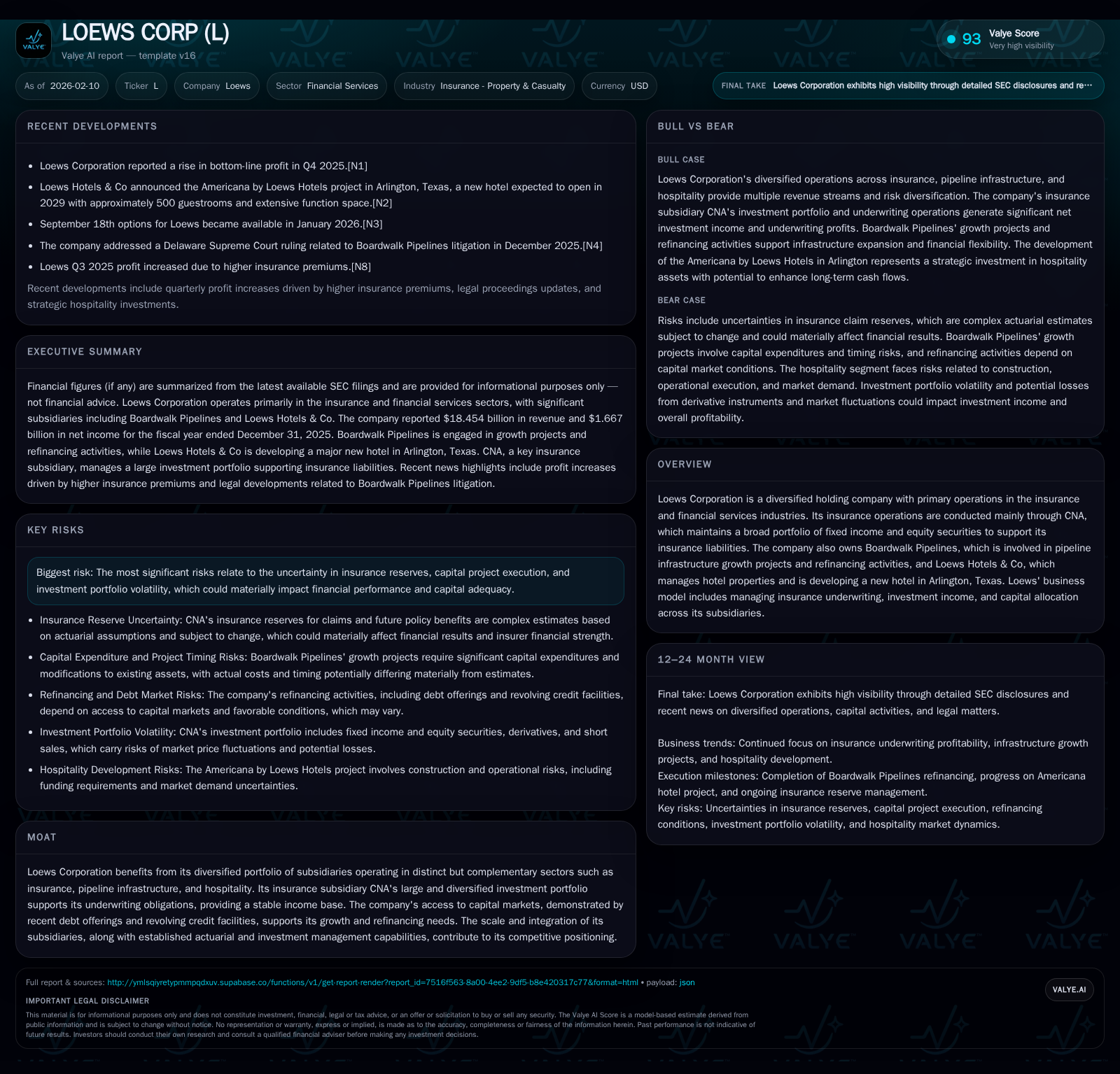
Loews Corporation showcased robust Q4 2025 results reflecting strength beneath its diversified operations spanning insurance, pipelines, and hospitality. Its insurance arm, CNA, anchors underwriting stability through a large investment portfolio supporting liabilities, while Boardwalk Pipelines advances growth projects underpinned by prudent capital market access. Meanwhile, Loews Hotels pursues strategic expansion, notably with its Arlington Americana development. The company’s governance frameworks and risk oversight foster resilience despite inherent volatility in insurance reserves and capital project execution. Collectively, Loews’ business model demonstrates adaptive management of sectoral challenges through disciplined capital allocation.
Q4 Momentum: Earnings Reveal Strength Beneath the Surface
Loews Corporation came into early 2026 buoyed by a notable Q4 2025 earnings beat that provided tangible evidence of underlying operational health across its diversified portfolio. Reporting a net income of approximately $1.67 billion for the full year ended December 31, 2025, consistent with analyst expectations, the quarter served as a confirmation point for the company’s execution prowess amid varied market backdrops [N1][F1]. This financial performance was not an isolated outcome but rather the result of coordinated success across Loews' primary business segments: insurance underwriting through CNA, pipeline infrastructure via Boardwalk Pipelines, and hospitality led by Loews Hotels & Co. Each segment plays a calibrated role in generating sustainable cash flow while navigating macroeconomic pressures.
The Pillars of Diversification: Insurance, Pipelines, and Hospitality
The essence of Loews Corporation’s competitive advantage resides in its carefully curated diversification spanning three core sectors that complement each other’s cash flow volatility profiles [valye_report_excerpt]. CNA Insurance represents the bedrock underwriting business; it generates recurring premium-based income complemented by realized gains from its investment portfolios. Boardwalk Pipelines contributes regulated infrastructure cash flow underpinned by long-term contracts while simultaneously engaging in organic growth projects aimed at capacity expansion. Loews Hotels pools real estate assets within premier properties offering both stable lodging revenues and asset appreciation potential through redevelopment efforts.
This tripartite structure balances cyclical dynamics intrinsic to financial services with more contractually predictable pipeline revenues alongside opportunity-driven hospitality asset development.
CNA’s Investment Portfolio: The Backbone of Underwriting Stability
A standout feature within Loews’ conglomerate model is CNA’s substantial investment portfolio that supports its insurance liabilities. With diversified allocations across fixed income securities—emphasizing quality credit instruments—and select equity holdings, CNA mitigates underwriting risk through steady investment income streams [valye_report_excerpt]. This prudent asset-liability management supports loss reserves and bolsters capital adequacy during periods of claims volatility or adverse loss trends.
The robustness of CNA’s portfolio acts as a stabilizer when underwriting results fluctuate due to natural catastrophe events or changes in economic conditions affecting claim frequency or severity.
Boardwalk Pipelines in Focus: Navigating Growth Projects and Capital Needs
Boardwalk Pipelines remains at the forefront of Loews’ growth narrative within infrastructure. As disclosed in the latest filings, it holds binding purchase commitments totaling roughly $355 million related to ongoing pipeline enhancement initiatives expected to resolve by 2028 [S1]. These growth projects generally involve modifications aimed at increasing throughput capacity or adapting to evolving commodity flow patterns driven by market demand shifts.
To finance these expansions alongside debt maturities, Boardwalk successfully completed a $550 million offering of senior notes due 2036 at a favorable coupon rate of 5.4% late in 2025, replacing near-term maturities carrying higher interest costs [S1]. Alongside this issuance, it maintains full availability under a $1 billion revolving credit facility renewed through November 2030—a crucial liquidity buffer enabling flexible capital deployment.
The combination of committed growth capital expenditures with conservative liquidity management highlights Boardwalk’s disciplined approach to balancing expansion ambitions with financial prudence.
Hospitality Expansion: Americana by Loews Hotels’ Strategic Bet
In parallel with its financial services footprint, Loews continues to leverage real estate development opportunities within hospitality via Loews Hotels & Co. The announcement in January 2026 to replace the existing Arlington Sheraton Hotel with Americana by Loews Hotels signals an intent to reposition key assets toward higher-value branded experiences tailored to evolving consumer preferences in the hotel sector [N2][S1].
This development aligns with prior refinancings totaling $363 million executed during 2025 that enhanced capital structure flexibility for such transformative projects. The acquisition of noncontrolling interests at two hotel properties earlier also consolidates ownership control enhancing overall operational coherence.
Such investments reflect a strategic pivot toward curating premier hospitality offerings that can capture higher ADRs (average daily rates) and improved occupancy metrics over time.
Capital Markets as a Catalyst: Refinancing, Debt Strategy, and Liquidity
Central to sustaining its multi-industry strategy is Loews’ adept access to capital markets—a lifeline vital for managing refinancing cycles and funding growth initiatives efficiently. Recent transactions illustrate this acumen: Boardwalk's senior note issuance replaced costlier maturing debt seamlessly without impairing balance sheet integrity [S1][F1]. The extension and full capacity availability under its credit revolver provide further liquidity assurance.
Similarly, Loews Hotels’ refinancing activities illustrate effective liability management designed to optimize maturities while minimizing interest expense variability. Across the conglomerate, maintaining investment-grade credit ratings—BBB-level ratings stable from S&P, Moody's Baa2 stable outlook—ensures favorable borrowing conditions which are instrumental for competitive financing costs and preserving shareholder value.
Governance and Risk Oversight: Cybersecurity & Operational Vigilance
Loews underscores risk governance by embedding cybersecurity oversight directly within its highest governance strata. The Audit Committee holds explicit responsibility for reviewing cyber risk management across corporate parent and subsidiaries [S1]. Senior IT leaders, including CIOs/CISOs at each entity level, develop tailored cybersecurity programs responsive to regulatory environments unique to their industries.
These structured reporting channels enable timely escalation of threats or incidents ensuring enterprise-wide situational awareness. Given the diverse nature of operations spanning insurance underwriting systems to pipeline operational technology control networks and hospitality property management platforms, such comprehensive cyberecurity vigilance remains critical.
Balancing Act: Managing Volatility Across Sectors and Investments
Despite structural strengths afforded by diversification, Loews confronts inherent risks well articulated in regulatory disclosures highlighting three principal areas: unpredictability surrounding insurance reserves due to claim developments; volatility stemming from fixed income/equity investment fluctuations; execution risks tied to capital-intensive pipeline expansion projects [valye_report_excerpt][S1][S2].
Notably, recent quarterly filings affirm no material changes in these identified risk factors underscoring steady risk monitoring practices [S2]. The complexity lies in dynamically aligning reserve adequacy assumptions with emerging claims patterns while ensuring investment strategies hedge effectively against market downturns without sacrificing yield potential.
Capital project delivery remains subject to timing uncertainties influenced by permitting hurdles or supply chain constraints amplified since pandemic disruptions; thus contingency planning remains embedded within project governance.
Investor Takeaways: Where Loews Stands in Financial Services Today
Synthesizing these threads reveals Loews Corporation as a multifaceted conglomerate proficiently leveraging sector diversification paired with disciplined capital allocation strategies. The dependable underwriting revenue base fortified by CNA's sizable investment assets cushions against economic cycles faced by more volatile segments like pipeline expansions requiring substantial upfront capital or hotel redevelopment contingent on travel recovery trajectories.
From the perspective of buy-side analysts scrutinizing financial services exposure today, Loews offers an intriguing case study balancing yield-oriented insurance investment income streams alongside infrastructural growth aspirations tempered with measured leverage tactics. However, vigilance over evolving insurance reserve adequacy assumptions amidst inflationary cost shifts remains paramount given historical industry surprises.
Similarly, sustaining pipeline project execution timelines without excessive cost overruns will be essential for delivering anticipated value accretion. On the hospitality front, success depends on capturing post-pandemic demand normalization plus margin enhancements through brand repositioning strategies such as Americana by Loews Hotels.
Overall, Loews manifests a nuanced resilience shaped by sectoral offsets baked into its portfolio—a reflection not merely of holding companies managing disparate businesses but an integrated approach emphasizing financial discipline anchored firmly within governance frameworks.
The foregoing analysis is based on publicly available information as of February 10, 2026 and does not constitute investment advice or recommendation. Readers should conduct their own due diligence before making any financial decisions concerning securities discussed herein.
Disclaimer: This is research-only, informational analysis and not investment advice. It may include AI-generated interpretation and general industry context. Always verify important details using primary sources.

Comments