
Liberty Energy Inc.: Bridging Traditional Hydraulic Fracturing Excellence with Next-Gen Distributed Power
LBRT leverages scale, proprietary technology, and strategic acquisitions to navigate the evolving energy landscape.
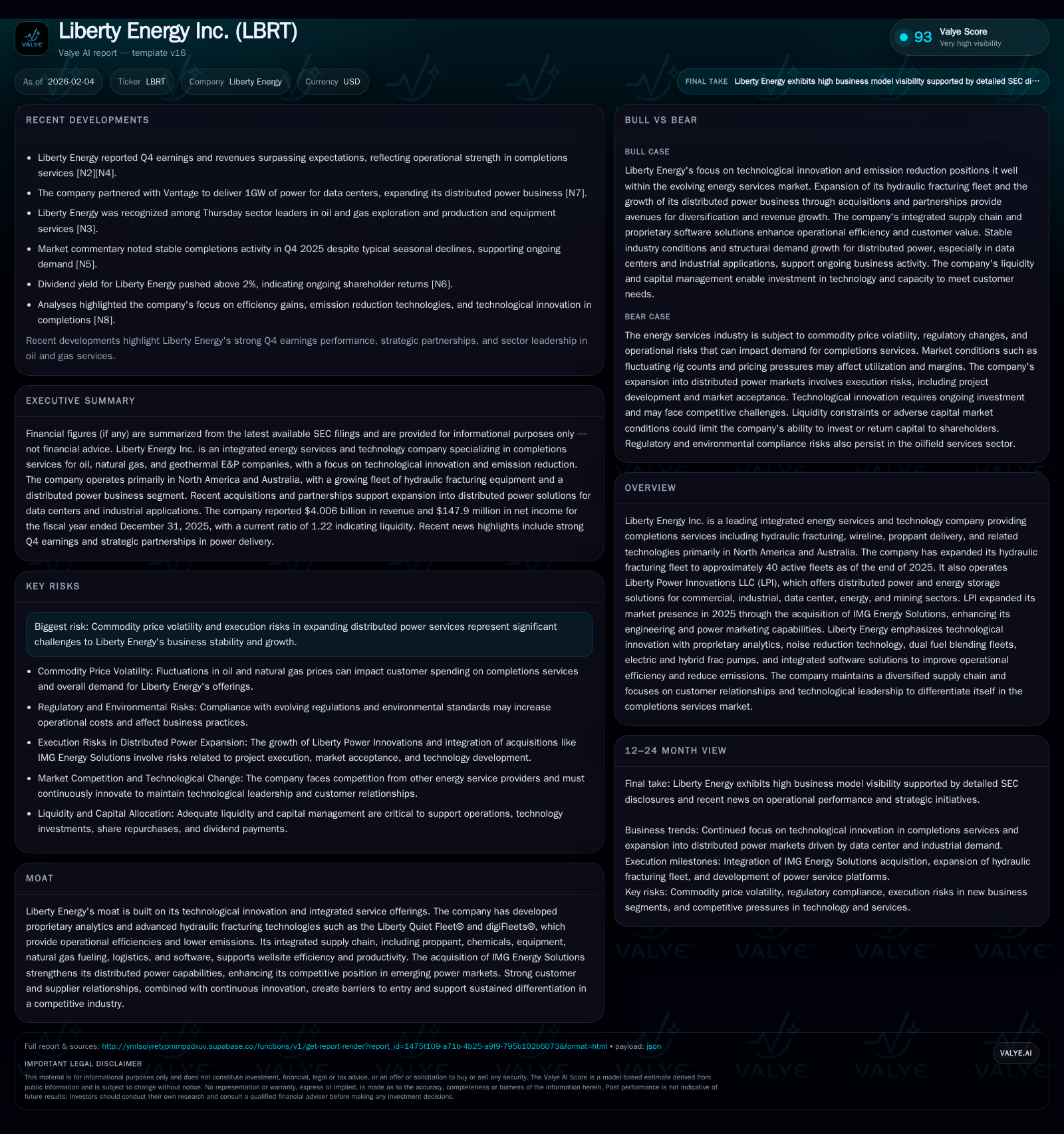
Liberty Energy has rapidly expanded its hydraulic fracturing fleet from a single unit in 2011 to approximately 40 by the end of 2025, underpinning its significant operational footprint in North America and Australia. Its technological innovations — including the Liberty Quiet Fleet®, digiFleets®, and dual fuel blending technologies — fortify a competitive moat through efficiency and emissions reductions. Complementing its core oilfield services, Liberty Power Innovations’ acquisition of IMG Energy Solutions marks a decisive move into distributed power markets serving commercial and industrial sectors. While commodity price volatility and execution challenges in the distributed power expansion remain risks, the company's strong balance sheet and capital return programs reflect financial resilience. Market sentiment shows cautious optimism, balancing Liberty's growth prospects with inherent sector cyclicality.
From Fleet Expansion to Competitive Edge: Liberty Energy’s Scale Advantage
Liberty Energy’s transformation from a modest presence with a single hydraulic fracturing fleet in December 2011 to operating approximately 40 active fleets by the close of 2025 signals a deliberate scaling strategy grounded in operational breadth. This fleet expansion primarily covers major shale formations across North America and extends into Northern Australia’s resource-rich Northern Territory [S1].
Scale benefits for Liberty are multi-fold: first, enhanced geographic coverage enables proximity to multiple drilling sites reducing logistics complexity; second, having a sizable fleet allows flexible deployment which improves service reliability during peak demand periods; third, the scale supports cost efficiencies through better asset utilization and consolidated maintenance operations. This expansion underpins Liberty’s ability to offer fast turnaround times – a critical competitive factor as E&P operators face increasingly complex well designs requiring intense fracturing workloads.
Additionally, the scale advantage facilitates integrated supply chain management extending beyond equipment fleets to proppant delivery and on-site natural gas fueling services. This holistic integration further cements Liberty’s role as an indispensable partner for large-scale completion projects [S1].
Innovation Engine: Proprietary Technologies that Define Liberty's Moat
Beyond sheer scale, Liberty’s moat is constructed heavily on technological differentiation. The company has pioneered several proprietary offerings designed to boost operational efficiency while decreasing environmental impact.
The Liberty Quiet Fleet® exemplifies innovation focused on noise mitigation—a major concern near populated areas—allowing hydraulic fracturing operations without significant community disruption or regulatory friction [S1]. Meanwhile, the digiFleets®, including digiFrac® and digiPrime® electric and hybrid frac pumps, represent a leap toward next-generation completions technology offering roughly 25% lower CO2e emissions compared to conventional Tier IV diesel engines. Such emission reductions not only align with tightening environmental regulations but help customers advance their own decarbonization efforts [S1].
Complementing hardware advancement is Liberty’s suite of internally developed software solutions embedding advanced analytics. These systems leverage extensive data sets on unconventional wells applying multi-variable statistical techniques to optimize fracture designs—translating into better resource recovery and cost savings [S1].
Moreover, dual fuel dynamic gas blending (DGB) technology enables flexible engine operation on diesel or mixed diesel-natural gas fuels optimizing fuel costs while curbing emissions—a particularly salient feature given fluctuating fuel price environments [S1]. Collectively these innovations construct high barriers for peer entrants by necessitating significant R&D investments as well as complex integration capabilities.
Powering Forward: The Strategic Growth of Liberty Power Innovations
Liberty’s foresight into distributed power is concretized through its wholly-owned subsidiary Liberty Power Innovations LLC (LPI). Initially established to support powering its advanced frac fleets—especially digiFleets®—LPI broadened ambitions significantly in 2025 with the acquisition of IMG Energy Solutions for approximatively $19.6 million cash consideration [S1]. IMG brought critical assets spanning custom engineering design for distributed power systems along with sophisticated power marketing expertise.
This acquisition strategically aligns LPI’s offering to serve robust growth sectors such as commercial real estate, data centers (including a noted partnership targeting delivery of over 1GW power capacity), industrial facilities, and mining operations [N10][S1]. By augmenting its technical depth and expanding into utility interconnection consulting alongside operations/maintenance capabilities, LPI positions itself as an integrated solution provider rather than just an equipment vendor.
Developing an end-to-end power service platform coupled with expanded natural gas fueling infrastructure reinforces LPI’s ability to meet rising demand for lower-cost reliable power especially where grid constraints or sustainability targets elevate onsite generation importance [S1]. This pivot diversifies Liberty’s revenue base beyond traditional oilfield services—a notable hedge against cyclicality—and situates it within emergent clean energy transitions.
Financial Fortitude Amid Commodity Volatility
Liberty concluded fiscal year 2025 with revenues surpassing $4 billion USD accompanied by net income near $148 million USD [F1]. The company maintains healthy liquidity metrics highlighted by current assets around $878 million versus current liabilities about $720 million yielding a current ratio of approximately 1.22—indicating prudent balance sheet management which offers flexibility for capital investments or weathering industry downturns [F1].
Financial results from recent quarterly releases have consistently beaten market expectations reflecting successful execution amidst ongoing oil price fluctuations which notoriously impact completions demand levels [N2][N3]. Such resilience underscores management’s ability to optimize operational efficiency while capturing pricing power from differentiated technology offerings.
While upstream market cyclicality remains an overarching challenge affecting all service providers, Liberty benefits from diversified service lines—including LPI—and integrated supply chains that help modulate margin pressures compared to peers more singularly focused on fracturing services alone.
Navigating Risks: Execution Challenges and Market Uncertainties
As disclosed in filings [S1][S2], two principal risk vectors stand out for Liberty: commodity price volatility inherent in hydrocarbon markets; and execution risks tied to scaling the nascent distributed power segment.
Volatility manifests via fluctuating oil & gas activity levels influencing fleet utilization rates directly impacting revenue streams—a persistent sector-wide headwind outside company control. Additionally, distributed power ventures face hurdles ranging from regulatory uncertainties across jurisdictions to technical complexity deploying advanced systems at scale plus customer adoption variability.
Execution missteps or cost overruns related to new product launches or acquisitions like IMG Energy could impede anticipated margin expansion or stall market penetration. Moreover, customer concentration or supplier dependency remain latent risks amplified amid global supply chain disruptions.
The firm’s candid disclosures indicate management awareness and preparedness but also signal that these challenges present real constraints on near-term upside absent mitigating factors.
Capital Allocation Priorities: Share Repurchases, Dividends, and Investments
Management has adopted a balanced capital return policy reflective of confidence in underlying fundamentals yet cognizant of volatile sector dynamics. Since initiating quarterly cash dividends in December 2022—which are subject to board discretion—Liberty complements distributions with aggressive share repurchase mandates.
Notably, the Board authorized an expanded repurchase program cumulatively up to $750 million extending through July 2026 [S1]. Such buybacks provide shareholders value enhancement potential while signaling conviction about intrinsic business strength amidst market uncertainty.
Concurrently investments continue flowing toward technology development (particularly digiTechnologies), supply chain integration enhancements, and LPI platform buildout illustrating capital deployment aimed at sustaining competitive differentiation alongside shareholder returns.
Market Sentiment and Analyst Perspectives on Liberty’s Trajectory
Investor dialogue around Liberty oscillates between recognition of demonstrated growth metrics — materially beating Q4 earnings consensus as recently reported — and measured caution for cyclical headwinds ahead [N2][N3][N7]. The Piper Sandler upgrade underscores institutional reaffirmation of LBRT’s franchise value though other market voices counsel a ‘hold’ stance reflecting macro sensitivities even amid operational momentum [N11].
Encouraging commentary surrounding technological leadership juxtaposes against the fundamental uncertainty stemming from commodity markets—a dynamic common across energy equipment & services names but accentuated here given LBRT’s dual focus on legacy fracturing alongside distributed power evolution [N8].
This nuanced market narrative suggests increasing investor sophistication attentive both to short-term earnings beats as well as longer-term structural positioning within shifting energy paradigms.
Sustainability Commitments and Environmental Impact Reduction Strategies
Environmental stewardship forms an integral part of Liberty’s corporate agenda evidenced through various proprietary innovations designed explicitly for emissions mitigation. The digiFleets® demonstrate approximately 25% lower carbon dioxide equivalent emissions relative to standard Tier IV DGB machineries—a material reduction given fracturing operations traditionally carry high energy intensity footprints [S1].
Furthermore, the Liberty Quiet Fleet® reduces acoustic disturbances facilitating compliance with local noise ordinances often encountered near populated drilling locations.
Mine operations comply stringently with federal health and safety regulations underscoring responsibility towards worker welfare while supporting regulatory adherence in resource extraction processes [S1].
These attributes align decisively with increasing ESG investment priorities among institutional buyers seeking exposure to energy firms that proactively tackle carbon footprints without sacrificing performance.
Customer & Supplier Ecosystem: Building Barriers and Enhancing Loyalty
A cornerstone differentiator resides in Liberty's tightly integrated supply chain encompassing proppant sourcing from proprietary sand mines, chemicals tailored for reservoir-specific applications, field gas processing units providing compressed natural gas fueling options, specialized logistics networks coordinating material flow—all seamlessly linked through proprietary software platforms enhancing transparency and responsiveness [S1].
Such ecosystem depth fosters customer stickiness producing meaningful switching costs for operators who value coordinated comprehensive completions solutions over fragmented vendor assemblage. Simultaneously strong supplier relationships enable favorable terms while stabilizing inputs amid inflationary pressures or shortages.
This symbiotic network coupled with continuous innovation momentum consolidates barriers to entry serving both competitive defense objectives as well as raising standards industry-wide.
DISCLAIMER: This analysis is intended solely for informational purposes based on available public filings and reputable third-party sources as of early 2026. It does not constitute investment advice or recommendations regarding any securities or companies discussed herein. Readers should conduct their own due diligence before making decisions involving securities markets or corporate ownership interests.
Disclaimer: This is research-only, informational analysis and not investment advice. It may include AI-generated interpretation and general industry context. Always verify important details using primary sources.

Comments