
LCI Industries’ Rebound Strategy Fuels Double-Digit Earnings Growth
Strong execution and disciplined capital returns underpin LCI Industries’ financial turnaround in 2025 amid automotive sector cyclicality.
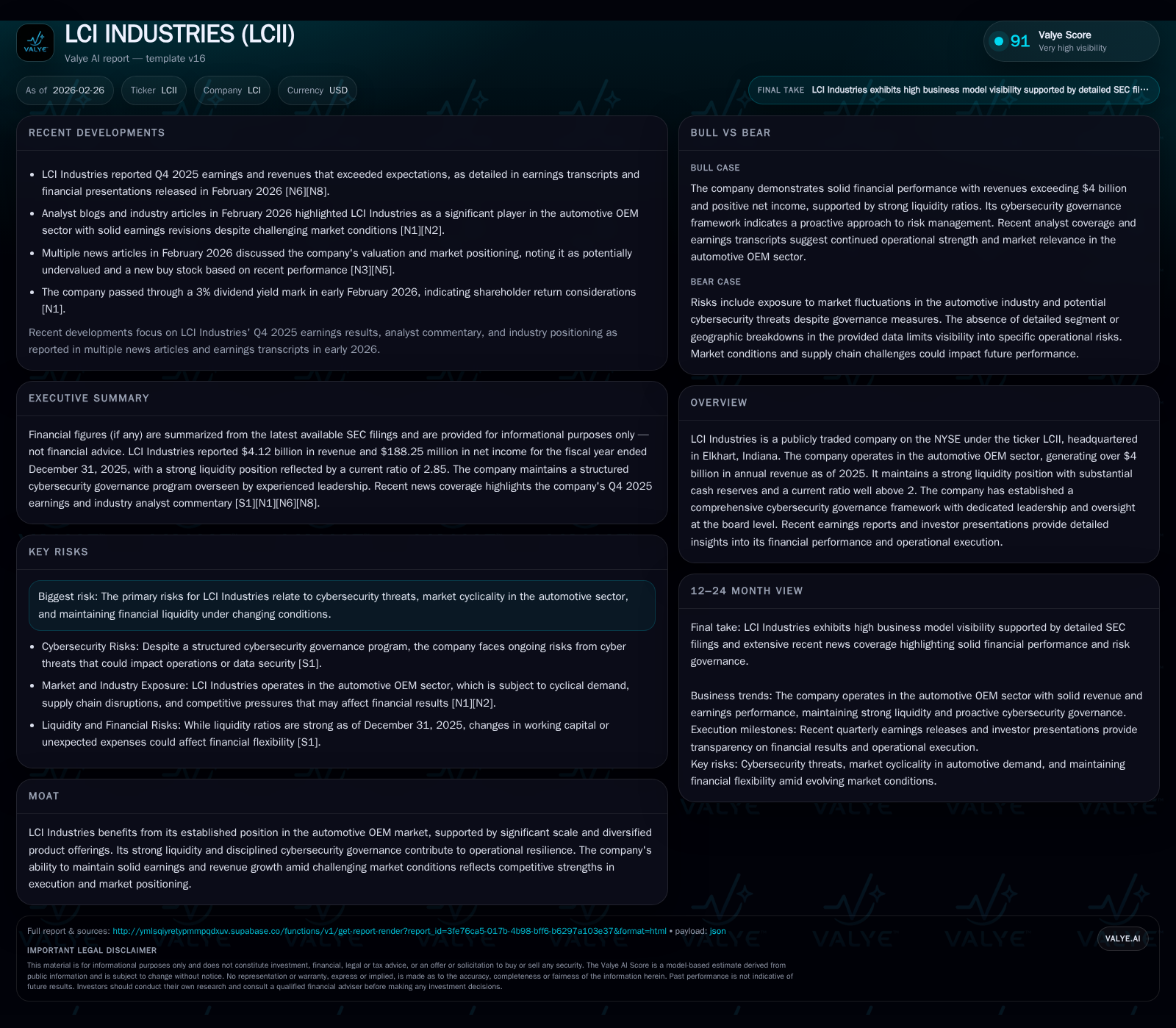
LCI Industries demonstrated a solid rebound in revenue and earnings in 2025, with revenue growing over 10% year-over-year and operating income surging nearly 30%, reflecting margin recovery. Despite ongoing cyclical pressures in the automotive OEM market, the company’s diversified product portfolio and scale helped sustain growth momentum. Capital allocation discipline remains evident through steady dividends surpassing a 3% yield and resumption of share buybacks, supported by a robust free cash flow profile. The firm’s structured cybersecurity governance further strengthens operational resilience amid evolving risks.
Resurgence in Revenue and Earnings: The 2025 Performance Turnaround
LCI Industries rebounded decisively in fiscal year 2025 following significant revenue pressure in prior periods. Reported revenue rose 10.2% year-over-year to $4.12 billion, reversing declines experienced in FY2023–2024 during industry downturns [F1]. Alongside top-line growth, operating income surged by an outsized 28.3% to approximately $280 million, reflecting margin expansion driven by operational efficiencies and scale leverage amid recovering volumes [F1][N3]. Net income followed suit with a robust 31.8% increase, reaching $188 million.
This rebound was underpinned by sturdy execution highlighted during the Q4 earnings conference call, where management attributed improved demand visibility across key OEM customers and disciplined cost management as drivers of profitability gains [N1]. Operating cash flow registered a year-over-year decline of about 10.6% to $331 million; however, given capex increased moderately by roughly 24.4% to $53 million for technology investments and production capacity upgrades, free cash flow after these outlays remained healthy at approximately $278 million—sufficient to support ongoing shareholder returns [F1].[
Historical performance (annual)
| FY | Rev ($bn) | Net ($mm) | CFO ($mm) | OpInc ($mm) | Rev YoY | Net YoY |
|---|---|---|---|---|---|---|
| 2025 | 4.1 | 188 | 331 | 280 | +10.2% | +31.8% |
| 2024 | 3.7 | 143 | 370 | 218 | -1.2% | +122.6% |
| 2023 | 3.8 | 64 | 527 | 123 | -27.3% | -83.7% |
| 2022 | 5.2 | 395 | 603 | 553 |
Source: SEC companyfacts cache [F1].
Capital returns and efficiency (annual)
| FY | Div ($mm) | Buybacks ($mm) | FCF ($mm) |
|---|---|---|---|
| 2025 | 114 | 129 | 278 |
| 2024 | 109 | 0 | 328 |
| 2023 | 106 | 0 | 465 |
| 2022 | 103 | 24 | 472 |
Source: SEC companyfacts cache [F1].
All figures are sourced from company filings and represent full fiscal years ending December ]
Automotive OEM Market Dynamics Impacting LCI's Growth Drivers
The automotive OEM sector remains inherently cyclical due to fluctuating production volumes influenced by broader economic conditions, supply chain variables, and consumer demand shifts [N6][S4]. LCI Industries operates within this context as a component supplier with a diversified product portfolio encompassing seating systems, structural components, and other interior applications.
This breadth provides natural hedging against volatility impacting specific segments or OEMs individually, helping smooth revenue streams compared to niche suppliers [F1]. Furthermore, LCI’s significant scale enables sourcing advantages and operational efficiencies that smaller competitors often cannot match—a critical moat preserving competitiveness when OEM production ramps decelerate or temporarily retract.
Yet the cyclical nature necessitates constant vigilance on inventory management and flexible manufacturing capabilities so that sudden order changes do not lead to margin erosion or capital inefficiencies.
Navigating Future Growth Prospects Within Industry Cyclicality
While explicit forward guidance remains limited within public disclosures, subtle cues from recent earnings commentary suggest cautious optimism regarding continued demand normalization among core OEM accounts [N1][S1]. Management highlighted opportunities through selective innovation investments aimed at newer vehicle architectures addressing electrification trends and interior customization demands.
However, this outlook is balanced against persistent uncertainties.
OEM production volumes may fluctuate depending on macroeconomic factors such as inflationary pressures or geopolitical developments impacting raw materials supply chains [S4]. Moreover, evolving technology standards impose ongoing costs that must be absorbed or passed along without eroding competitive pricing.
Hence future growth hinges on managing these external risks effectively while leveraging internal capabilities in product development and operational agility.
Capital Allocation Emphasis: Dividends, Buybacks, and Free Cash Flow Generation
LCI Industries exhibits disciplined capital allocation evidenced by an approximate return on equity (ROE) near 13.8%, combining profitability with prudent balance sheet management [F1]. The company has maintained a steadily growing dividend payout reaching over $114 million in fiscal year 2025—a yield surpassing the notable threshold of three percent per recent market commentary [F1][N10].
Importantly, share repurchase activity resumed in FY2025 after a hiatus covering FY2023–FY2024 when no buybacks occurred; the company repurchased approximately $129 million worth of shares last year [F1][S10], signaling confidence in intrinsic valuation levels supported by improved cash flows.
These returns are supported by strong free cash flow generation even accounting for capital expenditures focused on innovation and capacity improvements.
Long-term shareholders benefit from this balanced approach emphasizing both visible cash returns via dividends plus accretive buybacks while preserving financial flexibility needed for strategic investments.
Cybersecurity Governance as a Strategic Pillar for Operational Stability
Recognizing the sensitive nature of data within global automotive supply chains, LCI Industries embeds cybersecurity as a core strategic priority overseen rigorously at the board level [S1][S4]. The Board’s Risk Committee holds explicit responsibility for monitoring cyber threats alongside other risks.
Day-to-day cybersecurity leadership is entrusted to a Vice President of Global Information Security—a seasoned executive with more than two decades in IT operations who holds Certified Information Systems Security Professional (CISSP) credentials—underscoring professional rigor complementing technical safeguards.
This team reports regularly not only to senior executives but also participates in cross-company Enterprise Risk and Compliance Committees ensuring integrated risk management approaches leveraging internal controls combined with external intelligence including governmental advisories.
Such structured governance frameworks ensure rapid detection, mitigation, and remediation protocols are operationalized minimizing disruption potential vital for just-in-time OEM supply reliability.
Key Financial Milestones to Watch Post-2025
With explicit guidance scant beyond historical results reported through early-2026 filings and earnings calls ([N4],[S13]), monitoring upcoming earnings releases for consistent outperformance relative to estimates will be crucial markers indicating sustained momentum amid sector variability.
Additional liquidity updates will also merit attention given their implications on debt capacity utilization and potential further share repurchases or strategic acquisitions [S13]. Market participants should track innovations in product adoption related to vehicle electrification integration or new customer wins disclosed during investor calls or regulatory filings.
Overall absent firm numeric targets provided publicly, maintaining focus on quarterly execution versus consensus expectations offers the best forward frame while considering broader auto OEM unit forecasts externally.
Balancing Competitive Advantages Against Emerging Risks
LCI Industries occupies a fortified position within its niche benefiting from extensive scale advantages across diversified product lines—a competitive moat significant enough to weather short-term cyclical swings inherent in automotive manufacturing sectors [F1][S4]. The company's liquidity profile remains robust with current ratios near three times reflecting sound working capital management enhancing resilience.
Simultaneously, principal risks persist centered around the cyclicality of vehicle production schedules which expose revenue streams to contraction during downturns alongside ever-intensifying cybersecurity threats threatening operational continuity should breaches occur despite extensive controls detailed previously [S4].
Management’s proactive posture toward these exposures highlights an acute awareness balancing growth aspirations with risk mitigations rather than speculative optimism absent clear data points.
This report aims solely at providing a detailed factual analysis of LCI Industries’ recent performance dynamics alongside contextual industry considerations without rendering investment advice or recommendations.
Disclaimer: This is research-only, informational analysis and not investment advice. It may include AI-generated interpretation and general industry context. Always verify important details using primary sources.

Comments