
Liftoff Mobile Q2 2026: Balancing Net Loss and Liquidity in a Low-Disclosure Environment
Liftoff Mobile reported a net loss in Q2 2026 but maintained a current ratio above 1, reflecting sufficient short-term liquidity despite significant leverage.
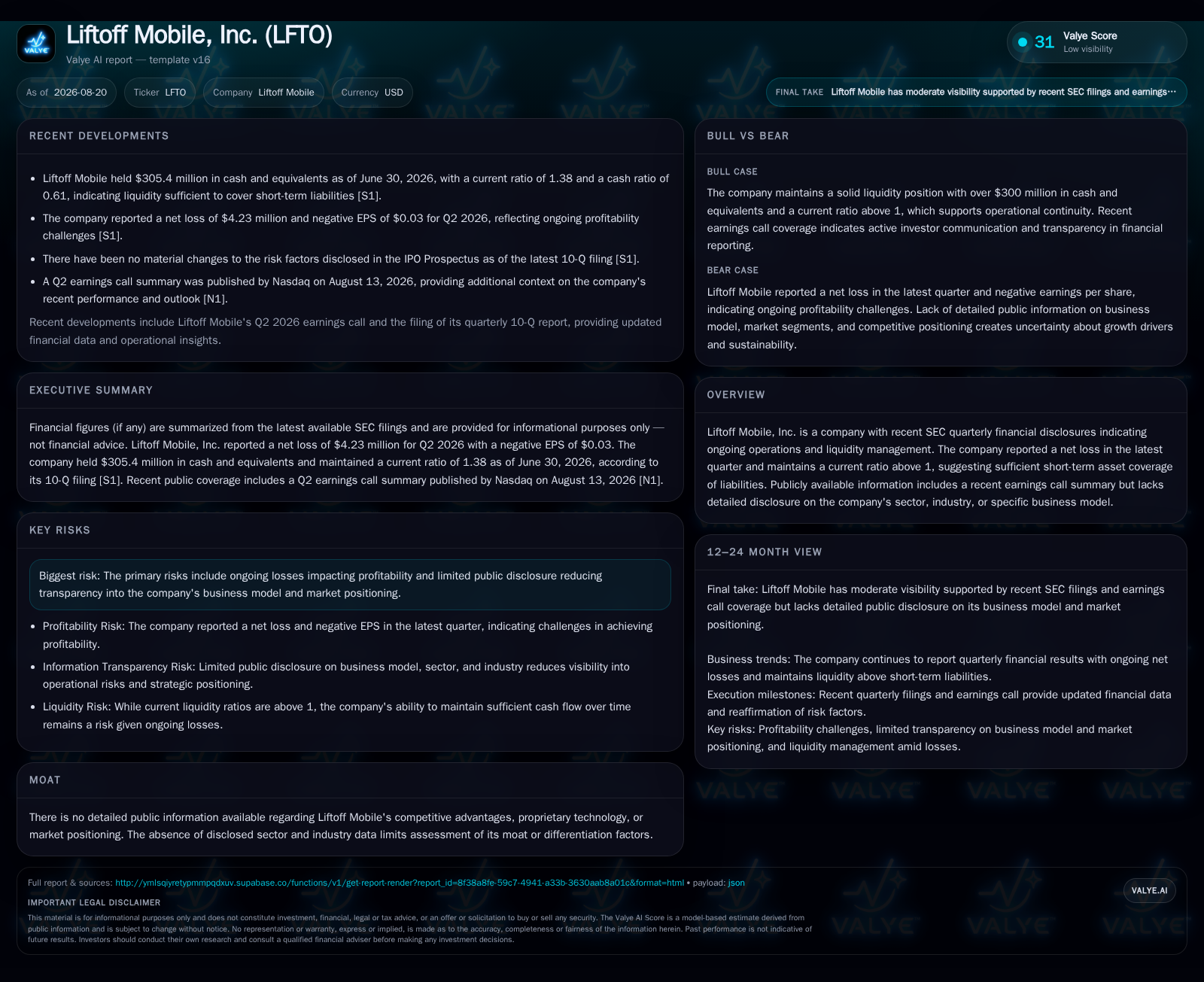
In the second quarter of 2026, Liftoff Mobile, Inc. recorded a net loss while holding a current ratio of 1.38, indicating that its current assets exceed current liabilities by 38%. The company’s liquidity position is supported by $305 million in cash and equivalents, which helps offset its substantial net debt of approximately $1.13 billion. Limited disclosure on revenue and operational metrics constrains deeper analysis of its business model and competitive standing. The ongoing net losses highlight challenges to profitability, raising questions about future cash flow and capital management.
Q2 2026 Financial Results and Liquidity Position
Liftoff Mobile, Inc. reported a net loss for the quarter ended June 30, 2026, as disclosed in its latest 10-Q filing dated August 13, 2026 [S2]. This continuing operating loss indicates negative profitability margins for the period. The company maintained a current ratio of 1.38 at quarter-end, reflecting current assets of $693 million against current liabilities of $503 million [F1], signaling sufficient short-term liquidity to cover its immediate obligations.
Supporting this liquidity position is the company's cash and cash equivalents balance of approximately $305 million as of June 30, 2026 [F1]. While this cash reserve provides a buffer against short-term liabilities, Liftoff Mobile's total debt remains substantial at about $1.44 billion, resulting in a net debt position near $1.13 billion after accounting for cash [F1]. This elevated leverage level underscores the company's significant financial obligations and potential refinancing considerations.
This level of indebtedness could constrain Liftoff Mobile's financial flexibility and may require ongoing attention to refinancing strategies and interest expense management, especially given the reported net loss in the quarter [F1][S2]
Business Model and Competitive Positioning
Liftoff Mobile operates in the digital advertising services sector, specifically offering programmatic mobile advertising and user acquisition solutions. Its customers are advertisers and marketers who seek to acquire and engage mobile app users through targeted campaigns. The company generates revenue primarily by charging fees for campaign management and performance-based advertising services, leveraging proprietary technology platforms to optimize mobile app install campaigns and retargeting efforts [S2][S3]
Margins and cash conversion in this business depend heavily on advertising spend volumes, campaign efficiency, and platform operating costs. However, Liftoff Mobile’s latest filings provide limited disclosure on revenue, customer metrics, or campaign performance, restricting deeper analysis of its competitive positioning or growth trajectory. Without detailed operating data, it is unclear whether the company’s losses reflect structural challenges or cyclical market conditions.
The lack of detailed disclosure on key performance indicators such as customer acquisition costs, churn rates, or revenue growth limits the ability to benchmark Liftoff Mobile against typical SaaS or software peers [S2]. This opacity hinders a comprehensive understanding of the company’s business economics and competitive advantages, leaving investors reliant on balance sheet and liquidity metrics for near-term assessment
Analytical Conclusions and Scenarios
The current ratio above 1, supported by $305 million in cash, indicates that Liftoff Mobile has sufficient short-term liquidity to meet its current liabilities despite its high net debt of approximately $1.13 billion [F1]. This liquidity cushion is critical for sustaining operations in the near term amid ongoing losses. However, the persistent net loss reported in Q2 2026 suggests continued challenges in achieving profitability, which could pressure the company's cash flow and capital allocation decisions going forward [S2].
One plausible base scenario is that Liftoff Mobile manages its liquidity prudently, using its cash reserves and working capital to sustain operations while it works toward improving profitability [S2][F1]. This scenario would be confirmed by stable or improving liquidity ratios and operating cash flows in future quarters. Conversely, a bear scenario considers the risk that ongoing net losses combined with elevated leverage could lead to liquidity stress or refinancing difficulties. This risk is heightened if operating losses persist or worsen and if the company faces challenges in raising additional capital or refinancing its debt
A grounded watchpoint for investors is the company’s ability to maintain liquidity and manage its leverage amid ongoing losses. Monitoring subsequent quarterly filings for changes in net income, cash flow, liquidity ratios, and any debt refinancing announcements will be essential to assess whether Liftoff Mobile can navigate its financial challenges without distress. Additionally, any new disclosures on business model details, customer base, or revenue drivers would provide valuable insight into its operational health and growth prospects.
In summary, Liftoff Mobile’s Q2 2026 results highlight a company with significant operating losses and a current liquidity position that remains adequate for near-term obligations based on a current ratio of 1.38 [F1]. The lack of detailed operational data limits a fuller understanding of its competitive dynamics and growth outlook, emphasizing the importance of monitoring forthcoming financial disclosures. The company’s elevated net debt position presents a material risk that requires careful attention to liquidity management and refinancing strategies going forward.
Disclaimer: This is research-only, informational analysis and not investment advice. It may include AI-generated interpretation and general industry context. Always verify important details using primary sources.

Comments