
ContextLogic Transitions to Holding Model with US Salt Acquisition as Growth Anchor
Post-Wish divestiture, ContextLogic refocuses as a holding company managing niche businesses highlighted by its purchase of US Salt in late 2025.
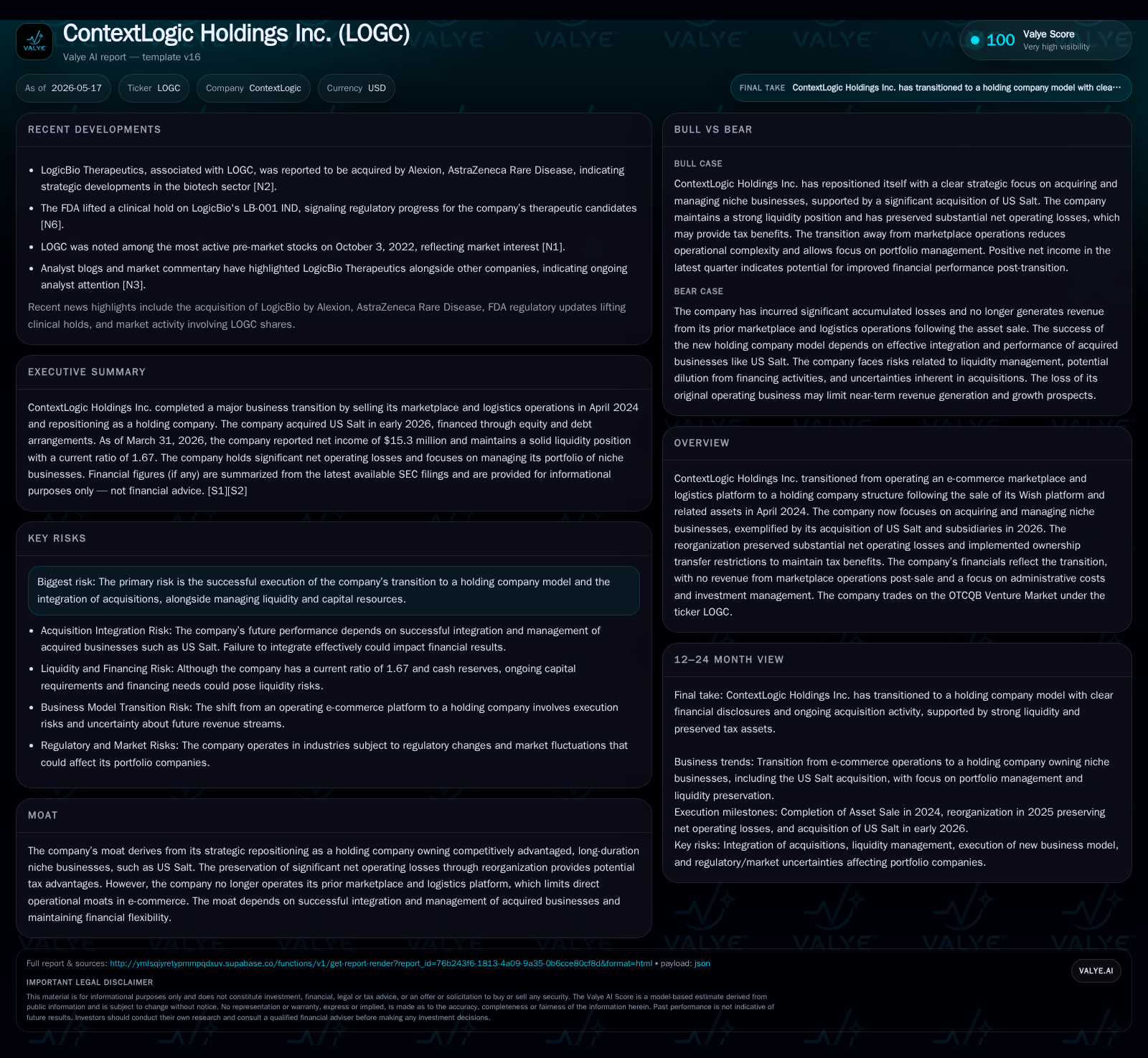
ContextLogic Holdings Inc. completed its transformation from an e-commerce platform operator into a holding company following the April 2024 sale of its Wish marketplace and logistics assets. The company's first meaningful acquisition under this model is US Salt, acquired in December 2025 for approximately $908 million, financed through a combination of debt and equity arrangements. Current operations no longer generate marketplace revenue; instead, ContextLogic's business model centers on managing acquired niche businesses with competitive advantages. The transition preserves significant net operating losses that may enhance future tax efficiency but places execution risk squarely on successful acquisition integration and cash flow generation from new holdings.
Recent Operating Update
ContextLogic Holdings Inc.'s most recent quarterly filing (10-Q dated May 15, 2026) confirms that it has fully exited its former marketplace business following the April 2024 sale of its Wish platform and logistics assets [S2]. There is zero revenue contribution from e-commerce operations post-sale. Instead, operating activity centers around managing investments, administrative expenses, and interest earned on cash reserves. The strategic pivot culminated formally with a reorganization completed in August 2025 that converted the company into a holding company structure under Delaware law and safeguarded existing net operating losses (NOLs) by imposing ownership transfer restrictions [S1, S23].
A major milestone was achieved in December 2025 with the acquisition of US Salt and its subsidiaries—a vertically integrated salt production business acquired for approximately $908 million. This transaction reshapes ContextLogic’s business profile by adding a large-scale manufacturing operation as the anchor asset in its new portfolio [S1,S24]. To finance this sizable deal, ContextLogic tapped multiple funding sources: a $215 million initial term loan facility drawn upon closing the acquisition [F1], rights offering raising equity subscriptions albeit undersubscribed (only about $3 million raised against an expected cap near $115 million) [S1], and backstop agreements contributing approximately $112 million securing the deal's financing package [S1].
The financial disclosures accompanying these developments show that while legacy operating losses persist—$31 million operating loss for full year 2025—the company expects to achieve operating profitability sooner rather than later driven by US Salt’s cash flows [S1,S21]. However, liquidity remains modest with roughly $12 million in cash & equivalents at quarter-end March 2026 against total debt obligations of about $215 million [F1]. This net debt position underscores a need for tight capital management going forward.
Business Model
Historically known for running the Wish e-commerce marketplace catering mostly to global consumers sourced from Chinese merchants, ContextLogic has shed this operational mantle entirely. The sale of Wish's core assets severed all revenue streams tied directly to marketplace transactions.
Currently, ContextLogic derives value through ownership stakes in niche companies with long-term durable competitive advantages. The proprietary focus is acquiring bolt-on businesses whose products or services have defensible market positions rather than competing directly in crowded consumer internet sectors. In practice, this means that earnings will predominantly come from managed subsidiaries such as US Salt, which produces industrial-grade salt primarily serving chemical producers, water treatment facilities, and de-icing markets.
Revenue mechanics fundamentally differ now: rather than volume or take-rates from third-party merchants or logistics providers driving top-line growth, revenue flows arise at the subsidiary level based on commodity prices, production capacity utilization, contractual customer relationships, and operational efficiencies within those firms. ContextLogic’s corporate-level margin profile thus largely reflects administrative overhead costs offset by interest income generated on invested capital. Any positive returns depend heavily on astute management of portfolio companies and leveraging residual tax assets extant before the reorganization.
This transition also introduced structural complexities such as strict ownership transfer limits designed to prevent triggering taxable events under Section 382 of the Internal Revenue Code. These measures protect approximately $2.9 billion in NOLs preserved through the restructuring process—valuable contingent assets that support future enterprise value creation if utilized effectively [S23].
Industry Structure and Competitive Position
As a holding entity without direct operational engagement in consumer-facing marketplaces or logistics networks post-2024 asset sale, ContextLogic no longer participates in highly competitive digital retail ecosystems dominated by Amazon, Alibaba affiliates, or Shopify-hosted marketplaces.
Instead, the company positions itself within industrial commodities via US Salt ownership—an established player in salt mining and processing servicing sectors characterized by capital-intensive barriers to entry and relatively stable demand tied to infrastructure maintenance and chemical manufacturing inputs. This segment exhibits less volatility compared to e-commerce but faces cyclical pressures linked to industrial output levels and weather patterns influencing road de-icing demand.
Competition within salt production includes regional miners and importers; however, US Salt's scale combined with vertical integration offers insulation against pricing shifts relative to fragmented smaller operators.
ContextLogic’s leverage over this space is indirect at present. It must rely on adept portfolio management teams at subsidiaries along with capital resource allocation strategies shaped by parent-level oversight led by external investors (including BC Partners-affiliated directors). Its OTCQB market status implies relatively lower liquidity compared to major public firms but provides strategic flexibility absent pressures typical for larger operators.
Growth Drivers
The centerpiece growth driver is consolidation within niche asset classes where ContextLogic can deploy capital efficiently to acquire businesses generating cash earnings resilient over time.
Specifically:
- US Salt Operating Leverage: Enhancing production efficiencies or expanding capacity could raise EBITDA margins materially given fixed cost bases inherent in mineral extraction.
- Further Acquisitions: ContextLogic signals intent for bolt-on deals complementary to US Salt or similar sector businesses that align with its holding company thesis [S1]. Acquisition pipeline development alongside disciplined deal sourcing could drive compounded value appreciation.
- Tax Efficiency: Effective utilization of preserved NOLs can reduce cash tax burdens materially aiding free cash flow conversion.
- Cost Optimization: Streamlining overhead at parent level while enabling subsidiary operational autonomy can optimize consolidated cost structures.
- Market Conditions: Stable or increasing infrastructure spending (government road maintenance budgets) sustains demand for salt products supporting steady revenues.
Risks / Watchpoints / Growth Constraints
Executing this significant pivot brings forward risks including:
- Integration Risk: Successfully melding acquisition targets into cohesive portfolio management without undermining subsidiary performance is unproven at scale for the firm.
- Liquidity Pressure: Modest cash buffers vs sizable outstanding debt (~$203 million net debt by March-end) impose constraints requiring prudent working capital management.
- Market Volatility: Commodities pricing swings or disruptions in supply chains impacting US Salt’s core markets could compress margins unexpectedly.
- Dependence on Acquisitions: Future success heavily reliant on identifying accretive targets amid competition for quality assets in niche industries.
- Regulatory/Tax Changes: Alterations to tax law potentially affecting ability to use NOLs pose downside risks.
- Management Transition: Changeover at CEO level late 2025 introduces uncertainty regarding strategic continuity though new leadership has relevant sector experience [S28].
- Public Market Liquidity: Trading exclusively on OTCQB limits institutional investor access which may impact valuation transparency.
What To Watch Next
Key upcoming indicators to monitor include:
- Quarterly earnings progress reflecting US Salt operational results as primary revenue source post-acquisition.
- Updates on integration efforts including any announced bolt-on acquisitions expanding business breadth.
- Management commentary clarifying strategic roadmap under new president leadership focused on investment opportunities.
- Cash flow trajectory improvements evidencing effective cost control alongside leveraging NOL benefits optimally.
- Refinancing activity or amendments related to existing credit facilities signaling evolving capital structure dynamics.
- Market reception measured via trading volumes and price action reflecting investor confidence toward new holding company thesis.
Financial Profile Summary
Latest financial snapshot
| Metric | Value | Period |
|---|---|---|
| Cash & equivalents | $12mm | |
| 2026-03-31 | ||
| Total debt | $215mm | |
| 2026-03-31 | ||
| Net debt | $203mm | |
| 2026-03-31 | ||
| Current assets | $40mm | |
| 2026-03-31 | ||
| Current liabilities | $24mm | |
| 2026-03-31 | ||
| Current ratio | 1.67x | |
| 2026-03-31 |
Source: SEC companyfacts cache [F1].
The financial snapshot highlights a leveraged balance sheet primarily associated with acquisition financing initiatives surrounding US Salt. Net losses reflect transitional costs plus pre-acquisition administrative expenses typical during strategic pivots [F1,S1,S2]. Ensuring a sustainable path toward positive operating profits depends crucially on realizing expected synergies at subsidiary level plus maintaining disciplined expense control at headquarters.
This analysis reviews publicly available SEC filings up through May 17, 2026. It aims to provide an informed industry perspective grounded solely in disclosed data without offering investment advice or price forecasts.
Disclaimer: This is research-only, informational analysis and not investment advice. It may include AI-generated interpretation and general industry context. Always verify important details using primary sources.

Comments