
Live Oak Acquisition Corp. V Leverages Experienced Team and Network to Unlock Targeted Acquisition Value
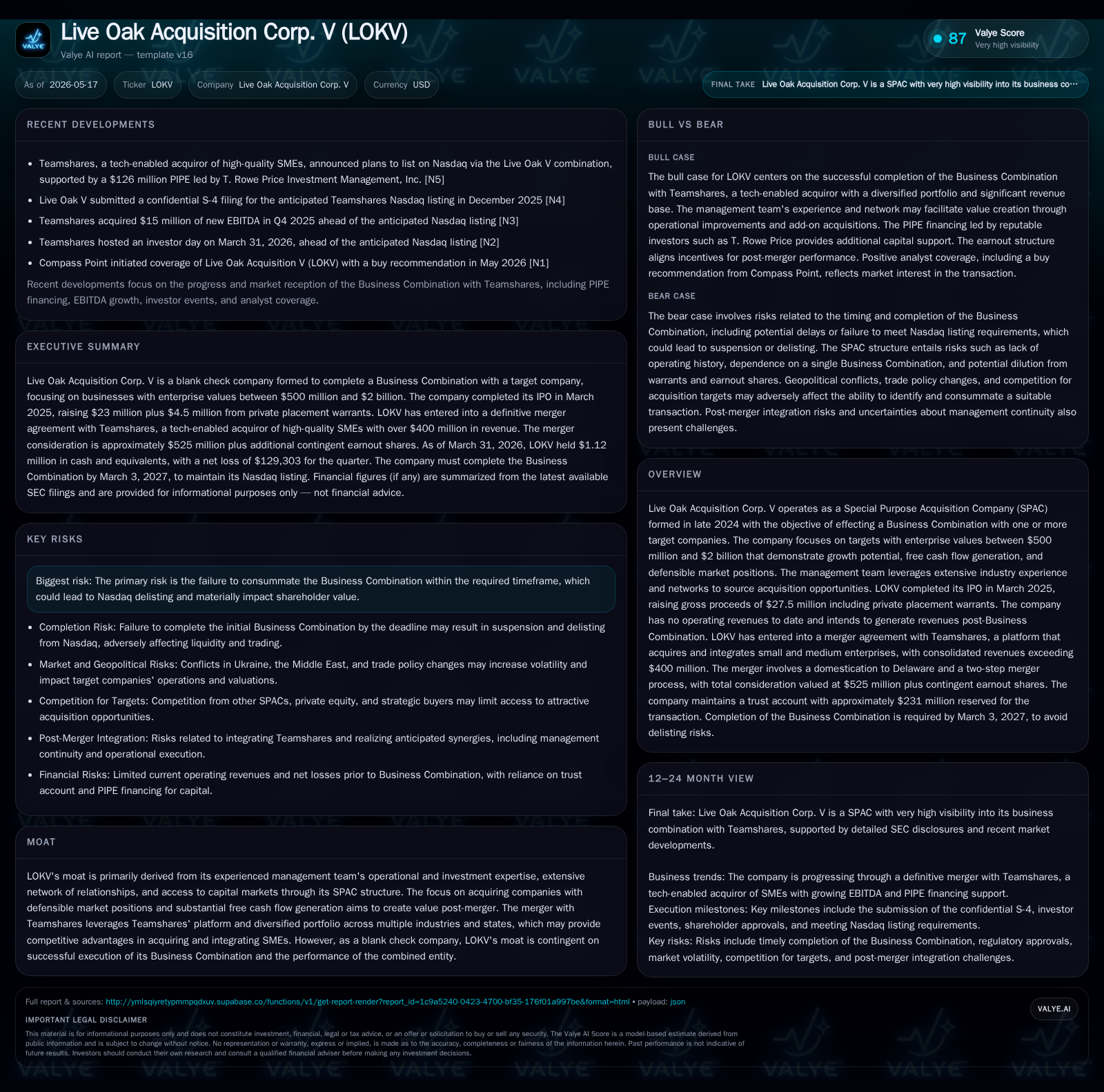
LOKV’s recent quarterly and event filings highlight critical progress toward its merger with Teamshares, underscoring a pathway to value creation through SME platform consolidation.
Live Oak Acquisition Corp. V (LOKV), a SPAC focused on growth-oriented businesses, disclosed in its Q1 2026 filing significant strides towards consummating its Business Combination with Teamshares, a platform with $400 million in consolidated revenues that acquires and integrates SMEs. The company’s business model pivots from a pre-combination blank check structure to a post-merger operating platform leveraging Teamshares’ diversified SME portfolio. Competitive advantages stem from management’s operational expertise and extensive networks, although challenges remain around timing, shareholder redemptions, and market volatility. Key milestones include merger approval votes and integration initiatives that will determine execution success.
Recent Operational Update and Importance of Q1 2026 Filing
Live Oak Acquisition Corp. V's (LOKV) latest quarterly filing dated May 15, 2026, provides crucial insights into its current progress toward completing the Business Combination with Teamshares [S2]. This filing confirms that the company has entered into amendments to the original merger agreement as recently as early May 2026 [S3], signaling active negotiations and refinements necessary to align terms with evolving operational or market considerations. Such amendments typically indicate responsiveness to shareholder feedback or market developments in ensuring the deal structure remains viable. The operational update highlights that while LOKV currently reports no revenues—consistent with its status as a Special Purpose Acquisition Company—its closer step toward consummating the acquisition pivots its outlook from capital vehicle toward operating enterprise [S1].
It also notes adherence to Nasdaq listing requirements contingent on successful completion of the Business Combination by March 3, 2027 [S2]. From a governance perspective, these filings confirm no material litigation pending or planned that would inhibit transaction execution [S1]. Crucially, this quarterly update serves as an intermediate milestone clarifying that LOKV remains on track—a positive signal amid volatile market conditions that have complicated many comparable SPAC transactions recently.
Business Model and Post-Merger Revenue Prospects
LOKV began life as a typical blank-check company formed in late 2024 structured specifically for effecting a Business Combination [S1]. Before the merger closing, it generates no operating revenues or traditional business cash flows but holds capital raised from its IPO in March 2025—approximately $27.5 million gross from units comprising ordinary shares plus warrants [S1]. Its economic model is essentially one of capital stewardship: sourcing acquisition targets within an enterprise valuation band of roughly $500 million to $2 billion where management's operational acumen can unlock growth.^
The current acquisition candidate Teamshares operates distinctly as a platform buyout firm specializing in small and medium enterprises (SMEs) with consolidated revenues exceeding $400 million spanning diverse industries and U.S. states. Post-merger revenue generation will arise directly from integrating these acquired SMEs under unified ownership while deploying operational improvements facilitated by Live Oak's management network. This platform-based approach attempts to generate growth both organically via scaling enterprises within its portfolio and through additional bolt-on acquisitions enabled by improved capital access following public listing.
Thus, the transformative waypoint for LOKV is crossing from a capital vehicle into an operating entity managing active business lines—a transition dependent entirely upon successfully closing the merger agreement with Teamshares. This structural shift differentiates LOKV from many other SPACs which may target single entities instead of operating platforms encompassing multiple firms.
Competitive Dynamics and Industry Positioning in SPAC-Driven Acquisitions
LOKV competes broadly within an active SPAC ecosystem where multiple sponsors pursue attractive business combinations targeting mid-market companies valued between $500 million and several billion dollars [S6]. Key competitors include other SPACs sponsored by seasoned investment groups plus traditional private equity entities seeking similar targets using either private funds or public vehicles. Against this backdrop, LOKV differentiates primarily through management's combined operational experience across relevant industries coupled with extensive networks composed of intermediaries—investment bankers, advisors—and prospective sellers who prefer transactions aligned with operational support rather than pure financial sponsors alone [S1].
Nevertheless, LOKV faces inherent constraints primarily governed by available financial resources raised in its IPO (~$27.5 million including private placement warrants) tempered against potential redemptions by public shareholders exercising their rights upon deal announcement. Redemption waves can diminish pro forma deal proceeds thereby complicating transaction structuring or forcing more dilutive financing through PIPE offerings or debt variants if accepted. Additionally, many target businesses require strategic capital solutions tailored beyond what the SPAC trust alone can provide; thus larger competitors with more extensive capital stacks maintain an advantage when bidding for overlapping opportunities.
Moreover, the presence of outstanding warrants introduces dilution risk potentially disfavored by some sellers. These structural considerations collectively temper LOKV’s ability to compete for higher-value assets relative to deeper-pocketed rivals but simultaneously emphasize its strength lies in niche sourcing efficacy supported by executive expertise.
Growth Catalysts: Leveraging SME Platform Potential and Management Expertise
Growth prospects fundamentally hinge on harnessing Teamshares’ existing platform business model which consolidates SMEs under one umbrella generating over $400 million in annualized revenue prior to combination closure. This aggregation across fragmented SMEs enables synergies including shared administrative functions, centralized procurement benefits, cross-selling opportunities between portfolio companies positioned in complementary verticals or geographies.
Management plays an instrumental role post-transaction not only in sourcing new acquisition candidates but also actively steering integration efforts focused on margin enhancement through operational best practices—ranging from cost rationalization leveraging scale economies to revenue growth initiatives optimized at local-market levels thanks to broad geographic reach across many U.S. states [S1].
The strategic intent includes expanding the portfolio through additional bolt-on acquisitions accretive both in revenue scale and margin improvement potential while exploiting access to listed equity markets for growth funding absent pre-existing private equity control constraints often limiting rapid rollup strategies.
This timeline risk is compounded by macro-environmental volatility including geopolitical tensions notably military conflicts impacting public market valuations adversely as underscored explicitly in recent filings referencing heightened volatility linked to conflicts involving Ukraine and Middle Eastern theaters plus unpredictable trade policy shifts affecting target company operations materially [S2].
Shareholder redemption rights represent another material constraint; following announcement shareholders may choose redemption thereby reducing available transaction proceeds unless mitigated via committed backstop financings or oversubscription PIPE deals—which themselves introduce dilution concerns unfavorable to existing owners [S6]. The combined effects of redemptions could compel renegotiations difficult under tight deadlines.
Additional risks typical for blank-check companies transitioning into operating businesses include potential disruptions during integration phases impacting anticipated synergy realization or loss of key personnel among acquired SMEs reducing forecasted returns post-close [S1]. Execution risk remains elevated given nascent post-merger operational infrastructure yet unproven at scale.
Upcoming Milestones and What Investors Should Monitor
In terms of imminent focus points for stakeholders monitoring LOKV’s trajectory include:
- Completion of shareholder approval votes regarding merger amendments submitted most recently (April-May 2026) ensuring continued legal authority underpinning deal closure timelines [S3];
- Clearance by SEC on registration statements encompassing proxy materials disseminated ahead of voting combining Live Oak shares with Teamshares securities post-merger consideration approvals;
- Synergy tracking metrics post-combination such as realized cost savings or incremental revenue growth within first two full quarters after closing illustrating feasibility of integration strategy execution;
- PIPE financing utilization effectiveness if further capital is raised supporting rollup acceleration plans;
- Public shareholder redemption rates during tender offer periods informing residual liquidity remaining for operative uses.
Investor attention should also monitor external factors such as broader equity market sentiment shifts driven by macro uncertainties which could influence secondary trading patterns ahead of transaction consummation.
Current Financial Snapshot Supporting Execution Viability
| Metric | Value | Period |
|---|---|---|
| Cash & equivalents | $1,124,492 | |
| 2026-03-31 | ||
| Current assets | $1,205,622 | |
| 2026-03-31 | ||
| Current liabilities | $1,852,147 | |
| 2026-03-31 | ||
| Current ratio | 0.65x | |
| 2026-03-31 |
Source: SEC companyfacts cache [F1].
While LOKV lacks operating income or net earnings as expected for a SPAC pre-business combination, its balance sheet encapsulates key preparatory asset/liability positions critical for near-term viability. This liquidity situation reflects modest working capital availability anticipating incremental costs related to merger finalization processes but sufficient given completion reliance predominantly on trust account funds raised during IPO phases plus PIPE commitments referred throughout filings [F1][S2]. Given no significant debt obligations documented contemporaneously, liquidity risk appears contained albeit tightly managed until Business Combination closure expands asset base substantially.
This analysis synthesizes all pertinent SEC disclosures through May 17, 2026 alongside proprietary sector knowledge about SPAC dynamics targeting SME consolidation platforms held by Live Oak Acquisition Corp. V under ticker LOKV. It aims solely to illuminate corporate strategy nuances and execution drivers without offering investment advice or valuation predictions.
Disclaimer: This is research-only, informational analysis and not investment advice. It may include AI-generated interpretation and general industry context. Always verify important details using primary sources.

Comments