
Matthews International's Strategic Portfolio Refinement and Operational Resilience Amid Uncertain Geopolitics
Matthews International has decisively narrowed its industrial focus through targeted acquisitions and divestitures, balancing operational discipline with emerging global supply challenges.
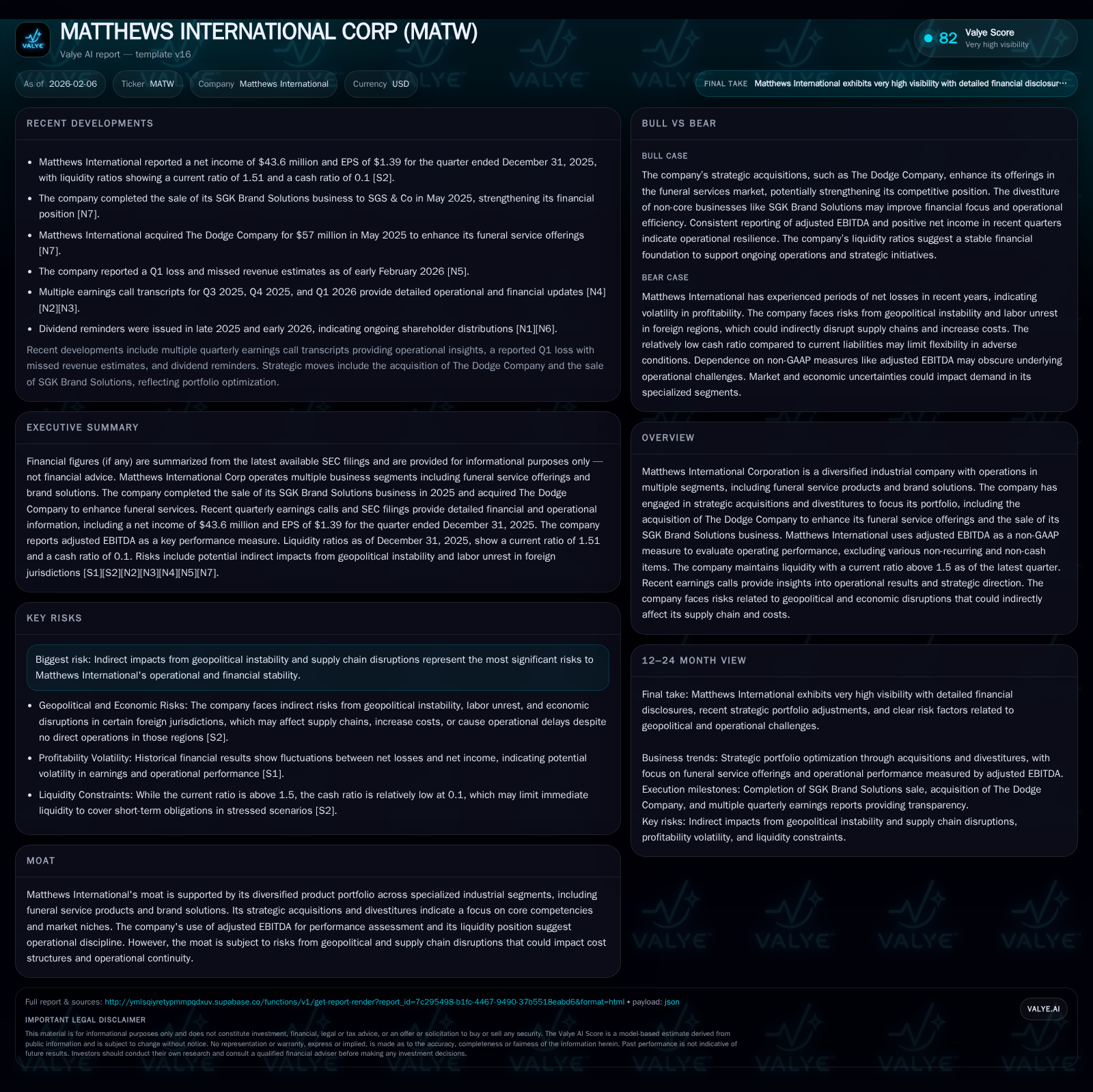
Once broadly diversified, Matthews International has streamlined its operational segments by acquiring The Dodge Company to solidify its funeral service product line while divesting its SGK Brand Solutions business. The company prioritizes adjusted EBITDA as a core performance metric, reflecting ongoing efforts to filter out non-recurring costs and underscore operational health. Its liquidity remains robust with a current ratio exceeding 1.5 as of late 2025, highlighting financial flexibility amid geopolitical uncertainties that pose indirect risks to supply chains and cost structures. Recent earnings reflect both challenges from external disruptions and strategic navigation towards niche industrial strengths.
Charting Matthews International’s Portfolio Evolution: From Diversification to Strategic Focus
Historically characterized by a diversified industrial footprint encompassing multiple product lines — notably funeral service products alongside brand solutions — Matthews International is undergoing a clear recalibration of its portfolio mix. This shift involves actively paring back certain segments while doubling down on niches where it can leverage core competencies more effectively. The recent strategic moves to acquire The Dodge Company enhance the firm’s foothold in funeral service offerings, which represent a core area of expertise. Conversely, shedding the SGK Brand Solutions business reflects Matthews’ intention to streamline operations and concentrate managerial resources toward higher-impact divisions [valye_report_excerpt][S1]. Such deliberate portfolio realignment signals a company responding decisively to evolving market dynamics and internal assessments of sustainable competitive advantage.
Decoding Adjusted EBITDA: The Lens into Core Operational Performance
Matthews International’s choice to highlight adjusted EBITDA — earnings before interest, taxes, depreciation, amortization, and select non-cash or one-off items — reveals an emphasis on isolating underlying operating performance from accounting noise. This non-GAAP figure excludes acquisition and divestiture-related costs, ERP integration expenses, strategic initiatives charges, stock-based compensation, and pension-related adjustments that management believes do not reflect day-to-day earnings power [S1]. By removing these elements, adjusted EBITDA provides a clearer view of ongoing business health and efficiency separate from episodic financial impacts. It serves both internal budgeting/planning purposes and external investor communications as the preferred metric for gauging operational trends over time.
Liquidity and Financial Fortitude: Analyzing Balance Sheet Strength at Fiscal Year-End
A critical pillar supporting Matthews’ operational strategy is its liquidity position. As of December 31, 2025, reported current assets stood at $489 million against $325 million in current liabilities, yielding a healthy current ratio just above 1.5 [F1]. This buffer underpins the company’s capacity to meet short-term obligations without strain, providing essential financial flexibility amid periods of market volatility or supply chain disruption. Cash and cash equivalents totaling $31 million further complement this cushion. The strong liquidity profile combined with careful financial stewardship enables Matthews to absorb episodic shocks while continuing investments aligned with strategic priorities.
Acquisitions and Divestitures: The Dodge Company Acquisition and SGK Branding Exit
These hallmark transactions crystallize Matthews’ modernized corporate focus. Acquiring The Dodge Company aligns directly with reinforcing Matthews’ legacy strength in funeral service products—expanding scale, product breadth, and customer reach within the specialized segment [valye_report_excerpt][S1]. Meanwhile, the divestiture of the SGK Brand Solutions business simplifies the organizational structure by offloading a less prioritized segment. This realignment helps concentrate capital deployment on higher-margin endeavors with clearer strategic rationale. Both moves positively influenced adjusted EBITDA computations through their one-time transactional effects but ultimately work toward enhancing long-term profitability and market positioning.
Behind the Numbers: Insights from Recent Earnings Calls
Between Q3 2025 and Q1 2026 earnings calls [N1][N2][N3][N4], management consistently acknowledged headwinds impacting near-term revenue growth contrasted with encouraging signs of stabilization in key units. Despite a reported loss and revenue miss in Q1 2026 [N4], executives clarified that these outcomes were partially due to macroeconomic softness compounded by temporary supply chain constraints rather than fundamental demand erosion. They underscored ongoing efforts to optimize cost structures while integrating acquisition synergies and maintaining operational discipline amid broader uncertainty. The tone reflected cautious optimism: vigilant adjustment to evolving market realities balanced against persistent commitment to core segments.
Navigating the Geopolitical Undercurrents and Supply Chain Vulnerabilities
Matthews openly recognizes that while it lacks direct exposure in areas experiencing acute geopolitical turmoil—such as Venezuela—it faces material indirect risks [S2][valye_report_excerpt]. Regional labor unrest or political instability can reverberate through global freight channels, energy pricing fluctuations, currency volatility, or emerging trade restrictions impacting supplier availability or cost inputs. Although its supply network diversification affords resilience against localized shocks, shifting diplomatic landscapes or regulatory frameworks could trigger unexpected delays or cost inflation. Management’s disclosure signals prudent vigilance without overstating imminent threats but acknowledges these factors as persistent variables requiring adaptable risk mitigation strategies.
Assessing Market Position and Competitive Moat in Specialized Industrial Segments
Matthews International’s moat derives fundamentally from its focused presence in specialized industrial niches supported by technical know-how accumulated over decades [valye_report_excerpt]. Its funeral services product line—bolstered by selective acquisitions—and brand solutions historically provided differentiated capabilities seldom easily replicated by generalist competitors. Maintaining disciplined capital allocation further ensures that investments emphasize reinforcing entrenched advantages rather than peripheral expansions. Nevertheless, this moat remains somewhat fragile given exposure to external macroeconomic dislocations; operational excellence alone cannot insulate fully from unpredictable geopolitical shocks affecting raw material access or logistics.
Risks on the Horizon: Indirect Impacts from Global Instabilities
While Matthews does not operate directly within conflict zones or politically unstable markets [S2], it faces several second-order risk pathways worth monitoring closely. Possible scenarios include tightening trade restrictions if broader diplomatic tensions escalate; sanctions affecting third-party suppliers; currency swings complicating cost management; and international compliance burdens raising administrative overheads. These factors could collectively inflate operating costs or impair timely delivery despite core demand stability. The company’s own disclosures suggest recognition that mitigating these indirect exposures requires continual evaluation of supplier diversification policies as well as flexible operational planning frameworks.
Synthesis: Balancing Operational Discipline with External Challenges
Matthews International exemplifies a mid-cap industrial adapting deliberately through focused portfolio transitions—markedly narrowing scope toward funeral services while exiting less aligned brand segments—to sharpen competitive edges amid an uncertain global backdrop [valye_report_excerpt][N1][S2][F1]. Its usage of adjusted EBITDA offers transparent insight into operational fundamentals unclouded by transaction-related volatility or pension accounting subtleties, demonstrating managerial discipline in assessing true business momentum. Supported by a robust liquidity profile enabling nimble responses to both strategic opportunities and disruptive episodes alike, Matthews nonetheless navigates latent risks inherent in global supply chains subject to geopolitical fluctuation—a domain largely outside direct control but demanding constant attention.
In aggregate, Matthews stands as an example of calculated refocusing combined with pragmatic resilience—balancing intrinsic strengths within specialized industrial spheres against ever-shifting external complexities.
This analysis is provided for informational purposes only and does not constitute investment advice or recommendations.
Disclaimer: This is research-only, informational analysis and not investment advice. It may include AI-generated interpretation and general industry context. Always verify important details using primary sources.

Comments