
Mobileye's EyeQ™ SoC Supply Constraints and OEM Partnerships Shape ADAS Growth Trajectory
Mobileye’s latest quarter underscores ongoing semiconductor dependency risks alongside expanding OEM engagements that anchor its ADAS leadership.
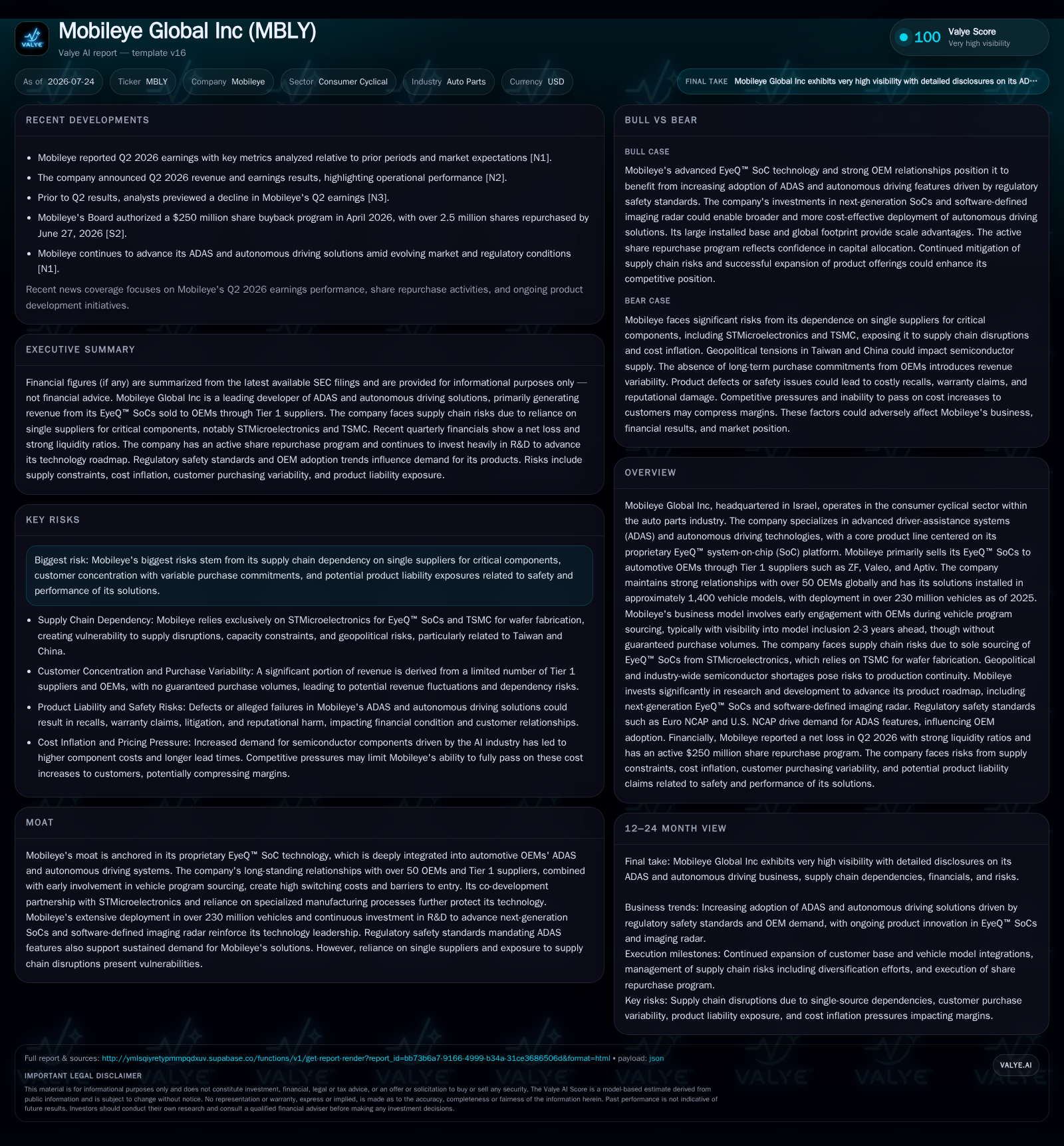
Mobileye Global Inc reported its second-quarter results confirming stable expansion in Advanced Driver-Assistance Systems (ADAS) applications despite persistent reliance on single-source EyeQ™ SoC supplies from STMicroelectronics. The company engages over 50 global OEMs and has its solutions installed in approximately 1,400 vehicle models worldwide. Its business model capitalizes on early vehicle program sourcing and design wins with Tier 1 suppliers but faces supply chain vulnerabilities that could impact delivery and revenue growth. Regulatory-driven demand growth and Mobileye’s proprietary technology underpin its competitive moat, while risks include customer concentration and product liability exposure.
Latest Operating Update: Q2 2026 Context
Mobileye Global Inc’s quarter ended June 27, 2026, reinforced its leadership in Advanced Driver-Assistance Systems (ADAS) with continued growth in unit shipments amid ongoing semiconductor supply challenges [S2][S16]. The company reported no new unregistered equity sales but repurchased approximately 2.5 million shares under its authorized $250 million buyback program as of Q2, reflecting management’s confidence in cash flow stability despite operational headwinds
Demand for Mobileye’s ADAS solutions remains robust, driven by global regulatory mandates requiring advanced safety features. However, the company continues to face supply chain constraints due to its sole sourcing of the EyeQ™ system-on-chip (SoC) from STMicroelectronics. This dependency poses risks for timely fulfillment of OEM contracts, as inventory buffers remain limited. While supply shortages that severely impacted 2021-22 production eased entering 2023 with inventory rebuilds, the risk of renewed constraints persists given the complexity and long lead times of semiconductor fabrication [S1]
In governance developments, CEO Amnon Shashua announced his planned resignation following the appointment of a successor, transitioning to Chair of the Board. This leadership change is orderly and maintains strategic continuity given Shashua’s ongoing board role [S25].
Business Model: Early Engagement and Product Evolution Drive ADAS Adoption
Mobileye’s business model centers on designing and licensing proprietary hardware-software platforms, primarily the EyeQ™ SoC, which powers vision processing and sensor fusion capabilities essential for ADAS and autonomous driving. These SoCs are sold predominantly to OEMs through Tier 1 suppliers, including firms such as ZF Friedrichshafen, Valeo, and Aptiv. The company’s technology is integrated into approximately 1,400 vehicle models worldwide across more than 50 OEM partnerships, highlighting broad industry penetration [S1].
A key monetization driver is Mobileye’s early involvement in vehicle program sourcing, often years before production launch [S4]. This early design win process provides visibility into future unit shipments but also introduces variability in purchase volumes until production ramps. Average selling prices (ASP) per unit vary by product complexity and typically decline as solutions mature and volumes increase. However, Mobileye offsets ASP declines by expanding its product portfolio toward higher-value full system solutions such as Mobileye SuperVision™, which bundles the EyeQ™ SoC with additional hardware like software-defined imaging radar and advanced software stacks. These systems command higher gross profit dollars per unit despite exerting downward pressure on gross margin percentages due to increased third-party hardware content
Industry Structure and Competitive Positioning
Mobileye operates at the intersection of automotive semiconductor design and ADAS system development, providing critical vision-processing SoCs that enable sensor fusion algorithms for lane keeping, adaptive cruise control, collision avoidance, and autonomous navigation. Its upstream position focuses on core silicon IP and software platforms delivered to Tier 1 suppliers and OEMs for integration into vehicle systems.
In comparison to peers such as NVIDIA, which emphasizes high-performance autonomous driving compute platforms, or NXP Semiconductors, specializing in automotive microcontrollers, Mobileye’s competitive advantage lies in its proprietary EyeQ™ SoC technology and extensive OEM relationships cultivated over decades. Tier 1 suppliers like Continental AG and Aptiv compete in broader systems integration but rely on upstream suppliers like Mobileye for core ADAS silicon.
Mobileye’s competitive moat is supported by:
- Deep integration of EyeQ™ technology within OEM vehicle programs creating high switching costs.
- Continuous R&D investment enabling successive SoC generations with enhanced features.
- Early vehicle program sourcing securing multi-year design wins.
- Alignment with evolving global safety regulations mandating ADAS features.
However, the company faces structural risks including sole reliance on STMicroelectronics for EyeQ™ SoCs, customer concentration with variable order forecasts, and competition from semiconductor and automotive technology firms targeting similar design wins.
Growth Drivers
Mobileye’s growth is underpinned by several structural factors:
- Regulatory mandates worldwide increasingly require ADAS capabilities, creating a steady baseline demand for vision-based safety sensors embedding EyeQ™ chips [S1].
- Rising adoption of autonomous driving features expands the addressable market for full-stack systems like Mobileye SuperVision™.
- The number of vehicle models equipped with Mobileye solutions continues to grow, broadening unit shipment potential annually.
- Advances in semiconductor fabrication improve processing power and reduce cost per chip, facilitating broader penetration.
- Growth in electric vehicle platforms necessitates sophisticated driver assistance systems, opening cross-segment opportunities.
- Expansion into emerging automotive markets introduces new demand driven by evolving safety regulations.
Risks and Watchpoints
Key risks include supply chain fragility due to sole sourcing of EyeQ™ SoCs from STMicroelectronics. Any disruption can delay OEM deliveries, defer revenue recognition, or impact design win momentum [S1][S16]. Additional risks encompass:
- Variability in OEM purchase commitments complicates revenue visibility and forecasting [S28].
- Product liability exposure from ADAS system failures or underperformance could lead to litigation, reputational damage, and increased regulatory scrutiny [S29][S27].
- Intensifying competition from semiconductor vendors and Tier 1 integrators may pressure market share and pricing.
- Long vehicle program lead times delay near-term volume visibility.
- Regulatory changes could alter feature requirements, impacting product development and certification timelines.
Financially, managing inventory levels against capital employed requires disciplined working capital control. Customer concentration remains notable, with some clients representing over 10% of revenue, necessitating monitoring of order variability [S6][S28]
What To Watch Next
Upcoming quarterly disclosures will be critical to assess:
- The trajectory of semiconductor supply constraints and their impact on inventory and shipment pacing.
- Trends in ASPs reflecting the mix shift toward full system solutions versus legacy EyeQ™ chip sales.
- Growth in the number of vehicle models equipped and new OEM partnerships as indicators of market expansion.
- Operating leverage improvements balancing R&D investment with margin expansion [S20][S26].
- Progress on CEO succession and its influence on strategic direction [S25].
Financial Profile Discussion
As of June 27, 2026, Mobileye held approximately $1.31 billion in cash and equivalents, with current assets totaling about $2.08 billion against current liabilities near $452 million, yielding a strong current ratio of approximately 4.6 [F1]. This liquidity position supports operational flexibility amid supply chain uncertainties
Gross margin pressures persist due to increased third-party hardware content in bundled system sales; however, gross profit per unit is expected to rise in line with the product mix shift toward higher-value solutions [S4][S26]. Capital expenditures are projected to increase relative to prior years, reflecting investments in engineering capacity and tooling to support future product ramps [S6].
This analysis integrates Mobileye’s latest SEC disclosures and industry context to provide a comprehensive view of its operational and strategic position as of mid-2026. It does not constitute investment advice.
Disclaimer: This is research-only, informational analysis and not investment advice. It may include AI-generated interpretation and general industry context. Always verify important details using primary sources.

Comments