
Navigating Innovation and Market Turbulence: A Deep Dive into Microchip Technology’s Strategic Positioning in Semiconductors
Microchip Technology balances its proprietary mixed-signal strengths against economic and supply chain pressures shaping its near-term performance.
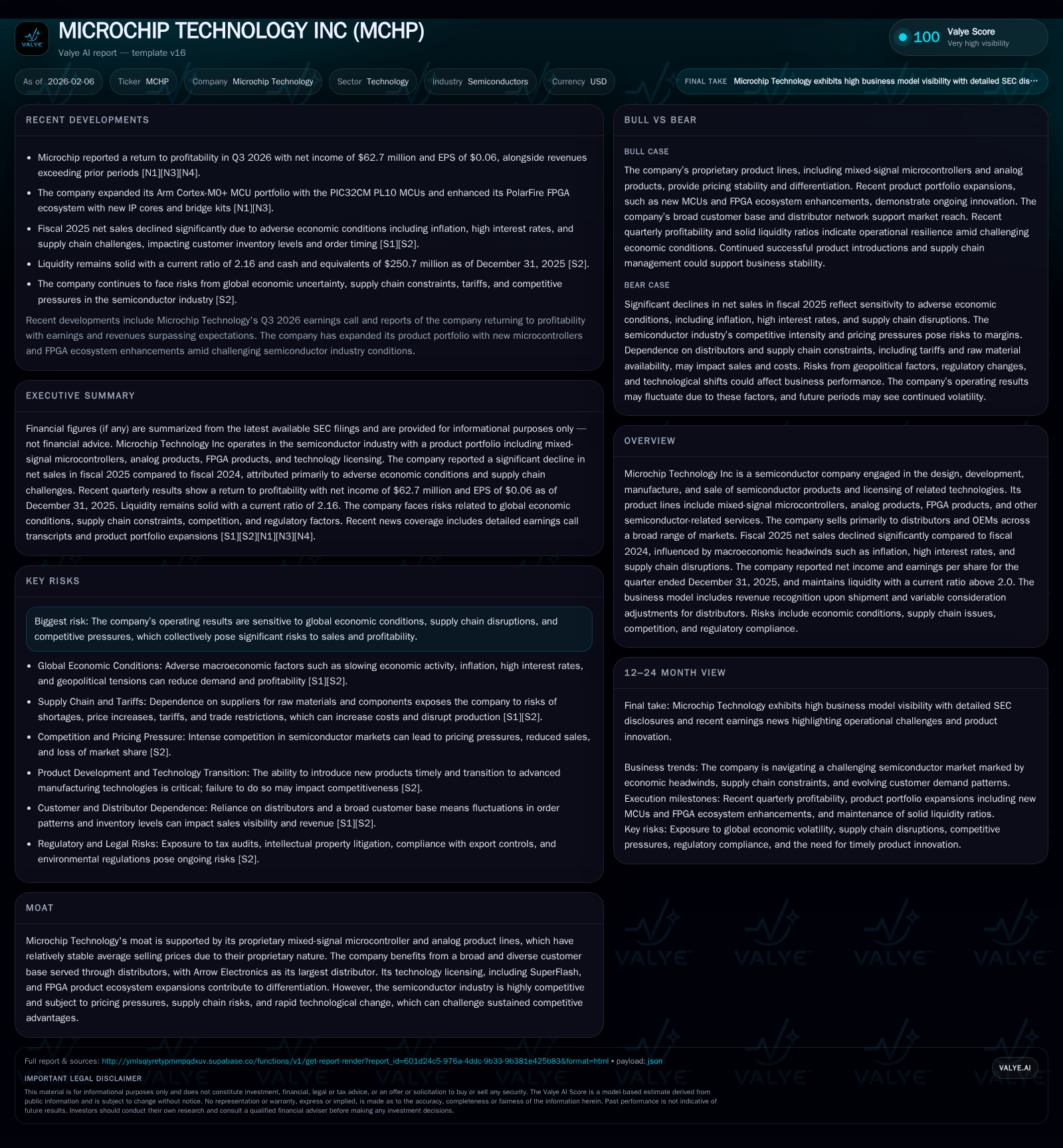
Microchip Technology Inc leverages its proprietary mixed-signal microcontroller and analog product lines to maintain pricing discipline amid semiconductor industry commoditization and fierce competition. Despite reported fiscal 2025 revenue declines driven by inflation, high interest rates, and persistent supply chain challenges, Microchip continues to showcase operational resilience, maintaining a healthy liquidity position with a current ratio above 2.0. Nuances in revenue recognition—especially related to distributor concessions—and reshaped manufacturing strategies underscore the company’s adaptation efforts amidst market volatility. However, risks linked to geopolitical tensions, cybersecurity threats, and pricing pressures persist as critical factors influencing Microchip’s forward trajectory.
Microchip Technology’s Enduring Moat in Mixed-Signal Innovation
At its core, Microchip Technology Inc (MCHP) commands a distinctive position shaped by its proprietary mixed-signal microcontrollers and analog product portfolios. This technological foundation underpins a competitive moat that affirms relative price stability even as many semiconductor products face ongoing commoditization pressures [valye_report_excerpt]. The SuperFlash technology licensing business supplements this advantage by embedding itself in customers' device ecosystems.
This niche focus on mixed-signal innovation is not just about product differentiation but also manifests in predictable average selling prices (ASPs), counterbalancing sector-wide aggressive pricing dynamics. Management underscores this point highlighting that their "technology licensing and embedded control product familiarity" act as key client retention pillars [S1]. Additionally, FPGA ecosystem extensions contribute incremental differentiation in an environment otherwise defined by rapid commodity-like erosion.
Nevertheless, sustaining this moat demands swift innovation cycles aligned with evolving market needs, fueled by continued R&D investment. Given the competitive intensity of semiconductor markets dominated by large integrated device manufacturers (IDMs) and foundry-centric models, Microchip’s ability to maintain product mix quality remains critical.
Examining Q3 Fiscal 2026 Earnings: Beyond the Numbers
Microchip’s Q3 fiscal 2026 results slightly exceeded consensus expectations on both revenue and earnings fronts [N1][N3]. Revenues reflected some resilience with $1.3 billion in quarterly sales despite facing macroeconomic drags including persistent inflationary pressures and elevated interest rates curbing end-market capital expenditures [N2]. Net income of $62.7 million was reported for fiscal year-end December 31, 2025 [F1], supported by disciplined spending particularly in selling, general, and administrative costs.
Margin trends showed modest contraction relative to prior periods — not unexpected given elevated raw material costs and shifts in product mix toward more mature segments. Management commentary during the earnings call stressed supply chain improvements but acknowledged lingering uncertainties tied to timing of shipments affecting quarterly comparability [N1]. This ‘‘lumpy’’ shipment pattern can obscure underlying demand trends when juxtaposed with analyst models assuming steadier flows.
Notably, Microchip’s gross margins held above industry averages for comparable semiconductor peers owing to their proprietary technology buffer; however, caution remains warranted as input cost inflation has shown less evidence of abatement [N4]. The macroeconomic environment compels vigilance around customer order patterns which remain volatile amid global economic softness.
Revenue Recognition Nuances and Distributor Dependencies
A complex but crucial aspect of Microchip’s financial reporting is how it accounts for revenue from distributor sales. The company predominantly sells through distributors like Arrow Electronics who receive price concessions and stock rotation rights customary within semiconductor distribution channels [S1]. These variable considerations require management to estimate refund liabilities based on historical data using expected value methods.
Revenue is generally recognized upon shipment when title transfers; however, variable price adjustments introduce quarter-to-quarter fluctuations that can obscure pure demand signals. For example, a mere 100 basis point variation in blended price concession rates influences refund liabilities by $5 million [S1], illustrating tight linkages between distributor incentives and recognized sales.
This dependency on distributor agreements therefore introduces some degree of opacity in interpreting top-line growth trajectories purely from revenue figures — investors must factor potential reversals or catch-up adjustments that could materialize as industry inventory turns evolve or sales return rates fluctuate.
Navigating Supply Chain Challenges Amid Global Economic Volatility
Persistent supply chain disruptions have marked feature points across Microchip’s recent operating backdrop. Tariff impositions, raw material shortages—including specialized silicon wafers—and logistical bottlenecks place strains on manufacturing yields and inventory valuation [valye_report_excerpt]. Such instability heightens the importance of flexible capacity management.
Microchip has been adapting by optimizing production schedules across its global fabrication facilities while cautiously modulating output to prevent excess inventory build-up [S1]. Despite these efforts, some degree of inefficiency remains evident due to forced slowdowns or temporary facility closures tailored to managing costs.
Moreover, pandemic-induced reshaping of global supply chains intersected harshly with geopolitical uncertainties—particularly tensions impacting China trade flows—exacerbating unpredictability over long-term supplier reliability [S2]. These constraints force Microchip’s procurement teams into continuous realignment strategies targeting alternative sourcing frameworks or more localized assembly operations whenever feasible.
Competitive Pricing Pressure and Market Positioning
Semiconductor markets remain fiercely contested arenas where pricing pressure is unrelenting. Microchip confronts this challenge particularly within older proprietary analog lines where modest ASP declines have been documented [valye_report_excerpt]. Newer products gain some reprieve thanks to incremental innovation cycles but cannot entirely neutralize industry-wide margin compressions.
The company’s scale benefits vis-à-vis diversified customer bases mitigate share loss risks somewhat; nonetheless competitors engage aggressively across segments targeting design wins or volume discounts to erode incumbents’ positions [S2]. Such dynamics compel ongoing R&D investment paired with selective price discipline — a balancing act highlighted by management acknowledging "modest pricing declines but offset partly by value-added features" during recent disclosures [N1].
In essence, retaining premium positioning requires continual product refreshment intertwined with robust intellectual property protections around technologies like SuperFlash memory components.
Manufacturing Strategy: Internal Capacity vs Outsourcing Dynamics
One of Microchip's strategic pivots lies in reshaping its manufacturing footprint towards greater internal control over assembly and test functions [S1]. Moving certain outsourced activities in-house enables tighter production oversight while potentially lowering variable costs over time. Capital expenditure plans reflect these ambitions with targeted investments allocated for capacity expansions supporting new product families.
This dual approach—to strengthen internal facilities while leveraging external foundries where beneficial—provides a flexible platform adapting dynamically to market cycles or shifting demand profiles. The transition requires balancing upfront capital outlays against expected efficiency gains or yield improvements.
Management reiterates confidence that these moves will further bolster overall cost effectiveness without sacrificing responsiveness amidst evolving customer requirements [S1]. Yet execution risks persist given the complexity of semiconductor manufacturing ecosystem coordination across multiple geographies.
Risks on the Horizon: Cybersecurity, Regulations, and Geopolitical Factors
Looking beyond operational concerns lie multifaceted risks integral to Microchip's forward path. Cybersecurity threats persist as cyberattacks targeting intellectual property or confidential customer data become increasingly sophisticated [valye_report_excerpt]. Although management assesses that recent IT compromises have had no material detrimental impact so far, vigilance remains paramount.
Regulatory complexities also weigh heavily—especially given sizeable governmental contract exposure layered atop export control regimes governing semiconductor technology transfers. Compliance burdens intensify alongside international tax disputes creating uncertainty over effective tax rates or cash tax liabilities [S2].
Geopolitical frictions manifest through tariffs volatility or access restrictions within key markets like China pose ongoing structural risks disrupting global supply continuity or escalating raw material costs. Such factors accentuate the necessity for adaptive sourcing strategies while potentially curtailing certain revenue streams dependent on sensitive sectors.
Forward-Looking Capital Allocation and Investment Priorities
Capital allocation decisions illuminate management’s intent to simultaneously fortify manufacturing capacity internally while advancing R&D productivity [S1][valye_report_excerpt]. The planned capital expenditures aim explicitly at sustaining growth avenues tied to next-generation devices demanded by evolving embedded control applications alongside FPGA platform enhancements.
Efficiency initiatives are designed both to improve cost baselines and accelerate time-to-market capabilities with increasingly complex chips integrating analog-mixed signal functionalities disrupted by AI-driven market shifts. This dual investment thrust complements selective licensing ventures that underpin recurring revenue streams derived from technology patents like SuperFlash memory architectures.
Ultimately these priorities signal Microchip’s commitment to embedding technological relevance firmly within its industrial fabric even amid challenging broader economic backdrops.
Investor Implications: Liquidity, Valuation, and Growth Prospects
From a financial health perspective, Microchip exhibits robust liquidity markers including a current ratio exceeding 2.0 as of fiscal year-end December 31, 2025 ($2.29 billion current assets vs $1.06 billion liabilities) complemented by $250 million cash reserves offering cushioning against cyclical downturns or unexpected expenditures [F1].
Yet net income remains pressured at $62.7 million under persistent inflationary input costs compressing margins somewhat compared with prior cycles reflecting continuing economic headwinds [F1][valye_report_excerpt]. This interplay frames a narrative around measured resilience rather than unmitigated expansion — one calling for astute monitoring around demand recovery pace especially within automotive and industrial end markets reliant on semiconductors.
In aggregate, investor considerations must weigh the benefits arising from proprietary technological moats against vulnerability stemming from external macroeconomic shocks plus industry structural forces driving margin squeeze potential over medium terms.
This analysis draws exclusively upon publicly available filings and recent news incorporating direct citations without speculation beyond presented information. It aims to elucidate key facets shaping Microchip Technology Inc’s current position within an intensely competitive semiconductor landscape without providing investment advice or recommendations.
Disclaimer: This is research-only, informational analysis and not investment advice. It may include AI-generated interpretation and general industry context. Always verify important details using primary sources.

Comments