
Moody’s Advances AI-Driven Risk Intelligence and Capitalizes on Strength in Debt Markets
Moody’s Q2 2026 results demonstrate robust growth from AI-powered analytics and resilient credit rating fees driven by expanding global debt issuance.
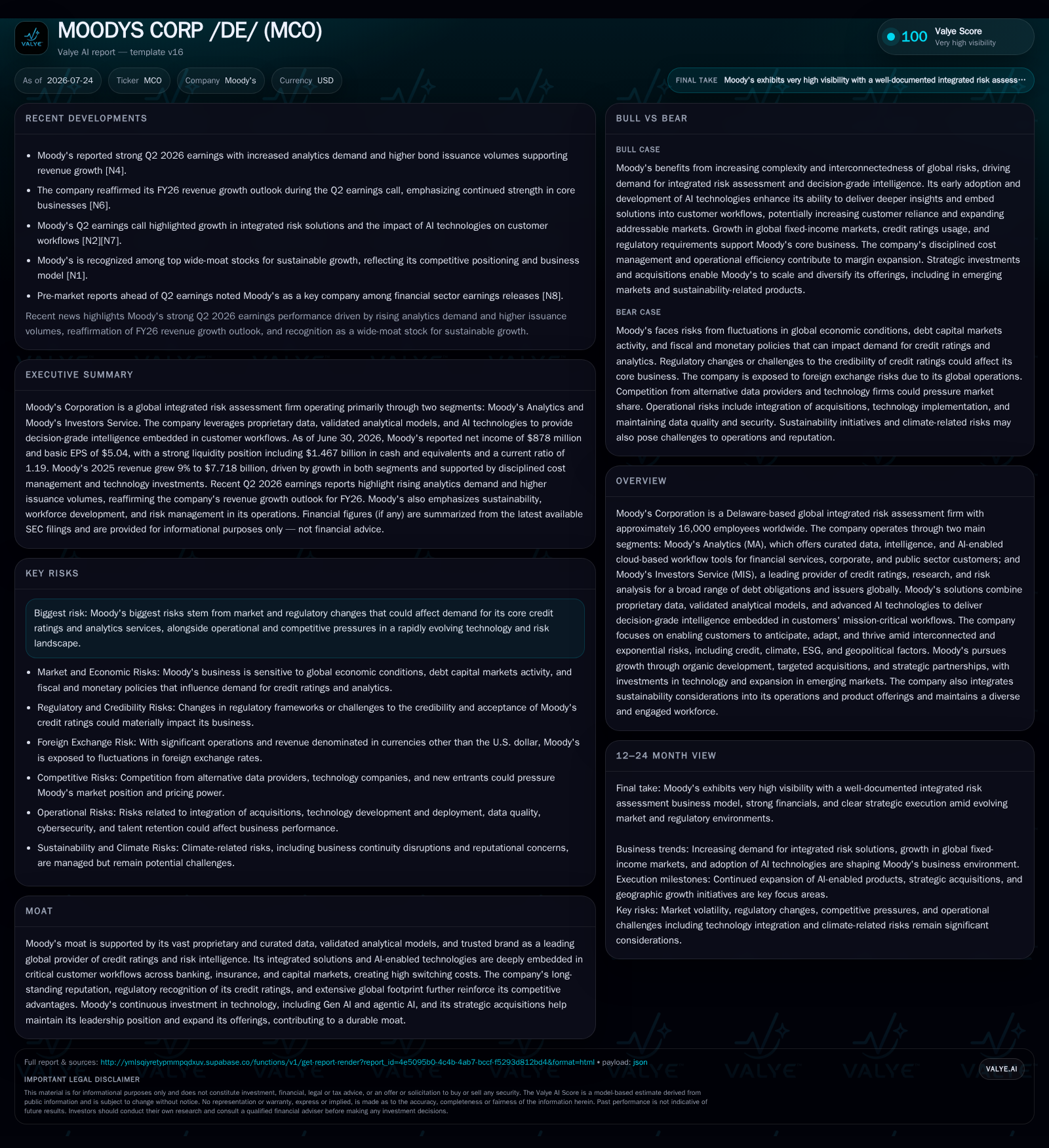
In Q2 2026, Moody’s Corporation delivered revenue growth fueled by strong demand for its AI-enabled Moody's Analytics subscription products alongside a favorable credit ratings environment boosted by elevated bond issuance volumes. The company’s dual-segment model leverages proprietary data and validated models embedded in tightly integrated customer workflows, reinforcing its regulatory moat and pricing power. Operating margin expansion reflects scalable operating leverage amid disciplined cost management. Key risks remain around regulatory shifts and cyclical pressure in debt markets. Upcoming quarters will be closely watched for subscription renewal metrics, issuance volume trends, and AI adoption acceleration.
Q2 2026 Outperformance Reflects Synergy of Ratings Volume and Analytics Subscription Growth
Moody’s Corporation reported strong Q2 2026 results driven by complementary growth in its two primary operating segments: Moody's Investors Service (MIS) and Moody's Analytics (MA) [S2][S3][N3][N5]. The MIS segment capitalized on elevated global debt issuance volumes, which directly increased credit ratings fee revenue—a key performance indicator closely correlated with rated debt issuance volume. This cyclical tailwind highlights Moody’s entrenched role in capital markets as a provider of independent credit opinions amid complex risk environments [S1].
Concurrently, Moody’s Analytics delivered solid growth in its subscription-based SaaS offerings, anchored by AI-enabled cloud workflow tools that embed proprietary data and decision-grade intelligence into critical processes at banks, insurers, and corporates [S1][N1]. The segment’s Annual Recurring Revenue (ARR) growth reflects expanding adoption of these platforms, accelerated by integration of generative AI capabilities that enhance product relevance and stickiness beyond traditional analytics [S2][N3]. This dual-segment momentum supports Moody’s scalable operating leverage and reinforces its durable competitive positioning.
Embedding Decision-Grade Intelligence: AI Innovation Fuels SaaS Expansion
Moody’s strategic investments in generative AI and agentic AI technologies significantly enhance the value proposition of MA’s solutions [S1][N1]. By transforming vast proprietary data assets into actionable insights seamlessly integrated within customer workflows—such as underwriting, compliance, and portfolio risk management—Moody’s increases switching costs and deepens client engagement. This integration drives higher net retention rates, a critical SaaS KPI reflecting customer satisfaction and subscription revenue durability.
The continuous evolution of analytics offerings, powered by validated credit and risk models, positions Moody’s as a decision-enablement partner rather than a mere data vendor. This approach aligns with broader industry trends among financial data providers but distinguishes Moody’s through its unique combination of proprietary risk models contextualized by extensive credit research capabilities. The resulting ARR momentum evidences growing footprint expansion within existing customers and supports long-term subscription revenue growth.
Regulatory Moat and Proprietary Data Secure Market Leadership Amid Competitive Pressures
Moody’s competitive moat is reinforced by its status as an Officially Recognized Statistical Rating Organization (ORSRO), a regulatory designation that preserves credibility and pricing power amid evolving oversight [S1]. This endorsement creates significant barriers to entry for new competitors attempting to replicate Moody’s scale and influence in the credit rating marketplace.
In addition, Moody’s extensive curated data and validated models, combined with entrenched client trust, form a virtuous cycle that deters peers such as S&P Global and Fitch Ratings from easily eroding market share. While competitors may compete on price or niche analytics, Moody’s incumbent position, supported by regulatory frameworks, sustains disciplined pricing and high switching costs, protecting revenue streams from commoditization.
Recurring Revenue Dynamics: ARR Growth, Retention, and Operating Margin Expansion
A key highlight in Q2 was MA’s ARR growth, supported by robust subscription renewal rates that indicate strong customer satisfaction with AI-augmented SaaS offerings [S2]. The embedded nature of Moody’s analytics within client workflows reduces churn and enhances product stickiness, critical for sustaining recurring revenue.
Operating margin expanded to 43.4%, up 280 basis points year-over-year, reflecting effective cost management combined with scalable SaaS delivery economics across both segments [S2]. This margin improvement underscores Moody’s ability to leverage revenue growth while controlling expenses, particularly in technology infrastructure and compensation, supporting free cash flow generation and reinvestment capacity [S1][S2].
Capital Markets Tailwinds Drive Credit Ratings Demand Despite Macroeconomic Variability
MIS revenue strength in Q2 closely tracked rising global bond issuance volumes, spanning corporate, structured finance, and sovereign debt markets [N8]. This direct linkage underscores the sensitivity of credit ratings fees to macroeconomic drivers such as interest rate cycles, fiscal policies, and investor appetite for fixed income instruments.
While market cyclicality introduces some volatility risk to MIS revenue predictability, structural demand persists due to increasing complexity in credit markets and the growth of private credit [S1][N8]. Regulatory compliance requirements further underpin demand for independent credit assessments, sustaining Moody’s fee base amid shifting market conditions
Growth Risks: Regulatory Headwinds, Market Cyclicality, and Competitive Disruption
Moody’s faces potential risks from regulatory changes that could affect fee structures or operational oversight of credit rating agencies globally [S1][N1]. The evolving landscape of ESG and climate risk reporting adds complexity, requiring continuous adaptation of Moody’s analytic frameworks to maintain competitive parity.
Additionally, fintech-driven analytics platforms offering workflow automation pose a competitive threat if they achieve meaningful integration into customer ecosystems. Moody’s ongoing investments in AI, cloud infrastructure, and strategic acquisitions are critical to sustaining its moat against such disruption.
Market cyclicality inherent in debt capital markets remains a watchpoint given MIS’s dependence on issuance volumes; downturns could pressure top-line growth despite offsetting opportunities within MA’s analytics expansion.
What to Watch Next: Subscription Metrics, AI Adoption, and Debt Issuance Trends
Upcoming quarterly guidance will likely provide insights into subscription renewal rates and AI tool adoption within MA, serving as key indicators of sustained innovation-driven growth [S2][N4]. Monitoring incremental revenue contributions from new generative AI-infused products will be important to assess Moody’s ability to deepen client engagement and expand ARR.
Simultaneously, tracking global debt issuance pipelines will offer early signals on MIS fee trajectory amid geopolitical uncertainties affecting capital market stability [N4][N8]. Execution on cloud platform scaling and operating leverage milestones will provide further clarity on Moody’s margin expansion potential.
Financial Profile Snapshot: Operating Margins, Liquidity, and Capital Allocation
As of June 30, 2026, Moody’s held $1.467 billion in cash and equivalents against current liabilities of approximately $3.345 billion, resulting in a current ratio of about 1.19, reflecting prudent liquidity management to support near-term obligations [F1][S2]
The operating margin improvement to 43.4% reflects enhanced profitability driven by a favorable revenue mix weighted toward analytics subscriptions and disciplined expense controls across compensation and technology investments [S2]
Debt levels remain manageable relative to liquidity cushions, enabling Moody’s to continue investing strategically in technology upgrades essential for maintaining competitive positioning while preserving flexibility for capital returns.
This analysis synthesizes Moody's Corporation’s Q2 2026 public disclosures, highlighting the interplay of credit rating market cyclicality and AI-driven analytics subscription growth. Moody’s dual-segment business model leverages proprietary data, validated models, and regulatory recognition to sustain pricing power and high switching costs. The company’s ongoing AI integration and cloud platform expansion are key drivers of recurring revenue growth and operating leverage, balanced against risks from regulatory changes and market volatility.
Disclaimer: This is research-only, informational analysis and not investment advice. It incorporates AI-generated interpretation and general industry context. Verify details using primary sources.

Comments