
MongoDB Inc: Navigating Cloud Database Growth Amid Competitive and Economic Challenges
MongoDB continues to expand Atlas revenue and global footprint amid increasing competition, economic headwinds, and evolving technology demands.
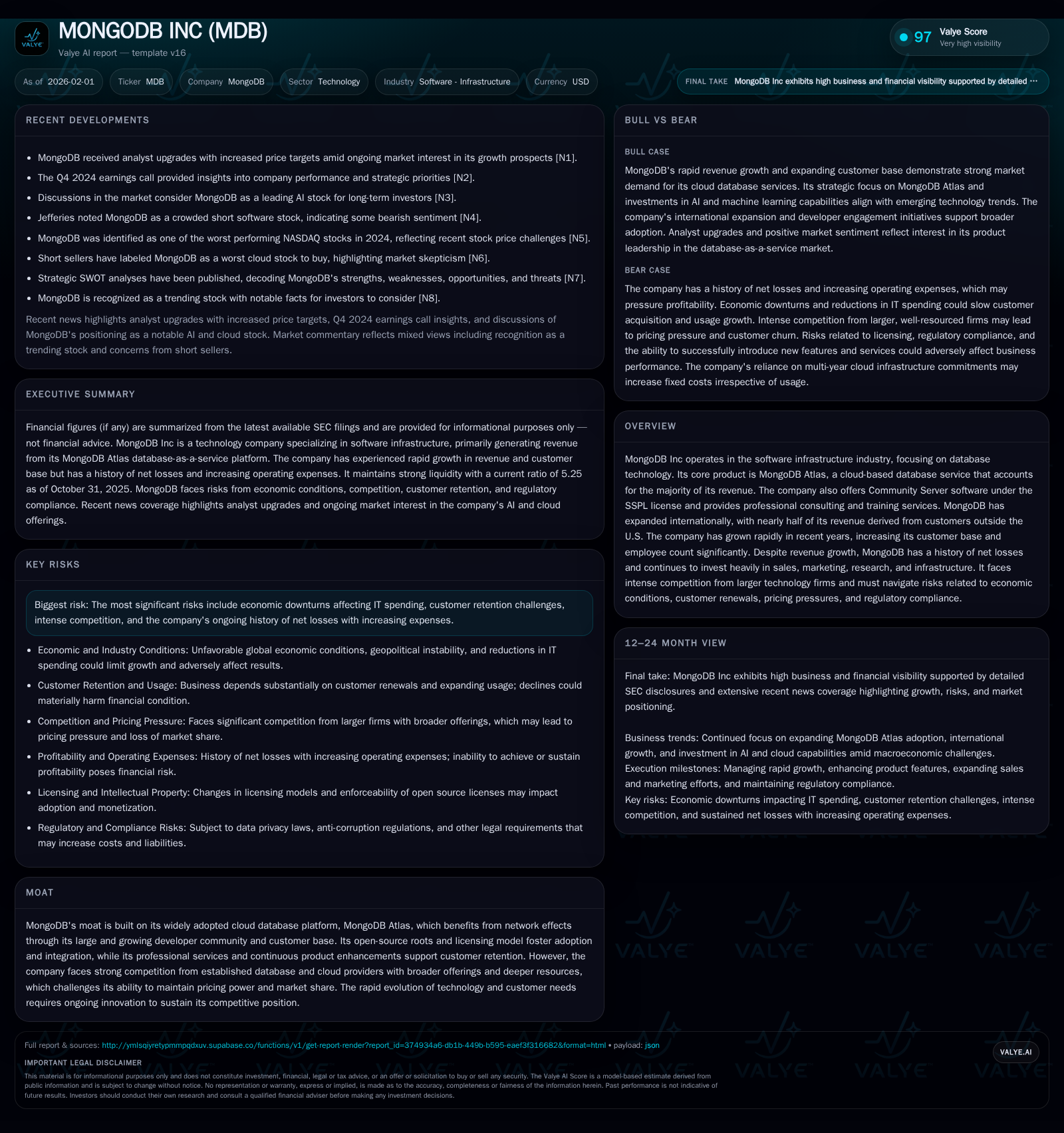
MongoDB Inc remains a prominent player in the cloud database infrastructure space, driven by its flagship MongoDB Atlas platform. Despite strong revenue growth and an expanding international presence, the company faces profitability challenges due to high sales and marketing expenses and significant investments in R&D. Competition from hyperscalers and traditional database vendors intensifies pressure on pricing and customer acquisition. Economic uncertainties have slowed existing customer expansion, underscoring risks in demand predictability. MongoDB’s open-source heritage and developer community engagement underpin its moat, but sustaining growth requires continuous innovation and operational discipline.
What Changed Recently
MongoDB Inc reported its Q4 2024 earnings with continuing revenue growth, but revealed a slowdown in the growth rate of existing Atlas applications, attributed largely to adverse macroeconomic conditions including cautious IT spending by customers [N1][S5][S8]. Despite mixed sentiment in public markets—with some analyst upgrades contrasting with bearish short seller views—the company remains focused on expanding MongoDB Atlas, its cloud database-as-a-service platform, which now contributes the majority of revenue. MongoDB also continues to invest heavily in sales, marketing, and R&D, reflecting ongoing efforts to penetrate a competitive market and build out AI and ML capabilities [N2][N3][N5][N7]. The company’s international footprint remains sizable, generating roughly 46% of revenue outside the U.S., but geopolitical and regulatory risks persist, especially in EMEA and Asia [S2]. Open-source Community Server licensing under SSPL continues to be a strategic lever but carries adoption uncertainty given the license’s novelty and lack of OSI endorsement [S7].
Business Model as a System
MongoDB’s business centers on its cloud-native document database platform, MongoDB Atlas, which operates on a consumption-based pricing model primarily recognized on actual usage, making revenues sensitive to customer activity levels [S5]. The company supplements this with its Community Server, software licensed under the Server Side Public License (SSPL) designed to encourage usage while limiting cloud providers from monetizing the software without contribution back to the community [S7]. This open-source foundation fuels developer mindshare, supporting growth through a broad ecosystem including MongoDB University, local user groups, and partnerships with global system integrators and ISVs [S1].
The company invests heavily in sales and marketing — historically 43% to 54% of revenue — to attract and convert new customers, educate the market on the benefits of non-relational, JSON document-based databases, and expand its brand globally [S1]. Professional services including consulting and training accelerate adoption and facilitate migrations from traditional relational databases, which remain a significant competitive hurdle due to incumbent lock-in and customer inertia [S4].
MongoDB’s revenue growth depends on increasing the number of Atlas customers, expanding usage within existing customers, and international market penetration. However, MongoDB carries risks related to customer retention and renewals, pricing pressure, and the cost of sales and marketing, which have historically undermined profitability despite strong top-line growth [S3][S9].
The company also faces operational complexity from rapid growth: scaling from just over 700 employees in 2017 to more than 5,500 by early 2025, with significant investments in cloud infrastructure capacity subject to multi-year non-cancelable contracts, further weighing on margins [S6][S9][S11].
Industry Map & Competitive Battlefield
MongoDB operates at the intersection of database infrastructure, cloud computing, and developer-oriented software platforms. Its primary competitive set includes:
- Hyperscale cloud providers such as AWS (offering Amazon DocumentDB), Microsoft Azure Cosmos DB, and Google Cloud Firestore, which bundle database services with extensive cloud ecosystems and global infrastructure.
- Traditional relational database vendors like Oracle, IBM Db2, and Microsoft SQL Server, which have long-standing enterprise relationships and entrenched deployments.
- Other NoSQL and multi-model database providers including Couchbase, Cassandra, and Redis Labs.
MongoDB’s open-source roots and document model offer flexibility and developer productivity advantages, fueling adoption among modern application developers. However, large cloud providers leverage their platform breadth to bundle database offerings at competitive pricing, making it difficult for MongoDB to maintain premium pricing or prevent customer migration to bundled alternatives [S17].
Competition also comes from specialized vendors offering lower-cost or more narrowly focused solutions in certain geographies or verticals. The rapid pace of innovation in AI/ML and data analytics introduces both opportunities and threats, as database platforms integrate advanced capabilities to support new workloads [S12][S13].
Given the crowded landscape, MongoDB’s moat relies heavily on its developer community, continuous product enhancements, ecosystem partnerships, and the balance between open-source friendliness and commercial monetization [S7][S17].
Where the Economics Become Real
MongoDB’s unit economics hinge on balancing customer acquisition costs with long-term usage expansion and renewal rates. The subscription and usage-based revenue from Atlas is subject to variability, as customers may scale their consumption up or down based on economic conditions and internal IT priorities [S5][S3]. Historical data shows sales and marketing expenses consume a large portion of revenue, reflecting high upfront costs to onboard and educate customers, which delays profitability [S1][S9].
Infrastructure costs are amplified by non-cancelable multi-year commitments with cloud providers, creating fixed cost burdens irrespective of actual customer usage, adding financial leverage but also risk [S9][S11]. Research and development expenses are significant as MongoDB invests to maintain technological leadership, particularly integrating AI and machine learning features that demand specialized expertise and prolonged development cycles [S12].
International expansion adds further complexity and costs, as the company must navigate diverse regulatory environments, adapt products for local markets, and manage longer payment cycles and collection risks [S2][S8].
Profitability remains elusive due to these cost structures, even as revenue grows. The company reported net losses of $129 million for fiscal 2025, down from $176 million in 2024, but with an accumulated deficit approaching $1.8 billion [S9]. Cash on hand and a strong current ratio provide liquidity, but sustained losses necessitate continued operational discipline and revenue growth acceleration [S10].
Diligence Questions / Disconfirming Signals
- What is the trend in net customer additions and net revenue retention for Atlas customers, particularly among large enterprises?
- How sticky is Atlas usage given economic uncertainty and competition from hyperscalers’ bundled offerings?
- How effective are sales and marketing investments in converting free-tier or community users into paying customers, and is there evidence of diminishing returns?
- What is the roadmap and timeline for AI/ML feature integration, and how will this differentiate MongoDB versus competitors?
- How is MongoDB managing the risks and costs associated with international expansion, especially regulatory compliance and geopolitical tensions?
- Is the SSPL license impacting Community Server adoption positively or negatively, and how is MongoDB balancing open-source community expectations with monetization?
- How exposed is MongoDB to infrastructure capacity commitments during periods of slowed demand?
- Are there material risks from emerging data privacy laws and cybersecurity regulations that could require product or operational changes?
- How is MongoDB addressing the scalability and complexity challenges arising from rapid growth in employees and global operations?
These questions highlight key areas where MongoDB’s strategic execution and market dynamics will determine its ability to sustain growth and move toward profitability amidst a competitive and uncertain landscape.
This analysis is based on publicly available information as of early 2026 and is intended for informational purposes only. It does not constitute investment advice or a recommendation to buy or sell securities.
Disclaimer: This is research-only, informational analysis and not investment advice. It may include AI-generated interpretation and general industry context. Always verify important details using primary sources.

Comments