
Functional Brands Faces Financial Strain but Pursues Growth Through Innovation and Strategic Acquisitions
The latest quarterly filings reveal tight liquidity challenges and ongoing losses, while the company's product expansion and digital health integration aim to fuel growth.
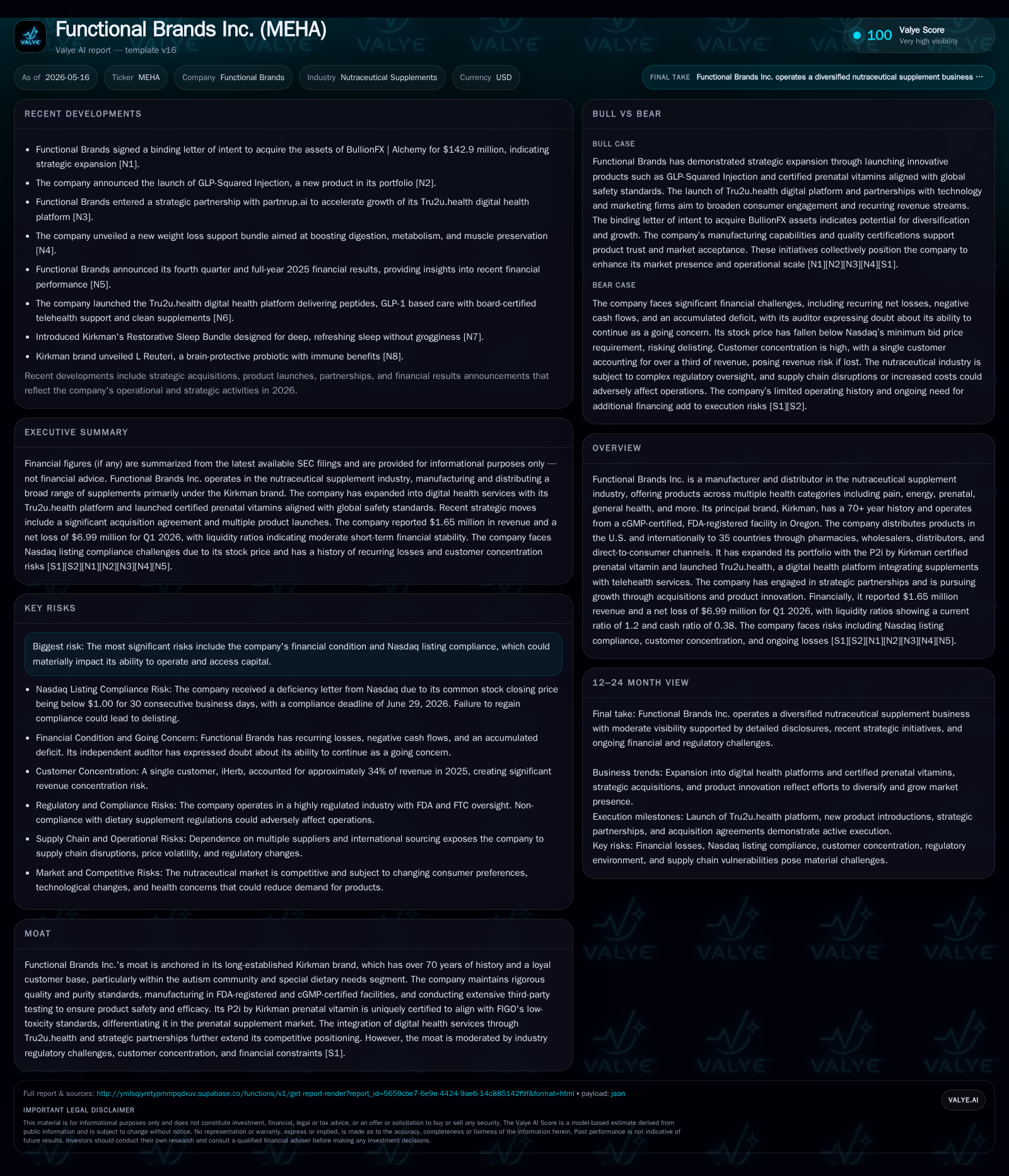
Functional Brands Inc. reported a net loss of $6.99 million in Q1 2026 and maintains a modest cash position with a current ratio of 1.2, underscoring ongoing liquidity pressures. The company’s core strength remains its Kirkman brand, known for high-quality nutraceutical products certified by FDA-registered and cGMP facilities. Recent moves include a conversion price adjustment on preferred stock and strategic engagements such as the launch of GLP-Squared Injection and expansion of its telehealth platform Tru2u.health. Despite headwinds including regulatory complexity and distributor concentration risks, Functional Brands seeks growth through targeted acquisitions and product innovation in evolving wellness categories.
Recent Operating Update
In its latest quarterly report filed on May 15, 2026 ([S2]), Functional Brands Inc. disclosed continued financial stress characterized by a net loss of $6.99 million in Q1 2026. The company reported cash and equivalents balancing at approximately $1.08 million against current liabilities around $2.84 million, yielding a current ratio of about 1.2 [F1]. This financial snapshot signals ongoing liquidity constraints that may challenge operational sustainability without additional capital or improved sales performance.
Further highlighting capital structure dynamics, on May 11, 2026 Functional Brands entered into an agreement with all holders of its Series C Convertible Preferred Stock to reduce the conversion price to $0.1636 per share during the fixed conversion period ([S3], [N4]). This adjustment simplifies conversion mechanics from previously tiered prices and may influence shareholder dilution and capital flexibility.
Strategically, Functional Brands is actively pursuing growth initiatives despite operational headwinds: on May 6 the company announced the market introduction of its GLP-Squared Injection targeting the weight management segment ([N3]). Further expanding its digital capabilities, Functional Brands recently forged a partnership with partnrup.ai to accelerate adoption of its Tru2u.health telehealth platform integrating supplement regimens with remote clinical support ([N1]). Additionally, the company signed a binding Letter of Intent aiming to acquire BullionFX's assets for $142.9 million ([N2]), signaling diversification efforts beyond core nutraceuticals.
Business Model
Functional Brands operates predominantly as a manufacturer and distributor within the nutraceutical supplement space ([S1], [S15]). Its flagship Kirkman brand benefits from over seven decades of heritage focusing on specialized supplements serving categories like pain relief, energy enhancement, prenatal care—including the certified low-toxicity P2i by Kirkman vitamin—immune function, bone & joint health, digestive wellness, mental clarity/ focus, sleep aids, cardiac support, detoxification products, and urinary health.
Revenue accrues primarily through sales to pharmacies, wholesalers across the U.S., international distributors spanning 35 countries, and increasingly through direct-to-consumer channels enabling higher margin capture ([S1], [S15]). The company's reliance on independent distributors is pivotal but introduces dependency risk since distributor retention impacts geographic reach and retail presence ([S19]).
Manufacturing leverages FDA-registered facilities adhering rigorously to cGMP standards coupled with third-party testing regimes ensuring product purity—a key differentiator within a competitive market rife with quality concerns ([S1], [S8]). The positioning around special dietary needs notably appeals to communities such as autism spectrum disorders creating a loyal customer niche.
The digital health ecosystem under Tru2u.health expands the company’s value proposition by embedding supplement use within telehealth consultations—an emerging trend that links compliance improvement with personalized medicine approaches ([N1], [N5]). This digitally driven channel complements traditional brick-and-mortar sales while generating more frequent customer engagement.
Industry Structure and Competitive Position
Nutraceuticals form an intensely fragmented sector characterized by diverse product sets ranging from conventional vitamins to specialized botanical extracts as well as functional food components ([S1]). Within this field, regulatory oversight remains complex due to tenuous FDA jurisdiction—products are not FDA-approved drugs but must meet strict labeling and manufacturing compliance under DSHEA rules ([S8], [S14]).
Functional Brands’ competitive moat resides in its Kirkman brand credibility supported by rigorous quality protocols uncommon among many smaller players lacking FDA-registered manufacturing footprint or NSF/cGMP certification (). The P2i by Kirkman prenatal vitamin commanding FIGO-aligned certification further differentiates it amid prenatal contenders typically undistinguished in formulation quality.
Integration of telehealth via Tru2u.health suits growing consumer demand for connected wellness solutions driven by convenience, personalization trends accelerated post-pandemic ([N1]). Such hybrid model integration edges out competitors solely dependent on OTC retail channels while enabling cross-selling opportunities.
Nonetheless, competitive threats include increasing FDA scrutiny risks potentially tightening permissible claims or prompting regulatory enforcement actions that would impact marketing efforts or necessitate reformulations ([S8], [S14]). Moreover, pricing pressure from large-scale national retailers or generic brands could compress margins — Functional Brands’ premium quality focus could partly insulate it but only if validated in customer perceptions.
Growth Drivers
Key growth drivers lie in product innovation backed by scientific certifications (e.g., FIGO certification for prenatal vitamins), expansion of digital health platforms merging supplements with telemedicine services (Tru2u.health), strategic pick-up of acquisition targets offering cross-market synergies (BullionFX assets LOI), and international market penetration via distributor networks spanning over 35 countries ([N1], [N2], [N5], [S15]).
Innovation pipeline includes recently launched weight management adjuncts like GLP-Squared Injection tapping into lucrative metabolic health categories increasingly sought after amid rising obesity awareness ([N3]). Importantly, digital platform extensions facilitating NAD+ supplementation highlight responsiveness to new wellness paradigms focusing on cellular energy enhancement combining biochemistry advances with consumer trends ([N5]).
The Letter of Intent regarding BullionFX suggests plans to diversify beyond nutraceuticals potentially mitigating concentration risk inherent in supplement markets although related integration complexity will require meticulous execution ([N2]).
Growing direct-to-consumer sales bolster margins by bypassing traditional distribution intermediaries while also assembling proprietary customer datasets crucial for personalized marketing strategies intrinsic to modern wellness companies ([S15]).
Risks / Watchpoints / Growth Constraints
Financial viability remains precarious as recurring operational losses aggregate significant deficit posing going concern doubts stated explicitly by auditors ([S1], [S17]). Cash runway appears limited given negative cash flows juxtaposed against modest liquidity reserves (approx $1 million cash vs $2.84 million liabilities) [F1]. Failure to meet revenue targets could exacerbate capital shortfalls requiring dilutive financing or asset divestitures.
Nasdaq listing compliance poses another material risk due to persistent stock price trading below minimum bids triggering deficiency notices communicated late December 2025; failure to regain compliance by June 29 poses delisting threat requiring remedial steps such as reverse splits ([S4], [S11]).
Regulatory flux around dietary supplements enforces constant monitoring; unexpected changes could increase compliance costs or restrict marketing claims impacting competitive posture ([S8], [S13]-[S14]). Litigation including contract disputes such as with True Health Medical Center introduce contingent liabilities injecting legal uncertainty into operations ([S1] Legal Proceedings).
Distributor dependence renders market access susceptible should relationships falter; expanded international presence entails geopolitical/regulatory complexity impairing cost efficiencies or requiring costly infrastructure investment ([S19], [S13]). Rapid growth may strain production capacity given that scaling nutraceutical manufacturing safely requires maintaining batch consistency which is non-trivial in ingredient sourcing.
Acquisition integration risks remain notable especially for large deals like BullionFX asset purchase which carries execution uncertainties affecting expected financial outcomes if synergistic benefits are not realized promptly or cost overruns occur.
What to Watch Next
Investors should monitor quarterly sales trajectory improvements signaling stabilizing demand given prior cost containment measures have limited upside absent top-line growth (reported Q1 loss set challenging baseline) ([S2], [F1]).
Progress toward Nasdaq bid price compliance remains critical; any remedial moves such as reverse splits or forward stock actions could materially affect shareholder structure and perception ([S4], [S11]).
Announcements confirming closing or terms on BullionFX acquisition will be pivotal milestones hinting at strategic diversification success or potential integration impact timeline ([N2], upcoming event filings).
Further rollouts or user adoption metrics related to Tru2u.health platform expansion including new clinical service partnerships constitute important leading indicators for digital channel viability (§[N1],[N5]).
Regulatory developments especially from FDA/FTC impacting labeling or marketing practices warrant close attention given their substantive influence over operational adaptability ([S8], [S13]-[S14]).
Finally, watch for periodic updates on financing initiatives or capital raises crucial to sustaining working capital needs without which growth ambitions remain constrained.
Financial Profile Summary
Latest financial snapshot
| Metric | Value | Period |
|---|---|---|
| Cash & equivalents | $1077967 | |
| 2026-03-31 | ||
| Total debt | $139571 | |
| 2026-03-31 | ||
| Net debt | $-938396 | |
| 2026-03-31 | ||
| Current assets | $3mm | |
| 2026-03-31 | ||
| Current liabilities | $3mm | |
| 2026-03-31 | ||
| Current ratio | 1.2x | |
| 2026-03-31 |
Source: SEC companyfacts cache [F1].
| Metric | Value (USD) | Period End |
|---|---|---|
| Cash & Equivalents | 1,077,967 | |
| 2026-03-31 | ||
| Total Debt | 139,571 | |
| 2026-03-31 | ||
| Current Assets | 3,397,323 | |
| 2026-03-31 | ||
| Current Liabilities | 2,837,840 | |
| 2026-03-31 | ||
| Current Ratio | 1.2 | |
| 2026-03-31 | ||
| Net Income (Q4 FY25) | (6.99) million* | Q1 FY26 (loss) |
Liquidity metrics reveal tight operational cash cushions relative to liabilities which underscores pronounced leverage risk though absolute total debt remains relatively low compared to asset base suggesting limited external borrowing thus far.
This analysis is based solely on information available as of May 16th, 2026 from SEC filings and public disclosures without offering investment recommendations or prognostications about stock performance.
Disclaimer: This is research-only, informational analysis and not investment advice. It may include AI-generated interpretation and general industry context. Always verify important details using primary sources.

Comments