
Ramaco Resources Battles Volatile Coal Markets and Rare Earth Project Challenges
The company’s latest quarter reveals mounting pressures from transportation costs and rare earth development hurdles amidst a concentrated coal customer base.
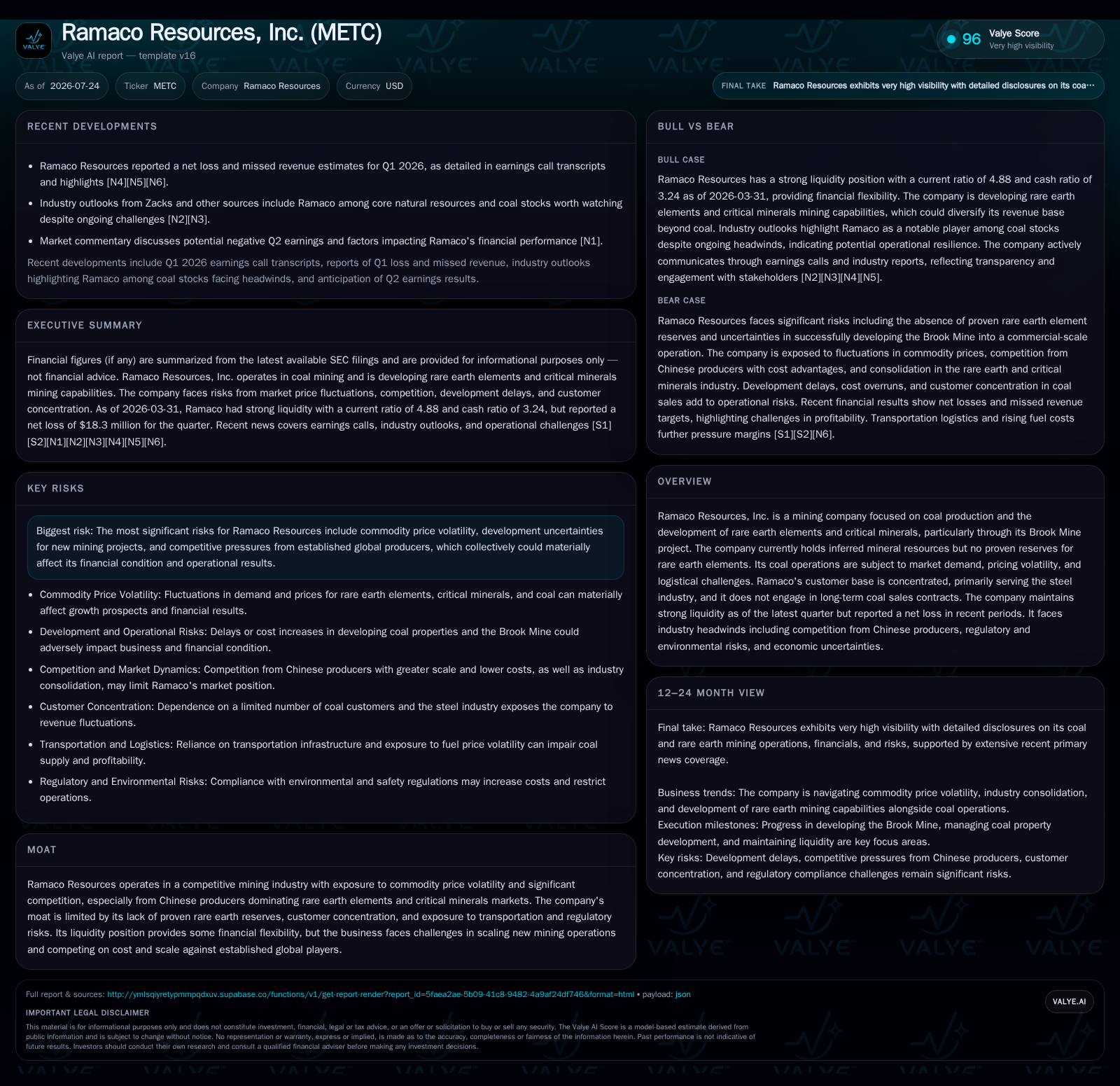
Ramaco Resources’ 2026 first-quarter disclosures highlight ongoing cost headwinds due to increased diesel fuel prices affecting coal transportation logistics, which tighten margins in the absence of long-term sales contracts. The Brook Mine rare earth elements project remains at an early, high-risk development stage with only inferred resources reported, facing competitive pressures from established global players, particularly Chinese producers. Customer concentration in the steel industry and logistical constraints compound revenue volatility. While the company maintains significant liquidity, net losses persist reflecting operational challenges and capital expenditure demands. Near-term growth depends on navigating these factors alongside commodity price cycles and infrastructure capacity.
Latest Quarterly Operating Highlights: Transportation Costs Squeeze Coal Margins, Development Delays Loom
Ramaco Resources’ first quarter of 2026 underscores intensifying operational challenges driven primarily by transportation logistics. The company highlights how rising diesel fuel prices directly inflate coal transportation costs, a crucial component since these add materially to delivered coal prices that determine competitiveness in its steel-industry customer segment [S2]. Past rail infrastructure issues experienced in 2022 continue to shadow current operations as the company reports risks of service delays or disruptions caused by factors ranging from accidents to governmental regulation or weather-related events. Such delays could impair timely coal deliveries and consequently constrain revenue generation.
This dynamic matters because Ramaco lacks long-term coal sales contracts, relying predominantly on spot-market sales to a concentrated set of steel industry customers. This exposes Ramaco not only to price volatility but also to fluctuations in demand within the cyclical steel sector [S1]. Importantly, while the company continues coal production operations, volumes sold must navigate these cost pressures alongside uncertain demand without scalability assurances from firm contracts.
Revenue Model Dependence on Spot Coal Sales Amid Steel Sector Concentration Risks
Ramaco's core revenue derives from metcoal sales chiefly to steel producers. This customer concentration signifies that any contraction or shift in purchasing patterns within this sector disproportionately impacts Ramaco’s top-line consistency. Without multi-year contracting frameworks, realized prices are subject to market swings intensifying revenue unpredictability [S1]. Steel industry sensitivity to raw material costs inherently links Ramaco’s financial health closely with macroeconomic steel demand cycles.
Moreover, the absence of long-term contracts means Ramaco carries more exposure than peers exhibiting integrated downstream or marketing agreements that hedge price risks. This positioning reduces pricing power and erodes margin stability during commodity downturns.
Competitive Pressures in Rare Earth Elements: Brook Mine Development Challenges Raise Uncertainty
A strategic growth avenue for Ramaco lies in developing rare earth elements (REE) at its Brook Mine project. However, filings clarify that this project currently holds only inferred mineral resources without proven reserves—a classification signaling exploratory status subject to substantial technical and economic uncertainty [S1][S2].
Such early-stage projects demand significant capital expenditures for exploration, pilot-scale processing facilities, and eventual commercial mining infrastructure. Ramaco faces formidable competitive headwinds here—global REE markets are dominated by established Chinese suppliers who benefit from scale advantages and supply chain integration. This entrenched competition heightens risks around successful cost reduction and product commercialization for Ramaco’s nascent Brook Mine effort.
Given these factors, tangible growth visibility remains limited until the company transitions from inferred resources through technical feasibility studies to proven reserves supported by viable extraction methods.
Supply Chain Constraints: Fuel Price Volatility and Rail Capacity Limit Coal Delivery Competitiveness
Transportation logistics emerge as a critical operating lever shaping Ramaco’s market presence. Diesel fuel price volatility driven by global geopolitical tensions—such as conflicts impacting Middle Eastern crude supplies—and refining capacity bottlenecks have led to elevated transportation expenses [S2]
Additionally, regulatory requirements enforcing emission controls on locomotive fuels further increase demurrage and delivery costs. Since transportation forms a substantial share of total delivered coal cost, these input cost hikes directly compress margins or compel pricing concessions that undermine income potential.
The regional rail network’s limitations exacerbate these effects; constrained capacity or maintenance issues cause shipment delays jeopardizing reliable supply continuity demanded by industrial end-users.
Growth Opportunities Constrained by Capital Intensive Expansion Needs and Regulatory Headwinds
Ramaco acknowledges that scaling production capacity—both for metallurgical coal mines and rare earth mineral processing—requires sizeable capital investments coupled with adherence to complex environmental regulations [S1][S6][S7]. Capital expenditures extend beyond extraction equipment to infrastructure upgrades necessary for efficient logistic operations including preparation plants.
Environmental permitting processes introduce timeline uncertainty while compliance costs create upward pressure on baseline operating expenses. Potential overruns or schedule delays highlight risk profiles typical within upstream mining ventures transitioning from exploration into full production phases.
Moreover, access limitations to critical coal preparation facilities can materially affect product quality standards required by customers when mining expansions occur.
Risk Factors Intensified by Global Economic Conditions and Market Competition Dynamics
Broader macroeconomic conditions—such as inflationary pressures, rising interest rates curtailing industrial activity growth prospects—and geopolitical tensions contribute additional layers of risk case impacting both demand for Ramaco’s coal products and input cost inflation [S1][S2].
Intense competition from low-cost global REE suppliers centered in China constrains market pricing environments. Practices such as dumping or other anti-competitive tactics remain documented risks in the rare earth elements sector globally, undermining newcomers’ profitability potential.
Risks related to workforce shortages exacerbate operational efficiency challenges amid heightened equipment utilization demands required for ramp-up scenarios.
What to Watch for Execution Milestones, Commodity Price Trends, and Development Progress
Upcoming catalysts include operational readouts from Brook Mine pilot plant phases aimed at demonstrating scalable processing capabilities essential for transitioning inferred resources into viable reserves [N1][S1]. Progress here would be pivotal in attracting investment or partnership interest necessary for commercial mining development.
Commodity cycle direction—both for metallurgical coal pricing tied closely to steel production trends and for rare earth element market dynamics influenced by clean energy technology demand—is another major factor shaping forward-looking margin outlooks.
Infrastructure projects addressing rail capacity enhancements or alternative logistic solutions could relieve some delivery bottlenecks currently pressuring margins.
Financial Profile Discussion: Strengthened Liquidity but Ongoing Net Losses Reflect Operational Strains
As of March 31, 2026, Ramaco Resources reported robust liquidity with $355 million in cash and equivalents against $452 million in total debt obligations yielding an approximate net debt of $97 million—a manageable leverage given current assets exceeding liabilities comfortably with a current ratio near 4.9 [F1][S2][S6]
However, recent quarterly results show continued net losses reflecting margin compression arising from elevated transportation costs alongside ongoing capital expenditures mainly directed towards Brook Mine exploration and mining developments [F1]. This financial strain indicates persistent structural challenges tied to commodity volatility, cost inflation, and operational execution risks enumerated above.
Maintaining this liquidity buffer will be critical as capital-intensive projects mature but have yet to generate positive cash flow contributions.
This analysis is based exclusively on publicly available information including SEC filings up to July 2026 and relevant market disclosures. It does not constitute investment advice nor research views regarding Ramaco Resources’ securities.
Disclaimer: This is research-only, informational analysis and not investment advice. It may include AI-generated interpretation and general industry context. Always verify important details using primary sources.

Comments