
Monroe Federal Bancorp's Conservative Growth Amid Local Market Pressures
Recent quarterly results underscore Monroe Federal Bancorp’s credit discipline and community-centric model amidst regional banking challenges.
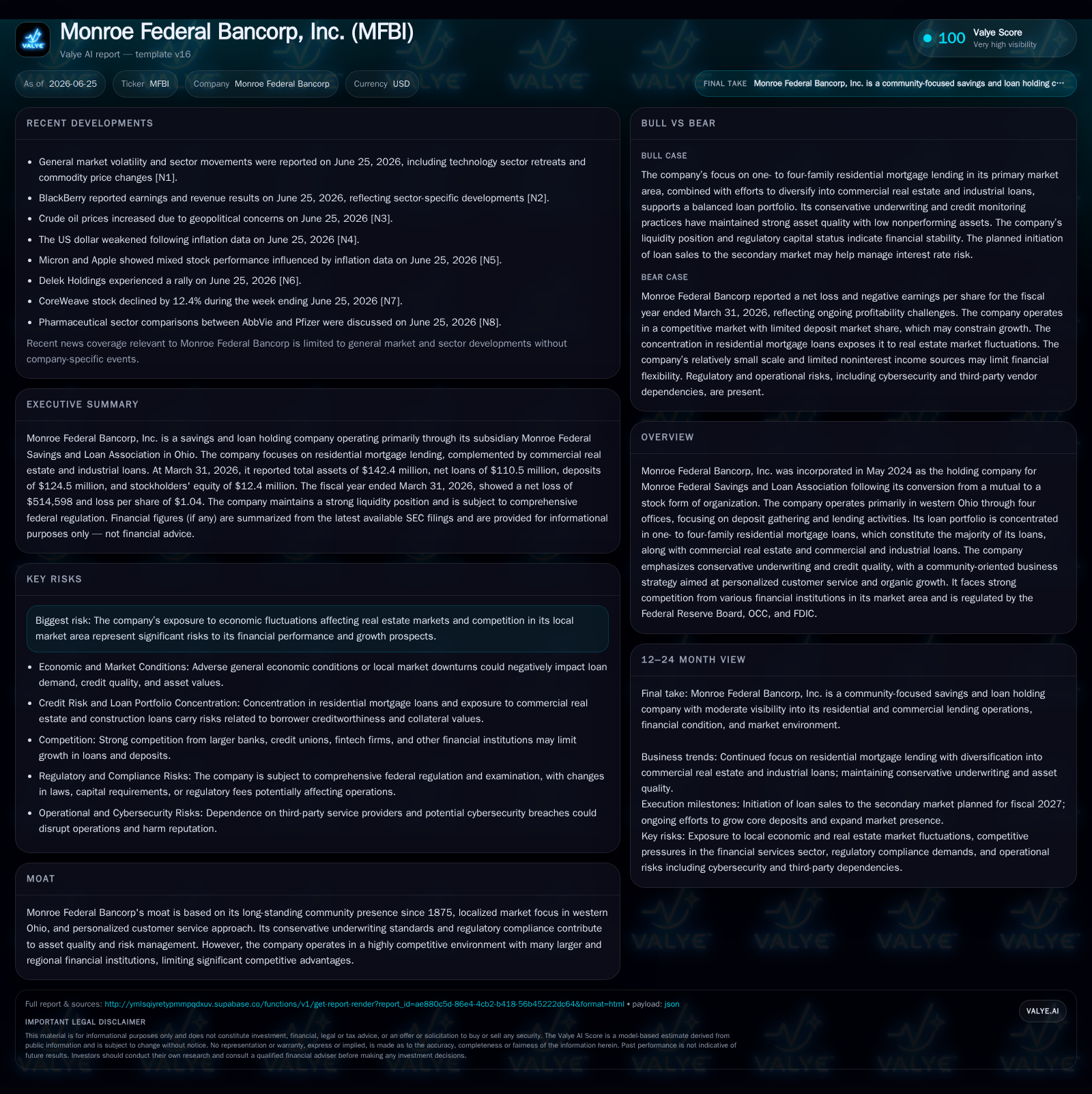
Monroe Federal Bancorp's latest 10-Q filing reveals steady management of a concentrated residential mortgage loan portfolio and disciplined credit loss provisioning, reflecting its conservative underwriting approach. Operating primarily in western Ohio through a localized, community banking model, the company emphasizes organic growth funded by deposit gathering while navigating steady competitive pressure from larger regional banks and non-bank lenders. Interest rate volatility and economic sensitivity of its loan mix remain key ongoing risks. The company’s financial results highlight resilience shaped by regulatory compliance and focused asset quality management.
Latest Quarterly Operating Trends: Loans, Deposits, and Credit Quality
Monroe Federal Bancorp’s February 2026 10-Q filing offers a snapshot of its operational status entering 2026 Q3 [S2]. The bank continues to concentrate its loan portfolio on one- to four-family residential mortgage loans, which form the bulk of its lending book. This focus aligns with its historical savings and loan identity emphasizing homeownership finance within a Western Ohio locality. Complementary exposures include commercial real estate and commercial & industrial loans, but these represent smaller proportions.
The reported loan-to-deposit ratio signals a conservative liquidity posture consistent with community banks wary of overextension during uncertain interest rate environments. This ratio supports sufficient liquidity buffers required by regulators while maximizing earning assets backed by stable deposits. Further reinforcing credit discipline, the allowance for credit losses remains judiciously provisioned relative to total loans. The company reports no material upticks in non-performing loans ratios as of quarter-end, suggesting early indications of stable asset quality.
These data points point to controlled balance sheet growth with measured credit risk appetite forming the foundation for defensive earnings during external volatilities.
Business Model Overview: Localized Lending and Deposit Strategies
With incorporation as a stock holding company in May 2024 after mutual conversion [S1], Monroe Federal Bancorp maintains a classic savings & loan business architecture. Its revenue model is anchored mainly on net interest margin (NIM) earned by funding primarily residential mortgage loans through community-sourced deposits. Deposits, garnered locally via four branches in western Ohio, provide relatively low-cost funds essential for cost-effective lending.
Credit underwriting standards lean toward conservatism aiming to preserve asset quality in an environment fraught with rising interest rates and regional economic headwinds. This discipline manifests in allowance policies tailored to anticipated losses from concentrated residential mortgage exposures predominantly secured by one- to four-family homes.
The localized footprint fosters intimate customer relationships facilitating organic growth via personalized service rather than scale-driven acquisition strategies or extensive product diversification. Regulatory capital requirements imposed by OCC, FDIC, and Federal Reserve further frame lending capacity, mandating prudent earnings retention and capital levels that support the loan book while buffering systemic shocks.
Overall, Monroe Federal represents a narrowly focused community banking model balancing growth ambitions against credit risk mitigation within constrained operational scale.
Competitive Context: Regional Savings Associations and Market Positioning
Operating within western Ohio situates Monroe Federal amidst a competitive financial ecosystem populated by various sized institutions including larger regional banks such as those similar to Huntington Bancshares or First Financial Bancorp analogues. These competitors benefit from broader product arrays including commercial banking services beyond residential mortgages and enhanced technology platforms.
Monroe’s differentiation relies heavily on its entrenched local presence dating back to its mutual origins in 1875 combined with tailored customer interactions emblematic of community banks. However, this niche positioning imposes natural scaling limits restricting profitability leverage achievable by peers with more diversified geographic or product footprints.
Non-bank mortgage lenders exert additional competitive pressure by leveraging digital origination models enabling faster turnaround times and pricing flexibility attractive to certain borrower segments. As such, Monroe Federal must continuously refine underwriting rigor while maintaining deposit growth to sustain net interest income under these conditions.
Portfolio Composition Implications for Credit Risk and Earnings Stability
Concentration risk emanating from a substantial allocation toward one- to four-family residential mortgages inherently ties Monroe Federal’s credit risk profile closely to local real estate market dynamics [S1], [S2]. Should housing prices soften or unemployment rise regionally, collateral values could erode alongside borrower repayment capacity triggering higher delinquencies.
The institution’s allowance for credit losses is calibrated carefully to absorb expected stress within this portfolio segment without excessively burdening current earnings. Stable non-performing loan ratios further validate initial success in balancing growth with asset quality control.
Additionally, interest rate exposure within securities holdings complements margin optimization but requires ongoing management given volatile yield curves impacting reinvestment returns and deposit pricing sensitivity. Prepayment risks embedded in mortgage portfolios also influence interest income timing necessitating constant refinement of asset-liability strategies.
Growth Drivers: Community Banking Levers and Economic Tailwinds
Near-term growth remains anchored on several tangible factors: continued expansion of the deposit base through strong local relationships supporting increasing loan originations; modest economic growth within western Ohio fueling housing market activity; cross-selling opportunities inherent in close customer proximity fostering ancillary fee income streams [S1]
Favorable phases in interest rate cycles enhance net interest margins by widening spreads between loan yields and deposit costs—though this is counterbalanced by the need to maintain competitive deposit rates in a crowded local market.
Importantly, Monroe Federal prioritizes organic growth over acquisitions or aggressive new product rollouts consistent with its community banking ethos which seeks long-term customer loyalty rather than short-term volume spikes.
Risks and Constraints: Interest Rate Sensitivity and Competitive Pressures
Primarily exposed to fluctuations in monetary policy that alter deposit funding costs and loan repricing yields, Monroe Federal faces variable net interest margin outcomes akin to many regional lenders [S1]. Volatility impairs margin predictability complicating earnings forecasts.
Economic downturns concentrated locally could undermine residential real estate valuations central to collateral backing most loans leading to elevated credit loss provisions or charge-offs. Increasing competition from national banks swooping into attractive markets or non-bank lenders offering digital alternatives may compress pricing power affecting new originations volumes or margin sustainability.
Regulatory changes encompassing capital requirement revisions or enhanced compliance obligations could also restrict available capital for lending expansion or elevate operating expenses respectively. Additionally, operational risks such as cybersecurity threats require continuous investment mitigating potential reputation-damaging events.
What to Watch Next: Milestones in Loan Growth, Asset Quality, and Capital Adequacy
Investors should surveil quarterly updates for patterns in loan-to-deposit ratio shifts indicating changes toward more aggressive vs. conservative liquidity stances; evolving non-performing loans metrics revealing the health of the underlying portfolio; net interest margin trends reflecting responses to funding cost moves; and tier 1 capital ratios signaling regulatory compliance scope maintaining or constraining future lending capacities [S2], [S1].
Broader external variables such as Federal Reserve policy shifts or meaningful local housing market developments will materially influence strategic execution ability going forward.
Financial Snapshot: Key Metrics From Latest Filing
For the quarter ending December 31, 2025, Monroe Federal reported a modest net loss of approximately $515 thousand reflecting challenges reconciling interest rate pressures alongside prudent credit costs [F1]. Allowance for loan losses continues at a level indicative of conservative loss absorption intent while maintaining regulatory capital targets ensuring an adequate buffer against unforeseen shocks [S2]. The absence of significant loan charge-offs or deposit outflows during this period corroborates stable operating execution despite a tight competitive landscape.
This analysis is based entirely upon disclosed SEC filings as well as recognized industry frameworks for regional banking institutions focused on savings & loan operations. It purposely refrains from speculative commentary on future outcomes beyond documented facts allowing an informed understanding of Monroe Federal Bancorp’s current positioning within its niche regional ecosystem.
Disclaimer: This is research-only, informational analysis and not investment advice. It may include AI-generated interpretation and general industry context. Always verify important details using primary sources.

Comments