
BlackBerry's Strategic Momentum: Recurring Revenue and Innovation in Embedded Software
BlackBerry’s latest quarterly results reflect strong growth in software licensing and secure communications, reinforcing its leadership in automotive embedded platforms and government-grade encryption.
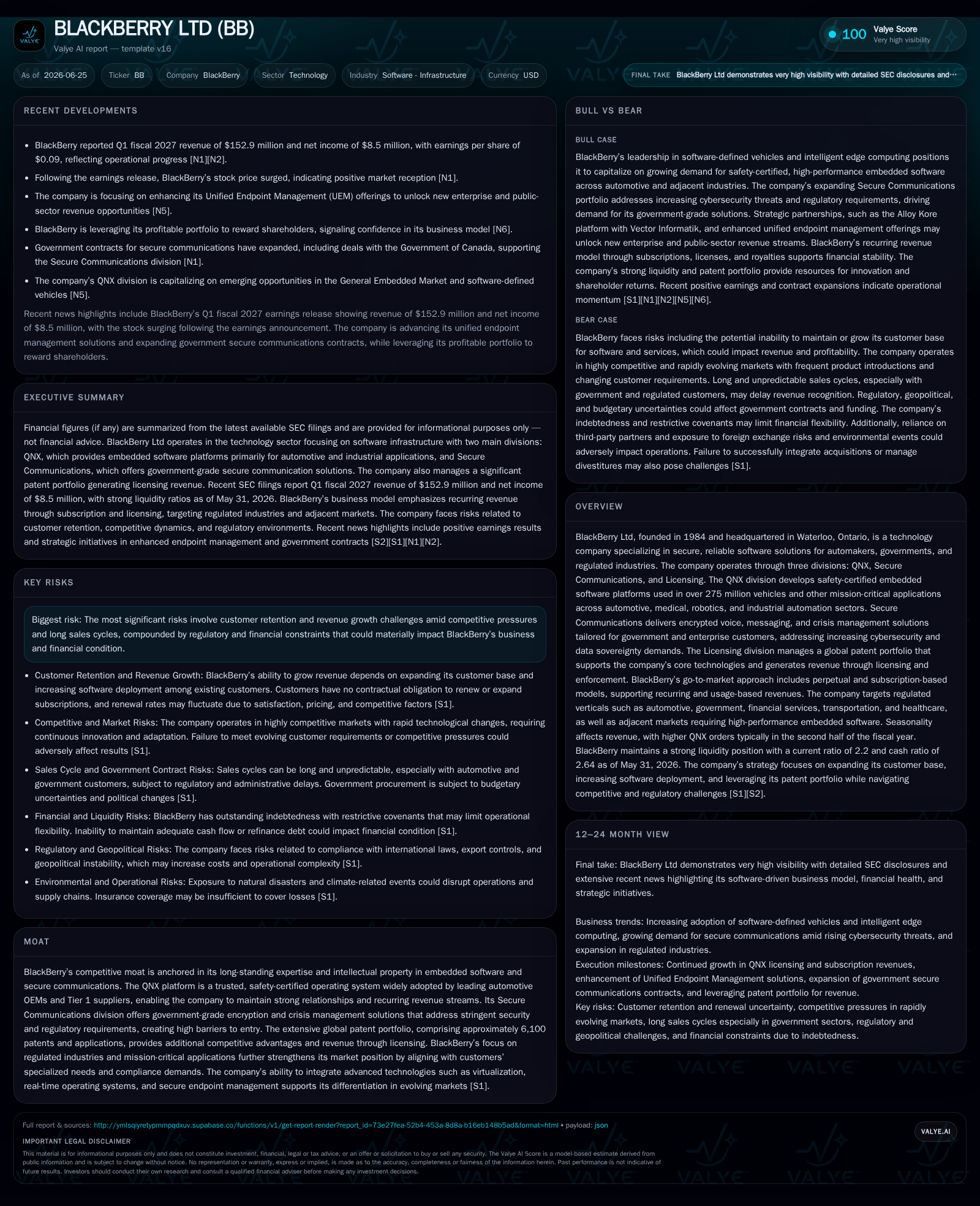
In the quarter ended May 31, 2026, BlackBerry Ltd demonstrated measurable growth in recurring revenue streams driven by widening adoption of its QNX embedded software platform and a rebound in Secure Communications contracts. The company leverages its unique position in safety-certified real-time operating systems for automotive and mission-critical applications alongside government-level encrypted communications. BlackBerry’s extensive patent portfolio further supports complementary revenue through licensing. While long sales cycles and competitive pressure from open-source alternatives remain challenges, operational resilience and strategic innovation underpin BlackBerry's pathway toward broader adoption amidst growing software-defined vehicle trends and regulated industry demand.
Recent Quarter: Operational Highlights Driving Performance Upside
BlackBerry’s most recent quarterly filing for the period ending May 31, 2026 reports continued expansion in licensing revenue primarily attributable to the QNX division alongside improvement signals in its Secure Communications segment [S2]. The company highlighted increased intangible asset activity tied to licensing bookings that reflect customer commitments expanding across its embedded software platforms used extensively in over 275 million vehicles worldwide. This illustrates ongoing traction amid the rapidly growing software-defined vehicle (SDV) market where real-time operating system (RTOS) reliability and safety certification remain critical [S2][S1]. Concurrently, Secure Communications benefited from renewed contract momentum as geopolitical factors have sustained demand for government-grade encrypted voice and crisis management solutions [N12]. Such developments contrast prior quarters’ pressures and suggest an inflection toward higher recurring revenue ratio supported by subscription-based models.
Business Model: Embedded Software Licensing Plus Secure Communications Subscription Engines
BlackBerry's revenue model is multifaceted—anchored by three main divisions: QNX (embedded software platforms), Secure Communications (encrypted messaging and crisis management), and Licensing (patent monetization) [S1]. Core revenue derives from perpetual licenses supplemented by subscription arrangements generating annual recurring revenue (ARR), royalties based on vehicle units shipped or seats deployed, plus ancillary professional engineering services required for integration and certification compliance. For instance, QNX engages directly with automotive OEMs and Tier 1 suppliers through both direct sales teams and channel partnerships providing scalable embedded OS solutions certified for safety-critical functions [S6]. The Secure Communications business similarly sells via direct enterprise channels augmented by value-added reseller networks to fulfill stringent security regulatory needs in government entities.
Meanwhile, the Licensing unit sustains steady cash flow through management of an extensive global patent portfolio comprising roughly 6,100 patents across operating systems, cybersecurity, cryptography, messaging technologies, supporting both product differentiation and additional royalty income streams [S1]. These diverse revenue mechanisms create stable cash conversion potential despite the long average contract lengths and seasonal purchasing rhythms observed, particularly in the second half of fiscal years when OEM order volume typically ramps.
Industry Positioning: Differentiation Through Certification, Encryption, and Intellectual Property Strengths
BlackBerry’s durable moat resides primarily in its unmatched domain expertise delivering safety-certified RTOS software trusted by tiered global automotive manufacturers—a segment characterized by high barriers due to rigorous functional safety certifications (e.g., ISO 26262) essential for mission-critical embedded systems. Few competitors match QNX's pedigree or install base scale within such regulated environments [S1][S16]. Additionally, Secure Communications offers government-grade encryption capabilities designed to meet demanding operational resiliency requirements including crisis management interoperability—a niche difficult to replicate given compliance complexities.
The company’s vast patent portfolio underpins competitive positioning by legally protecting core technologies while providing leverage through licensing agreements or enforcement actions against infringement risks. Such intellectual property stewardship is vital since several OEM clients are investing in internal embedded system development or exploring open-source alternatives perceived as cost-effective yet lacking equivalent certification status or security assurances [S16]. Nevertheless, BlackBerry must continuously innovate vigorously to defend against commoditization pressures intensified by rapid AI-driven software development cycles emerging among competitors.
Growth Drivers: SDV Market Expansion, Regulated Industry Demand, Patent Portfolio Monetization
Broader industry tailwinds favor BlackBerry’s core offerings. The rise of SDVs necessitates embedded OS platforms capable of mixed-criticality workloads balancing infotainment with safety systems—a domain where QNX’s mature technology stack excels [N10][S1]. Moreover, expansion into adjacent sectors such as medical devices, robotics automation, and industrial IoT leverages the foundational real-time performance properties intrinsic to BlackBerry’s products.
Simultaneously, escalating cybersecurity threats magnify demand for highly secure communications among governments and enterprises—bolstering uptake for BlackBerry’s encrypted messaging suites as geopolitical tensions drive investment into resilient information exchange infrastructures [N12].
Patent portfolio monetization also represents a compounding growth vector. Licensing revenues supplement core product sales providing incremental margin enhancement whilst reinforcing technological leadership through legal asset control [S1]. Ongoing portfolio reviews target identification of emerging royalty opportunities aligned with new product launches or technology trends within wireless connectivity standards or cryptographic methods deploying advanced algorithms.
Risks & Challenges: Customer Retention, Competitive Open-Source Pressure, Sales Cycle Complexity
Several risks temper BlackBerry's outlook. Customer retention hinges on demonstrating persistent value additions amid tough competition not only from established incumbents but increasingly from internally developed OEM software stacks or widely embraced open-source RTOS alternatives that can effectively reduce vendor lock-in albeit often lacking comprehensive certification [S8][S16]. Furthermore, protracted sales cycles extend forecast uncertainty as regulatory approvals combined with deep integration engineering delays contract finalization timelines.
Pricing pressures threaten margin sustainability given some competitors offer bundled solutions potentially below cost or feature parity aiming to secure larger ecosystem footholds. Additionally, evolving AI tooling accelerates competitors’ development velocity possibly eroding BlackBerry’s relative advantage if pace gaps widen unaddressed [S16]. Regulatory changes influencing encryption standards or autonomous vehicle safety compliance may impose extra implementation burdens further complicating timely deployment.
Finally external macroeconomic headwinds including tariff policies or supply chain disruptions affecting global automotive volumes could trigger oscillations in license royalties per unit shipped impacting top-line predictability.[S23]
What Investors Should Monitor: Renewal Rates, Royalty Metrics, New Contract Wins, Regulatory Developments
Key performance indicators meriting scrutiny include license renewal rates reflecting customer satisfaction and platform entrenchment; royalties per vehicle unit shipped signaling penetration depth especially amidst expanding SDV deployments; new contract announcements indicating pipeline vitality; and clear disclosures on patent licensing gains validating intellectual property monetization progress [S2].
Regulatory developments affecting certifications or cybersecurity compliance affecting solution acceptance warrant continuous observation as these govern competitive moats' durability. Timely management commentary around product roadmap execution relating to AI adoption or edge-computing advancements can signal modernization effectiveness critical to retaining relevancy amid fast-moving market structures.
Financial Review: Current Liquidity, Profitability Dynamics, Capital Structure Snapshot
From a financial standpoint,[F1] BlackBerry holds a solid liquidity position with approximately $257 million in cash against $197 million total debt resulting in a net cash balance near $60 million as of quarter end May 2026 supporting financial flexibility during ongoing R&D investments.[F1] Operating income remains positive reinforcing margin resilience despite competitive pressures.[F1] This capital structure affords runway to invest in strategic growth initiatives within software-defined vehicles while maintaining steady patent portfolio enforcement activities.[S2]
Overall profitability dynamics reflect disciplined expense control coupled with gradual scaling of recurring subscription revenues balancing seasonal fluctuations especially concentrated later in fiscal periods aligning with OEM purchasing behaviors.[S6]
This analysis relies strictly on publicly available filings through June 25, 2026([S2],[S3],[S1]) complemented by supporting companyfacts metrics ([F1]) ensuring an evidence-based assessment without speculative extrapolations. It highlights BlackBerry’s intrinsic strengths anchored on legacy embedded software expertise tempered by competitive risks inherent to fast-evolving technological landscapes requiring sustained innovation investment.
This article does not constitute investment advice but serves as an informed industry evaluation focusing on underlying operational health delineated from quantitative filings.
Disclaimer: This is research-only, informational analysis and not investment advice. It may include AI-generated interpretation and general industry context. Always verify important details using primary sources.

Comments