
Yellowstone Group Ltd: Building Recurring Revenue in Financial Reporting for Small OTC Companies
The latest quarterly report reveals Yellowstone Group’s foundational reliance on a narrow client base and small operational scale to deliver specialized SEC-compliant services in the Australasian OTC market niche.
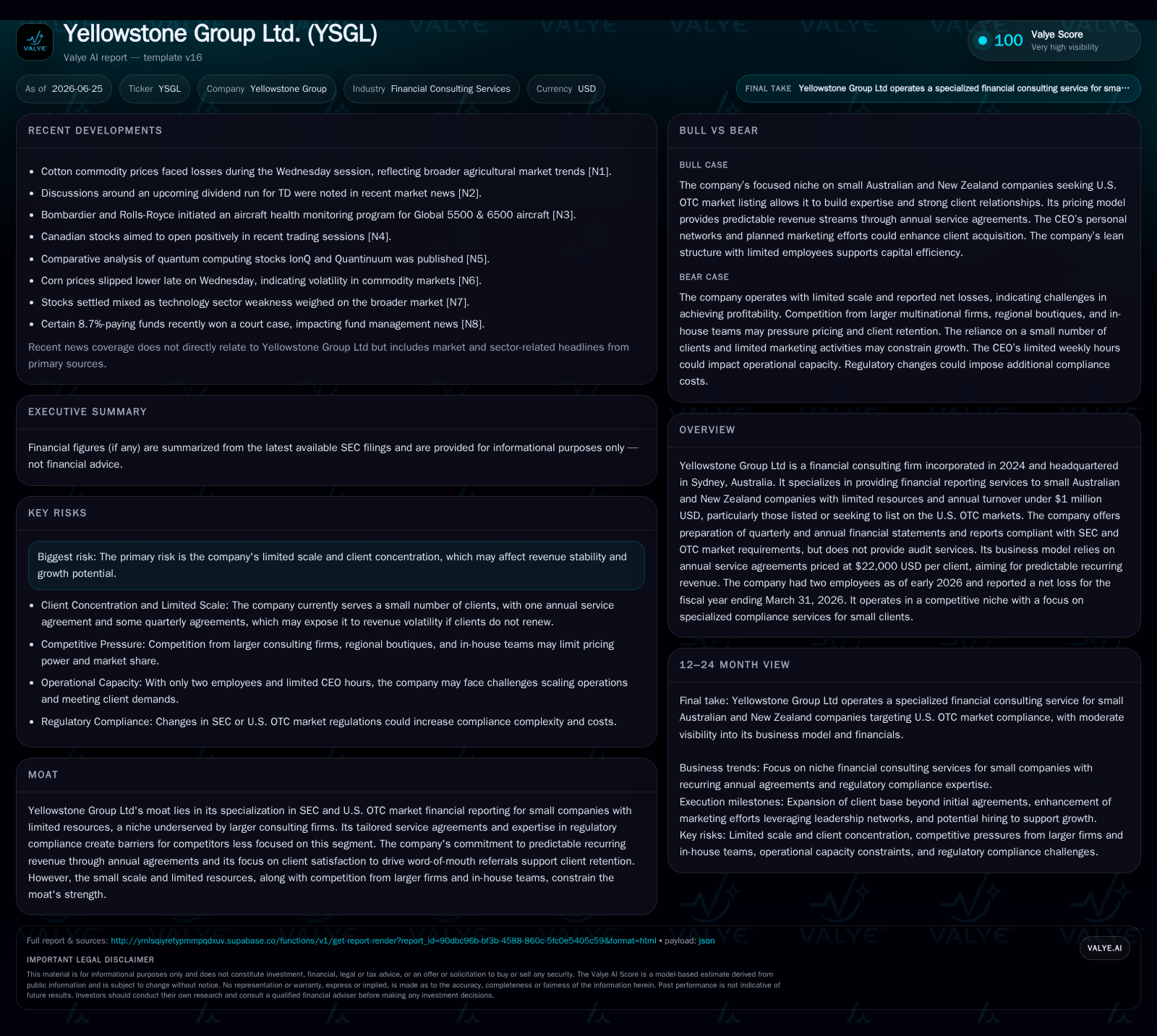
Yellowstone Group Ltd reported revenue of $11,000 in its third fiscal quarter ended December 31, 2025, generated from three active clients located in Australia and New Zealand who are either listed or pursuing listing on U.S. OTC markets [S2]. The company operates on a recurring revenue model based on annual service agreements priced around $22,000 USD per client, preparing quarterly and annual SEC- and OTC-compliant financial statements without audit services [S1]. Despite maintaining liquidity with $56,936 in cash and a current ratio of 1.57 as of March 31, 2026 [F1], Yellowstone faces structural challenges due to its small two-person team and high client concentration risk. The firm’s competitive position is defined by specialization in a regulatory-complex environment underserved by larger consultants but constrained by scalability limits and the ebb and flow of a limited client portfolio.
Latest Quarterly Operating Update: Revenue and Client Insights
General and administrative expenses for the quarter ran at $26,146 — primarily bank fees and external professional costs — resulting in a net loss of approximately $15,146 for the period [F1][S2]
Importantly, the concentration of revenue from a mere three clients—reportedly accounting for over 90% of sales—reveals significant client concentration risk inherent in Yellowstone's limited customer base [S21]. Concurrently small headcount (two employees) positions the company within operational constraints that directly affect workforce utilization rates and project scalability.
Business Model Overview: Recurring Agreements and Service Portfolio
Yellowstone Group Ltd's business model centers on providing essential financial reporting services tailored specifically for small public companies based principally in Australia and New Zealand with annual turnovers under $1 million USD that are listed or target listing on U.S. OTC markets [S1]. The company crafts quarterly financial statements and comprehensive annual reports including Management’s Discussion & Analysis designed to fulfill stringent SEC compliance mandates without engaging in audit services.
Revenue mechanics are straightforward: an annual service contract typically priced at $22,000 USD per client guarantees both predictable billing cycles and steady income streams resembling subscription arrangements more common in SaaS models than traditional consulting. The firm leverages its domain expertise to fill an underserved niche where many small-cap issuers struggle with complex U.S. disclosure requirements due to constrained internal resources.
This focused offering emphasizes meeting exacting regulatory disclosure deadlines with quality documentation thereby mitigating compliance risk for clients seeking transparent investor communications amid difficult capital market environments.
Competitive Environment: Boutique Specialists Versus Larger Firms
Within the financial consulting ecosystem targeting small-cap SEC/OTC issuers in Australasia, Yellowstone operates as a boutique specialist distinguished by its granular expertise in regulatory reporting tailored specifically for microcap companies with limited turnover [S1]. Unlike large multinational consulting firms whose sizable overheads necessitate targeting higher-revenue clients or broader advisory scopes, Yellowstone concentrates on regularized report preparation ensuring regulated transparency without extension into audit or expansive advisory services.
Its competition also includes internal corporate finance teams within these small public companies who may attempt to handle compliance internally but lack deep SEC knowledge or spare bandwidth during peak filing seasons. Additionally, regulatory compliance software providers threaten some displacement potential although software tends not to fully replicate consultative nuance required for accurate MD&A narrative crafting or complex disclosure judgment calls.
Thus Yellowstone’s moat stems largely from specialization-driven trust built through consistent delivery of detailed SEC- and OTC-compliant documentation coupled with a pricing architecture matching client scale.
Growth Opportunities: Regulatory Complexity and Outsourcing Trends
The broader industry serving small public companies driving demand centers on growing SEC regulatory complexity particularly impacting companies listed on low-tier exchanges such as U.S. OTC markets. Increasing enforcement rigor combined with evolving disclosure expectations compel resource-constrained firms to increasingly outsource these functions rather than strain internal capabilities.
This outsourcing trend is especially pronounced among Australasian entities seeking access to U.S. capital markets who benefit from Yellowstone’s local presence combined with dedicated expertise on SEC frameworks.
Complementing this demand environment are incremental opportunities from expanding product offerings adjacent to core reporting such as compliance advisory services or tailored reporting solutions that could enhance average contract value beyond the existing standard packages.
Client referrals and reputation growth within this niche microcap segment also represent organic growth levers critical given resource limitations constraining expansive marketing campaigns.
Constraints and Risks: Scalability Limits and Client Concentration Exposure
Despite promising niches for growth grounded in regulatory complexity trends, Yellowstone faces structural constraints stemming primarily from its minimal staffing (two employees) limiting ability to onboard additional clients or broaden service offerings rapidly without increasing overhead significantly [S1][S2]. Employee utilization rates inevitably cap achievable throughput meaning new hires would be necessary before scaling materially.
A pronounced risk lies in their concentrated customer base where three customers account for more than ninety percent of total revenue; loss or non-renewal by any one would materially affect top-line stability given absence of broad diversification reducing recurring revenue predictability [S21]
Moreover, compliance risk manifests concretely—not hypothetically—in managing timely delivery of error-free quarterly filings compliant with fastidious SEC rules. Failures here could lead not only to reputational harm but regulatory sanctions potentially endangering client retention.
Competitive pressures from larger multinationals offering bundled consultant portfolios at possibly discounted rates to larger or growing entities also pose pricing pressures accelerating if Yellowstone cannot expand service breadth yet retain bespoke quality.
What to Watch Next: Milestones and Demand Indicators for Near-Term Monitoring
Key near-term indicators include successful renewal of existing client contracts confirming retention amid competitive alternatives and emerging pipeline development signaling new customer additions that could begin diluting dependency risks. Timeliness metrics around quarterly filing delivery will reflect operational efficiency sustained amid attempted expansions.
Regulatory shifts promulgated by both U.S. SEC enforcement offices and OTC market supervisors merit close attention as intensifications could either boost demand through compliance necessity or conversely introduce pricing disruptions if simplified digital disclosures emerge reducing specialized consultant needs.
Finally, any announcements regarding workforce augmentation or new service initiatives will provide insight into management’s strategic intent toward overcoming present capacity bottlenecks.
Financial Overview: Supporting Liquidity and Profitability Snapshot
From a financial perspective, Yellowstone reported operating losses cumulative through FY ending March 31, 2026 amounting to approximately $10,827 reflective of early-stage investment phases typical for boutique entrants seeking scale [F1]. The firm maintains sufficient liquid resources with cash balances near $56,936 supported by current assets totaling approximately $58,272 versus current liabilities below $37,167 yielding a current ratio of 1.57—indicative of manageable short-term liquidity risk [F1].
Continuing profitability hinges critically on expanding its active contracted client base beyond three clients servicing sub-$100K quarterly total revenues towards capturing additional accounts needed to absorb fixed operating costs while improving margins through higher employee utilization rates or premium pricing strategies on expanded service offerings.
This analysis is based solely on facts extracted from recent filings including Q3 2026 Form 10-Q dated February 17, 2026 [S2], latest annual Form 10-K filed June 25, 2026 [S1], plus underlying fundamental data snapshots as noted [F1]. No investment advice is offered here; readers should consider this as an informed industry commentary focused exclusively on operational fundamentals within Yellowstone Group Ltd’s specialized financial consulting niche.
Disclaimer: This is research-only, informational analysis and not investment advice. It may include AI-generated interpretation and general industry context. Always verify important details using primary sources.

Comments