
Worthington Enterprises Broadens Building Products Range with LSI Acquisition and Data Center Expansion
The company reports strong liquidity and steady earnings growth while diversifying into specialized roofing components and data center infrastructure markets amid construction demand fluctuations.
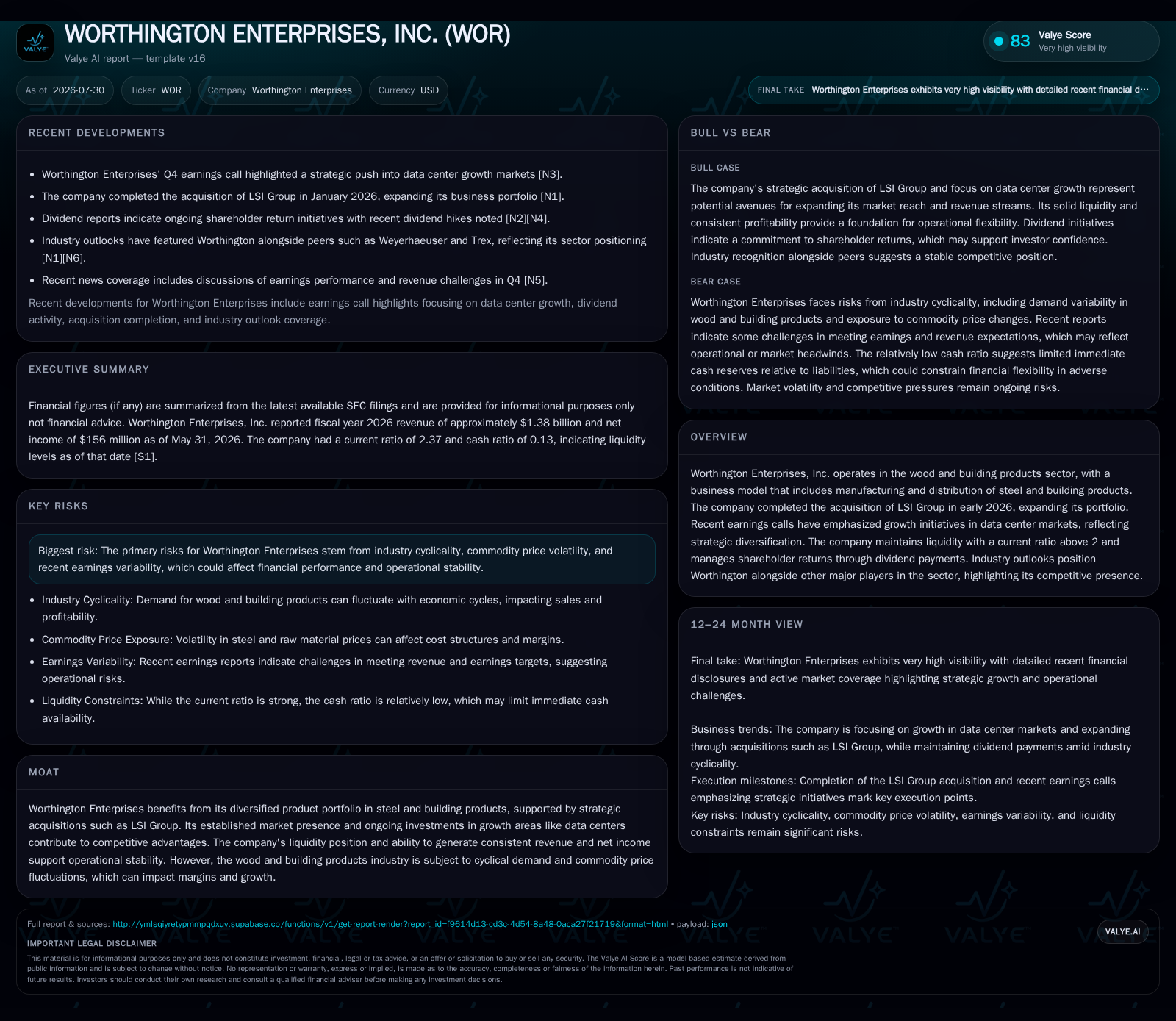
Worthington Enterprises, Inc. reported its latest quarterly results reflecting integration of the LSI Group acquisition, which broadens its footprint in commercial roofing components within the building products segment. The company emphasizes growth initiatives in niche data center infrastructure markets as part of its diversification strategy amid cyclical wood and building products demand. Worthington maintains a strong liquidity position with a current ratio of 2.37 and manageable leverage, enabling capital deployment toward acquisitions and operational optimization. While commodity price volatility and construction cyclicality remain key risks, strategic portfolio expansion and operational discipline underpin competitive positioning.
Recent Operating Update
Worthington Enterprises' latest quarterly filing dated April 9, 2026 [S2] provides the most recent insights into its operational trajectory following a pivotal acquisition earlier in the year. The company completed the purchase of LSI Group on January 16, 2026 [S26], an established manufacturer specializing in standing-seam metal roof clips crucial for commercial roofing systems—a targeted niche within the building products sector. The $206 million transaction was funded primarily through existing cash reserves complemented by borrowings under revolving credit facilities [S26]. This acquisition strategically expands Worthington’s product portfolio while enhancing exposure to differentiated commercial building materials.
Additional commentary from the June 24, 2026 earnings conference call underscored ongoing growth initiatives in data center infrastructure markets [S3; N1]. Data centers represent a fast-growing vertical demanding highly specialized building components such as pressurized containment solutions and customized steel assemblies—areas where Worthington is leveraging its manufacturing capabilities. This pivot towards niche industrial end markets aims to mitigate some cyclicality inherent in traditional wood and building product segments.
Business Model
Worthington Enterprises operates predominantly as a midstream manufacturer and distributor of steel and specialized building products aimed at residential, commercial, and industrial construction markets [S1]. Its revenue principally arises from the sale of finished or semi-finished products including steel framing components, ceiling suspension systems, wood-related consumer products, and pressurized containment apparatuses used for heating and cooling applications [S1; S7].
The company monetizes through direct sales contracts primarily with contractors, builders, distributors, and industrial customers. Pricing power varies with commodity input costs—particularly steel—and product differentiation levels tied to value-added manufacturing processes.
Post-acquisition integration of LSI Group adds a focused portfolio of retrofit components for metal roofing—a service-driven component requiring precision manufacturing—which enhances Worthington's capacity to meet specialized commercial customer needs [S26]. This also allows cross-selling opportunities within existing distribution networks.
The company’s monetization mechanics benefit from diversified end markets that range from consumer tools to highly engineered building product solutions. Contracts are often short to medium term without material long-term supply commitments but may include volume-based pricing adjustments reflecting input cost fluctuations [S1]. Operating margins hinge on efficient supply chain management amidst volatile raw material prices.
Industry Structure and Competitive Position
Worthington operates in the highly cyclical wood and building products manufacturing sector characterized by sensitivity to economic cycles, raw material commodity prices (notably steel), labor availability, regulatory changes related to environmental standards, and infrastructure investment levels.
The firm’s competitive landscape includes peer candidates such as Weyerhaeuser (wood products), Trex Company (building materials), USG Corporation (ceiling systems), Nucor Corporation (steel processor), and BlueLinx Holdings (building product distributor). Each competitor occupies overlapping niches but often focuses intensively on either raw material production or distribution services.
Worthington distinguishes itself through strategic portfolio diversification combining consumer-facing outdoor living products with industrial building solutions like light gauge metal framing and pressurized containment systems [S1; S7]. The company's ability to innovate value-added steel-processing techniques and penetrate specialized verticals like data centers confers some moat advantages despite inherent competitive pressures.
Growth Drivers
Several growth vectors underlie Worthington’s forward momentum:
- Increasing construction activity fueled by infrastructure spending and urban population growth creates sustained demand for both residential and non-residential building materials.
- Strategic acquisitions like LSI broaden product offerings and address more specialized market needs within commercial roofing—a segment with higher barriers for new entrants.
- Expansion into high-growth niches such as data center infrastructure leverages unique capabilities in manufacturing pressurized containment solutions responsive to cooling challenges critical in these facilities [N1].
- Rising demand for sustainable building materials encourages product innovation aligned with energy-efficiency standards across multiple jurisdictions.
- Improved operational efficiencies driven by proprietary business management systems reduce costs and improve working capital cycles allowing reinvestment into capex or acquisitions [S1].
These drivers could accelerate sales volume growth particularly if supplemented by favorable contract terms or longer-term supply partnerships.
Risks / Watchpoints / Growth Constraints
Primary risks persist around cyclical demand fluctuations due to macroeconomic headwinds or downturns impacting construction spending. Commodity price volatility—especially in steel—exerts margin pressure amid competitive pricing environments requiring careful supply chain hedging strategies [S2; S19].
Acquisition integration risks are noteworthy given LSI's recent inclusion; any failure to realize synergistic cost savings or cross-selling potentials could dampen expected returns [S26]. Furthermore, labor shortages or wage inflation in manufacturing operations could elevate production costs.
Regulatory developments influencing environmental compliance can necessitate incremental capex or alter product development priorities diminishing near-term profitability [S1]. Currency exchange rate movements may also impact international joint ventures or sourcing costs though their effect is less pronounced given domestic U.S.-centric operations
Finally, uneven recovery trajectories across construction subsectors may produce uneven order backlogs or utilization rates challenging consistent margin improvement.
What to Watch Next
Management commentary on raw material cost pass-through ability amid prevailing commodity market conditions will be critical given margin sensitivity [S2]. Any updates on further strategic acquisitions or divestitures should also be noted as signals of portfolio refinement.
Operational KPIs such as inventory turnover rates, capacity utilization improvements at recently acquired plants, and customer diversification metrics will provide additional insight into execution quality.
Financial Profile Discussion
As of May 31, 2026, Worthington Enterprises maintained a healthy current ratio of approximately 2.37 reflecting sound liquidity management balancing current assets ($524 million) against current liabilities ($221 million) [F1]. Cash & equivalents stood near $27.7 million supporting working capital needs despite elevated inventory levels typical for the sector.
Interest expense trends require monitoring as they influence net profitability especially amidst potentially rising interest rates impacting borrowing costs as noted in recent filings [S3]. Overall free cash flow generation appears stable but sensitive to working capital swings given raw material cost volatility common in steel-processing operations.
Disclaimer: This analysis is for informational purposes only based on publicly available sources as of July 30, 2026. It does not constitute investment advice or research views regarding Worthington Enterprises’ securities.
Disclaimer: This is research-only, informational analysis and not investment advice. It may include AI-generated interpretation and general industry context. Always verify important details using primary sources.

Comments