
McCormick Strengthens Global Flavor Leadership with Strategic Acquisitions and Robust Innovation
Q2 2026 results highlight McCormick's sustained organic growth, acquisition-driven geographic expansion, and ongoing integration of Unilever's foods business amidst commodity challenges.
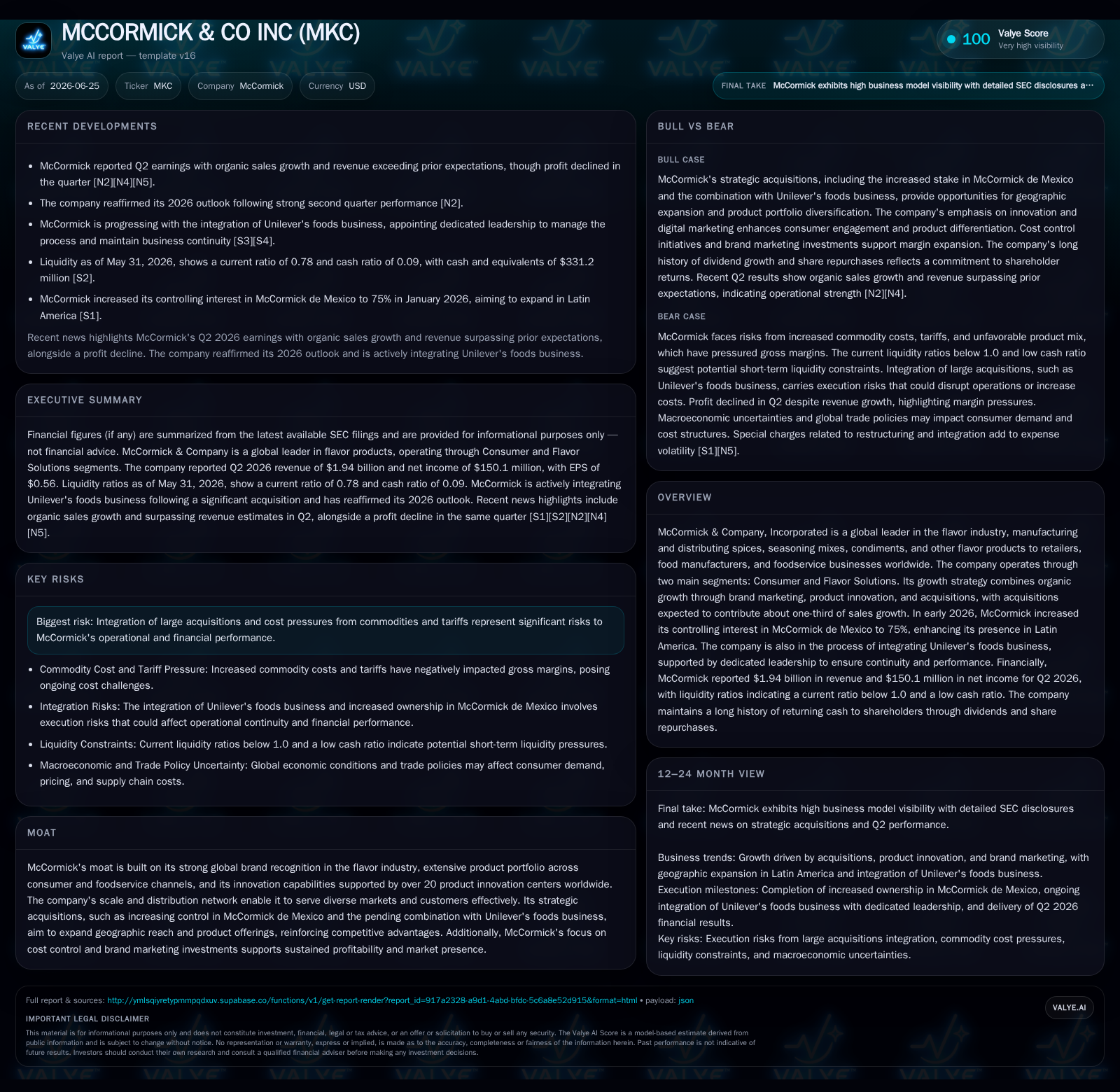
In its Q2 2026 filing, McCormick reported $1.94 billion in revenue and $150.1 million in net income, exceeding market expectations due to strong organic sales growth and strategic acquisitions. The company expanded its stake in McCormick de Mexico to 75%, reinforcing its Latin American presence, while dedicated leadership advances the integration of Unilever's foods business. Despite commodity cost pressures and supply chain risks, McCormick maintains momentum through innovation, brand marketing, and acquisition synergies. The company’s dual-segment model serves both consumer retail and flavor solutions B2B markets globally, supported by extensive distribution networks and product development initiatives.
Q2 2026 Operating Update Highlights Revenue Growth and Acquisition Momentum
along a dual-pronged growth strategy – combining internal innovation-led volume gains with external expansion via acquisition-fueled geographic reach.
Business Model Explained: Consumer Brands and Ingredient Flavor Solutions Driving Reach
McCormick operates through two principal segments: Consumer and Flavor Solutions [S1]. The Consumer segment primarily markets branded spices, seasoning blends, condiments, and related products sold through retail grocery chains to end consumers worldwide. This channel leverages McCormick’s extensive brand equity built over decades in the consumer packaged goods (CPG) space. The Flavor Solutions segment serves food manufacturers and foodservice operators with customized ingredient blends tailored for product innovation or menu enhancement needs. Each segment benefits from an expansive global distribution network that enables effective penetration across multiple geographies.
Underlying this structure is a complex value chain beginning at raw material sourcing—often volatile due to agricultural commodity pricing—and extending through sophisticated product development centers (over 20 globally) focused on continual pipeline renewal around emerging consumer trends like ethnic flavors and health-conscious formulations [S1]. Brand marketing investments further support demand generation in both segments by driving consumer recognition and retailer shelf presence.
Competitive Positioning: Brand Strength Against Global and Regional Peers
Within the global flavor solutions landscape catering predominantly to industrial customers, McCormick competes alongside leaders such as Givaudan and International Flavors & Fragrances (IFF), distinguished by their scale in R&D capabilities and deep customer relationships. Meanwhile, the Consumer segment contends with companies like The J.M. Smucker Company and Hormel Foods which operate broadly within branded seasoning CPG categories.
Additionally, private-label seasoning producers pose competitive pressures primarily in specific retail regions; however, McCormick’s extensive product breadth coupled with recognized premium brand status helps sustain customer loyalty and resist commoditization effects where applicable.
The company’s moat rests on its integrated model combining strong channel diversification—retail consumers, food manufacturers, foodservice distributors—with a broad portfolio addressing various taste preferences globally. Its aggressive acquisition moves also aim to outpace regional competitors by swiftly expanding local market share and innovation relevance.
Growth Drivers: Innovation Pipeline and Expansion Through Acquisitions
Organic sales gains are principally fueled by a vigorous product innovation pipeline focusing on health-conscious flavors, global ethnic taste profiles gaining traction worldwide, plus clean-label ingredient trends favored by modern consumers [S1], [S2]. Investments into brand marketing amplify the effect of new product introductions by fostering stronger retailer support and consumer trials.
Acquisitions remain instrumental in delivering roughly one-third of total sales growth annually as reported by McCormick [S1]. The increased ownership stake in McCormick de Mexico is exemplary of efforts to penetrate fast-growing Latin American markets adjusting rapidly to packaged food consumption upgrades. Additionally, advancing the combination with Unilever’s large-scale foods operation is expected to leapfrog geographic coverage substantially while diversifying product offerings across complementary categories [N5].
Distribution reach extension through these moves is critical — enabling scaling volumes that drive operational leverage despite rising input costs.
Risks to Monitor: Integration Complexity, Commodity Cost Volatility, and Supply Chain Dynamics
McCormick identifies key risks related to integrating sizeable acquisitions such as Unilever Foods’ business alongside managing price inflation for raw materials including spices and related inputs exacerbated by tariffs or geopolitical factors [S14]. Supply chain disruptions may interfere with timely deliveries or elevate logistics expenses while currency exchange fluctuations carry earnings impact given global operations.
Mitigating these risks requires balancing margin pressure against strategic pricing actions, ongoing supply chain improvements targeting efficiency gains, localized sourcing strategies where feasible, plus exploiting scale advantages from consolidated procurement post-mergers [S14]. Failure or delay in integration could impair cost synergies or distract managerial attention from core organic initiatives.
"Next Steps" to Watch: Integration Progress, Organic Growth Tracking, Margin Trends, and Guidance Updates
Investors should monitor forthcoming quarterly reports for evidence on how effectively the company sustains its organic sales trajectory relative to inflationary headwinds specifically within raw material costs [S2]. Key milestones include updates on the pace of Unilever Foods integration — particularly CEO commentary or progress toward synergy realization metrics — along with margin expansion outcomes reflecting successful cost control under intensifying input volatility.
Capital allocation announcements will also be insightful concerning funding balance between acquisitions versus internal innovation programs or shareholder returns. Continued enhancements in distribution penetration metrics across emerging markets will serve as early indicators for longer-term growth potential.
Financial Snapshot Supporting Operational Trajectory
As of May 31, 2026, McCormick held cash plus equivalents totaling approximately $331 million versus current liabilities around $3.57 billion resulting in a current ratio near 0.78 based on latest company facts data [F1]. This liquidity position combined with steady revenue growth ($6.8 billion annualized reported recently) underscores substantial operational cash flow generation capacity underpinning investment plans despite sector-wide commodity cost challenges.
This analysis is based exclusively on publicly filed SEC disclosures as of June 25, 2026, supported by referenced news sources without speculation beyond the documented information presented.
Disclaimer: This is research-only, informational analysis and not investment advice. It may include AI-generated interpretation and general industry context. Always verify important details using primary sources.

Comments