
Anterix Inc. Evolves Spectrum Strategy to Accelerate Utility Network Growth
The company advances beyond leasing to integrated spectrum solutions, leveraging FCC broadband expansions and new service offerings in utilities and critical infrastructure.
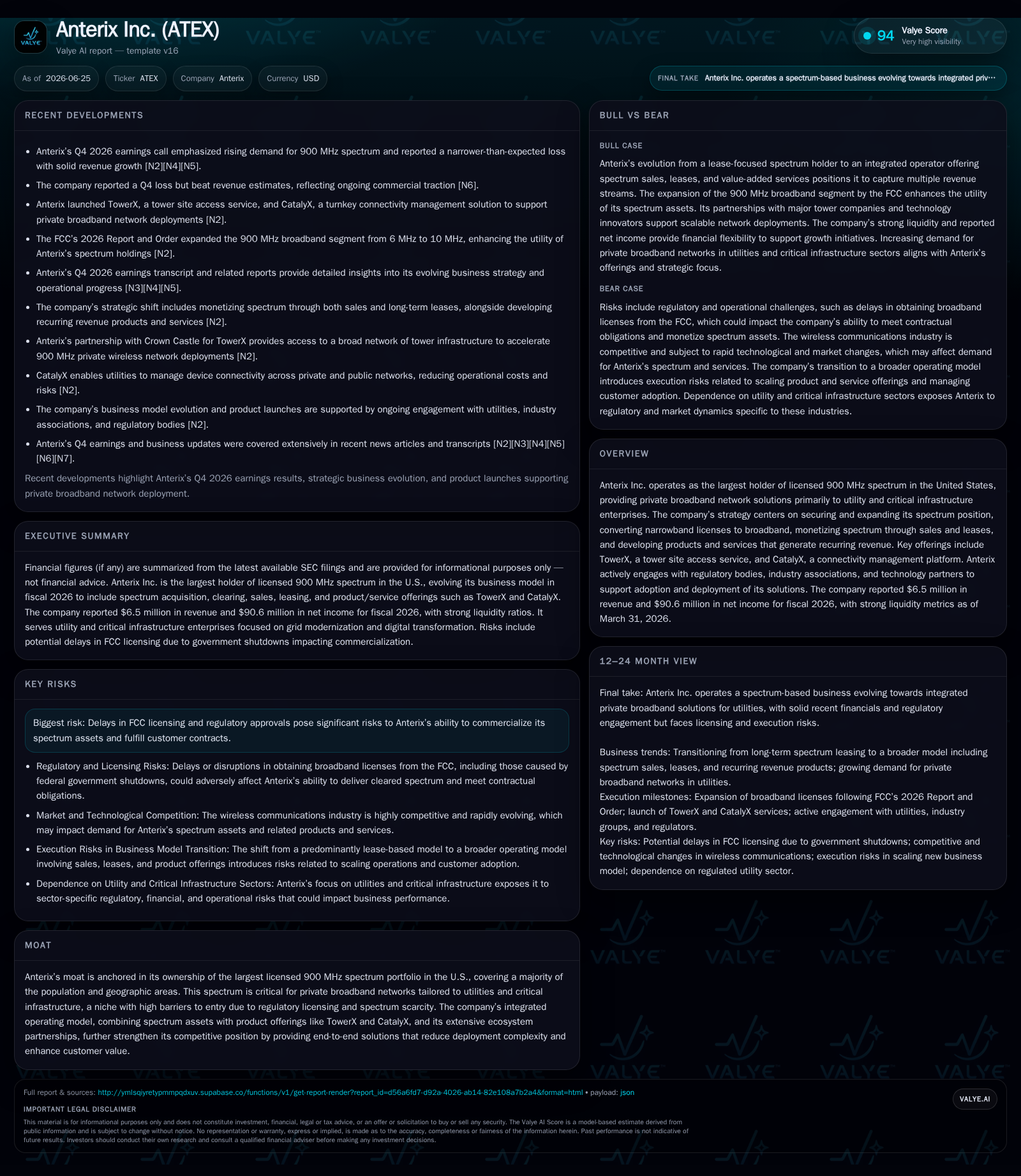
Anterix’s latest quarterly and annual disclosures reveal a strategic pivot from pure spectrum leasing toward a hybrid monetization model combining spectrum sales, leases, and recurring service offerings. This evolution is underpinned by the FCC’s approval to expand the 900 MHz broadband band, enabling greater spectrum utility for private networks in utilities and critical infrastructure sectors. The launch of products like TowerX and CatalyX complements spectrum monetization with managed services, addressing deployment complexity and fostering customer lock-in. Despite strong contracted proceeds and operating income gains in fiscal 2026, commercialization remains tied to regulatory licensing progress and concentrated customer relationships. Near-term growth hinges on executing license delivery, finalizing additional spectrum agreements, and scaling service adoption.
Recent Operating Update: Quarterly Progress & Strategic Pivot
The latest quarterly filing from February 2026 ([S2]) alongside the June event report ([S3]) delineates Anterix’s material shift in commercial execution. The company broadened its approach from predominantly long-term spectrum leasing toward an integrated platform comprising acquiring, clearing, selling, leasing licensed spectrum, as well as delivering products that generate recurring revenue. This strategic pivot was formally reflected in their accounting practices during Q4 fiscal 2026; post-December 2025 spectrum sales are now recognized as revenue under ASC 606 on a gross basis ([S4]).
Operationally, Anterix secured multiple new spectrum sale agreements with utilities including CPS Energy, Texas-New Mexico Power (TNMP), NorthWestern Energy (NWE), and subsequently Benton Public Utility District (Benton PUD). As of March 31, 2026, these contracts represent $127 million in contracted proceeds with $50 million remaining outstanding ([S1], [S4]). The company delivered broadband licenses across 155 counties while also exchanging narrowband licenses for broadband equivalents in 219 counties—a crucial step enabled by regulatory approvals.
In February 2026 the FCC adopted the "Maximizing the Potential of the 900 MHz Band" Report & Order expanding the broadband segment allocation from 6 MHz to 10 MHz ([S1], [S22]). This enhancement fundamentally increases the usable bandwidth available for private broadband networks deployed by utilities and critical infrastructure providers across Anterix’s expansive licensed geography encompassing the contiguous U.S., Alaska, Hawaii, and Puerto Rico.
Notably, Anterix launched two key ancillary service offerings: TowerX™, providing tower site access management analogous to infrastructure providers like American Tower or Crown Castle; and CatalyX®, a turnkey connectivity management platform targeted at simplifying network operations akin to solutions from private network vendors Calix or Cambium Networks ([S1], [S4]). These represent deliberate steps toward building recurring service revenues that complement one-time spectrum transactions.
Evolving Business Model: From Leasing to Integrated Spectrum Solutions
Historically reliant on long-term leases primarily structured per county-level utility customers within complex systems ([S1]), Anterix now embraces a more dynamic operating model that balances sales with leases while embedding productized service layers around its core licensed spectrum assets. The strategic rationale pivots on customer preferences—some utilities favor ownership (spectrum purchases) aligning operational control with financial considerations—while others prefer leasing arrangements offering flexibility.
The conversion of narrowband holdings into broadband via clearing and retuning underpins this expanded asset base compatible with LTE/5G standards relevant to Band 8 (880–915 / 925–960 MHz - US n106 variant). The enhanced technical capacity supports more intensive data transmission suitable for grid modernization applications such as edge AI analytics or real-time monitoring ([S1], industry context).
Accounting changes reflecting this business model evolution required significant auditor judgment as disclosed in audit notes ([S4]). Spectrum sales entered into after December 31, 2025 are treated as revenue-generating transactions within ordinary operations rather than anomalous asset disposals. This brings greater transparency into revenue mechanics tied directly to underlying customer contracts with utilities.
Moreover, bundled services like TowerX ease tower site access challenges which can slow network deployments by addressing logistics frequently handled by independent infrastructure providers. CatalyX streamlines private wireless network management enhancing operational reliability—key for critical infrastructure stakeholders sensitive to downtime or cyber threats ([S1], [S4]).
Industry Structure & Competitive Positioning in Private Broadband Spectrum
Anterix stands out as the largest holder of licensed spectrum in the dedicated 900 MHz band across all major U.S. geographies ([S1]). The scarcity of licensed bands suitable for private broadband use combined with regulatory barriers creates high entry hurdles resembling characteristics observed among telecom giants managing prime bands (e.g., T-Mobile’s AWS holdings or Verizon’s low-band control). Unlike public cellular operators who monetize via mass consumer services, Anterix targets niche private wireless networks essential for upstream energy grids and analogous critical infrastructure.
Spectrum monetization strategies vary across players: where T-Mobile or Verizon may emphasize wholesale leasing or joint marketing with public network overlays; Anterix pioneers a hybrid asset commercialization mix focused exclusively on private network rentals or sales at county/regional levels. Infrastructure analogs such as American Tower provide complementary site-access services but lack direct ownership of licensed spectrum—a domain where Anterix holds advantage through vertical integration combined with emerging service offerings ().
Reliance on FCC licensing timelines remains an industry-wide constraint given potential federal bottlenecks evidenced during recent government shutdowns impacting processing speed ([S2]). Competitive differentiation is augmented by Anterix’s proactive engagement with ecosystem partners delivering interoperable hardware/software combinations reducing total cost of ownership barriers for utility customers.
Growth Drivers: Regulatory Support, Technology Advances, & Ecosystem Expansion
The recently expanded FCC broadband allocation significantly elevates the usable bandwidth per license enabling higher throughput conducive to advanced utility applications requiring low latency and high security ([S1],[N1]). Transformative trends pushing demand include:
- Accelerated grid digitalization mandating secure private networks for distributed energy resources monitoring,
- Regulatory endorsements fueling private network deployments,
- LTE/5G technology maturing including native support for Band8/n106 frequency enabling standards-based equipment adoption,
- Growth in ecosystem innovations leveraging over 150 partner technology vendors collaborating within Anterix’s Active Ecosystem designed to simplify solution delivery ([S22],[N1]).
Quantitative KPIs such as increased broadband licenses delivered (155 counties), growing value of contracted sale proceeds ($127 million), plus rising engagement metrics within product ecosystems signal tangible momentum underpinning growth ambitions.
Risks & Constraints: Licensing Delays, Customer Concentration, & Market Adoption Challenges
Despite promising developments there remain pointed risks impacting execution:
- Dependency on FCC licensing schedules which have faced delays exacerbated by government shutdowns disrupting application processing — any recurrence could materially delay contract fulfilment timelines impacting revenues ([S2]);
- Geographic concentration risks arise given that each license area typically involves one or few utility customers controlling deployment decisions — failure to convert those leads leaves associated spectrum idle without alternate monetization avenues ([S1]);
- Technology adoption risk persists regarding utilities transitioning from legacy narrowband private networks toward full broadband LTE/5G platforms; uptake cycles may be elongated given financial/regulatory scrutiny typical for infrastructure spending;
- Capital intensity associated with clearing incumbent users from spectrum bands before broadband assignment increases deployment complexity requiring close coordination between Anterix and customers;
- Potential shifts in regulatory policies affecting future allowable uses or reassignment rules present ongoing uncertainty affecting long-term asset value realization ([S1],[S2]).
These factors collectively temper near-term margin expansion prospects despite current strong net income results which benefit from non-cash gains on license exchanges noted during fiscal year end.
Looking Ahead: What To Watch Next in Spectrum Commercialization & Product Uptake
Critical upcoming milestones include:
- Delivery completion of pending broadband licenses aligned with FCC’s expanded permissions allowing full utilization of the enhanced band segment;
- Closing additional announced or probable spectrum sale/lease contracts providing increased contracted revenue backlog;
- Customer adoption rates of TowerX™ tower access management service and CatalyX® connectivity platform demonstrating success in translating initial product launches into steady recurring revenue streams;
- Continued ecosystem expansion inviting technology partners enabling broader solution sets acceptable to conservative utility operator requirements;
- Monitoring legislative or regulatory developments potentially further shaping opportunities or constraints within licensed private wireless domains.
Tracking contract counts/value booked post-quarter plus monthly license issuance frequency will offer valuable visibility into near-term operational robustness ([N3],[S1],[S2],[N1]).
Financial Snapshot: Solid Liquidity Supports Expansion Plans
Balance sheet strength is evident with cash & equivalents reaching nearly $98.5 million against minimal reported debt (~$0.5 million) resulting in negative net debt position exceeding $98 million while maintaining a comfortable current ratio above 3x indicating solid short-term liquidity maintenance capacity ([F1],[S12]). Capital stewardship includes returning approximately $1 million via share repurchases under a board-authorized program expiring September 2026 ([S15]).
Liquidity provides necessary runway both for required investments in ongoing FCC licensing processes and selective scaling of product capabilities designed to build recurring services around core licensed spectrum assets.
This analysis synthesizes disclosures found primarily in Anterix's FY2026 filings supported by recent quarterly reports along with third-party industry context relevant to licensed private broadband infrastructure providers targeting utility sectors. The company's strategic transition towards integrated asset commercialization combining spectrum sales/leasing with ancillary product offerings positions them uniquely within a constrained regulatory landscape where licensing cadence and customer acquisition remain pivotal execution dimensions. No investment advice is expressed herein—this write-up is intended solely for informational purposes grounded strictly on documented SEC evidence and credible public sources.
Disclaimer: This is research-only, informational analysis and not investment advice. It may include AI-generated interpretation and general industry context. Always verify important details using primary sources.

Comments