
International Media Acquisition: Assessing Completion Risks and Capital Dynamics in Its Vietnamese Biofuels Deal
IMAQ's February 2026 quarterly filing highlights ongoing execution challenges and deadline extensions as it pursues a complex cross-border merger with a Vietnamese biofuels company.
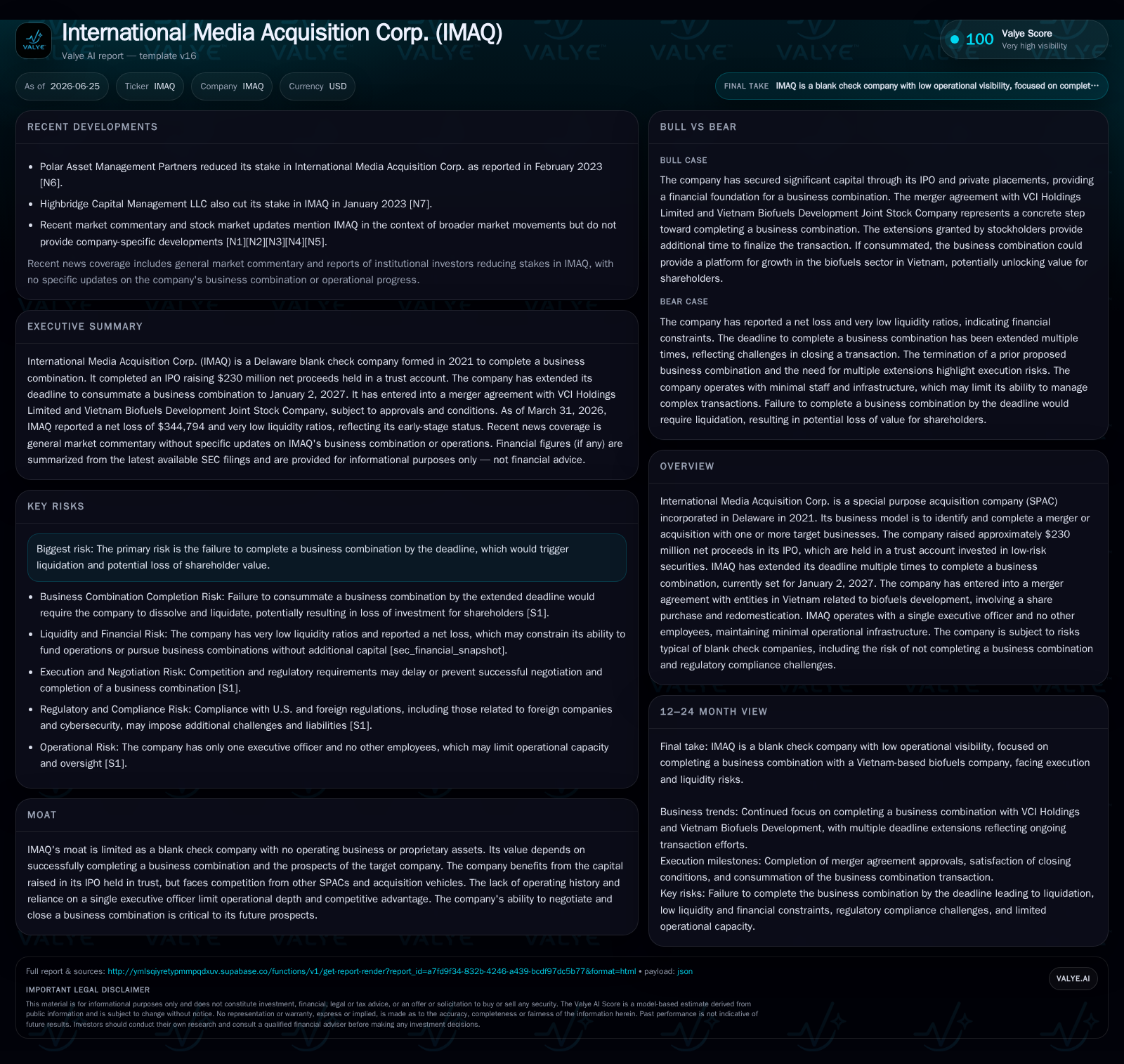
International Media Acquisition Corp. (IMAQ) remains a Delaware-incorporated SPAC focused on completing a business combination with a Vietnamese biofuels company by an extended January 2, 2027 deadline. The February 2026 quarterly report confirms continued reliance on trust account proceeds from its $230 million IPO, minimal operating infrastructure, and mounting timeline pressures despite multiple deadline extensions. The merger structure involves share purchase, reincorporation, and redomestication steps with foreign parties, introducing regulatory complexity and elevated completion risk. IMAQ’s future depends materially on deal execution, regulatory clearance in Vietnam, and shareholder approvals amid dilution and liquidation risks.
Latest Quarterly Update: Timeline and Transaction Status
International Media Acquisition Corp. (IMAQ) reaffirmed in its February 4, 2026 quarterly filing ([S2]) its intent to complete a business combination by January 2, 2027 — an extended deadline achieved through successive shareholder-approved amendments ([S19],[S21]). This extension follows multiple prior extensions since the initial August 2022 deadline granted to accommodate protracted due diligence and regulatory review processes.
The pending transaction centers on a merger agreement with Vietnamese entities engaged in ethanol production within the biofuels sector ([S1],[S3]). The deal structure incorporates a share purchase agreement complemented by reincorporation mergers and offshore redomestication into the British Virgin Islands jurisdiction ([S20]). These cross-border elements introduce heightened regulatory complexity uncommon in domestic SPAC transactions.
A recent May 5, 2026 Form 8-K filing ([S3]) indicates continued procedural progress but does not specify firm closing dates beyond milestones contingent on customary closing conditions including shareholder approvals. This underscores conditional momentum amid evolving geopolitical and regulatory environments.
Business Model: Classic SPAC Capital Market Intermediation
IMAQ functions as a blank check company designed to facilitate private companies’ access to public equity markets through a business combination ([S1]). Its principal asset is approximately $230 million in net proceeds raised via an Initial Public Offering (IPO) combining roughly 23.8 million units sold at $10 each through public offerings and private placements sponsored by Content Creation Media LLC ([S1],[S16]). These funds remain segregated in a trust account conservatively invested primarily in U.S. government securities or money market funds pursuant to strict investment guidelines until released upon business combination completion or liquidation ([S1],[S16]).
The company records no operating revenue pre-combination; expenses are minimal reflecting reliance on one executive officer without additional staff or infrastructure ([S1]). Investor returns hinge entirely on the post-merger performance of the acquired entity.
Dilutionary features common among SPACs—founder shares granted pre-IPO at preferential terms and warrants exercisable post-combination—are disclosed within recent amendments affecting ownership structure ([S5],[S6]). Redomestication maneuvers into BVI entities provide legal flexibility but add execution layers.
Competitive Context: Emerging Market Focus Amid Broader SPAC Ecosystem
Within the SPAC landscape, IMAQ distinguishes itself by targeting cross-border deals with emerging market private companies rather than focusing domestically. This contrasts with prominent blank check firms like Pershing Square Tontine Holdings or Churchill Capital Corp that engage predominantly with U.S.-based targets or mature sectors.
IMAQ’s pursuit of Vietnamese biofuels operators exemplifies targeting high-growth regions with promising sector tailwinds but increased regulatory scrutiny and disclosure opacity risks typical for foreign jurisdictions.
Alternative capital-raising routes competing for similar private targets include traditional IPOs, direct listings bypassing underwriters, or private equity buyouts without public listing ambitions. IMAQ’s SPAC approach offers expedited public market access but concentrates risk around timely deal closure amid complex foreign legal regimes.
Growth Drivers: Deadline Extensions and Sector Tailwinds
A key growth enabler has been securing multiple shareholder-approved deadline extensions permitting up to January 2, 2027 for deal consummation ([S19],[S21]). These extensions afford critical runway given the extended due diligence and regulatory navigation required for such cross-border transactions.
Vietnam’s biofuel industry benefits from favorable national policies promoting renewable fuels alongside growing global demand for sustainable energy sources (). A successful combination could enhance investor appeal relative to generic blank check vehicles lacking sector focus.
Post-merger scalability may arise through complementary acquisitions or expansions aligned with regional consolidation trends; however, limited disclosures restrict visibility into additional pipeline opportunities.
Risks: Completion Deadlines, Regulatory Challenges, and Shareholder Implications
Failure to complete the business combination by January 2, 2027 will trigger mandatory liquidation whereby trust account assets would be returned to public shareholders net of expenses—a material risk case ([S1],[S23]).
Cross-border complexities increase uncertainty due to SEC limitations accessing detailed operational information governed by Vietnamese laws restricting investigations or disclosures ([S1],). Such factors heighten transparency challenges uncommon in domestic deals.
Potential conflicts of interest arise from officers/directors holding overlapping fiduciary duties across multiple entities necessitating governance vigilance ([S1]). Dilution risk from founder shares and warrant exercises remains significant unless carefully managed post-merger.
Liquidity metrics reflect typical SPAC characteristics awaiting transaction closure: current assets stood at approximately $551K against current liabilities exceeding $7.7 million as of March 31, 2026 yielding a stressed current ratio near 0.07 ([F1]). This imbalance largely reflects accrued transaction-related costs rather than operational cash flow deficits.
What to Watch Next: Approvals, Closings, and Regulatory Developments
Upcoming milestones include SEC registration statement effectiveness tied to proxy solicitations for shareholder votes on merger agreements ([S9],[S15]), which will crucially influence transaction timing.
Stakeholders should monitor potential further extension requests reflecting negotiation complexities within foreign jurisdictions especially under evolving Vietnamese corporate law relevant to redomestication feasibility ([S12],).
Investor attention should also focus on voting support agreements locking major shareholders into approving the transaction ([S15]) as well as warrant exercise activity that could impact capitalization post-closing.
Brief Financial Profile Update
As of March 31, 2026, IMAQ reported operating losses near $461K consistent with minimal pre-combination operations alongside net losses around $345K reflecting typical expense profiles for a blank check company ([F1]).
Cash and equivalents were reported at approximately $1,177 as of December 31, 2023 ([F1]).
The disparity between current assets ($551K) and liabilities ($7.7 million) results in a low current ratio (~0.07), highlighting interim liquidity constraints typical for shell entities pending business combinations ([F1]). These figures primarily represent accrued transaction fees rather than conventional working capital shortfalls.
This analysis is based exclusively on International Media Acquisition Corp.’s publicly filed SEC disclosures through June 2026. It aims to clarify strategic positioning without offering investment advice.
Disclaimer: This is research-only, informational analysis and not investment advice. It may include AI-generated interpretation and general industry context. Always verify important details using primary sources.

Comments