
Wise Group Navigates Internal Control Challenges While Leveraging Robust Cross-Border Payment Infrastructure
Latest filings highlight Wise Group's material internal control weaknesses amid strong liquidity and operational scale in cross-border payments.
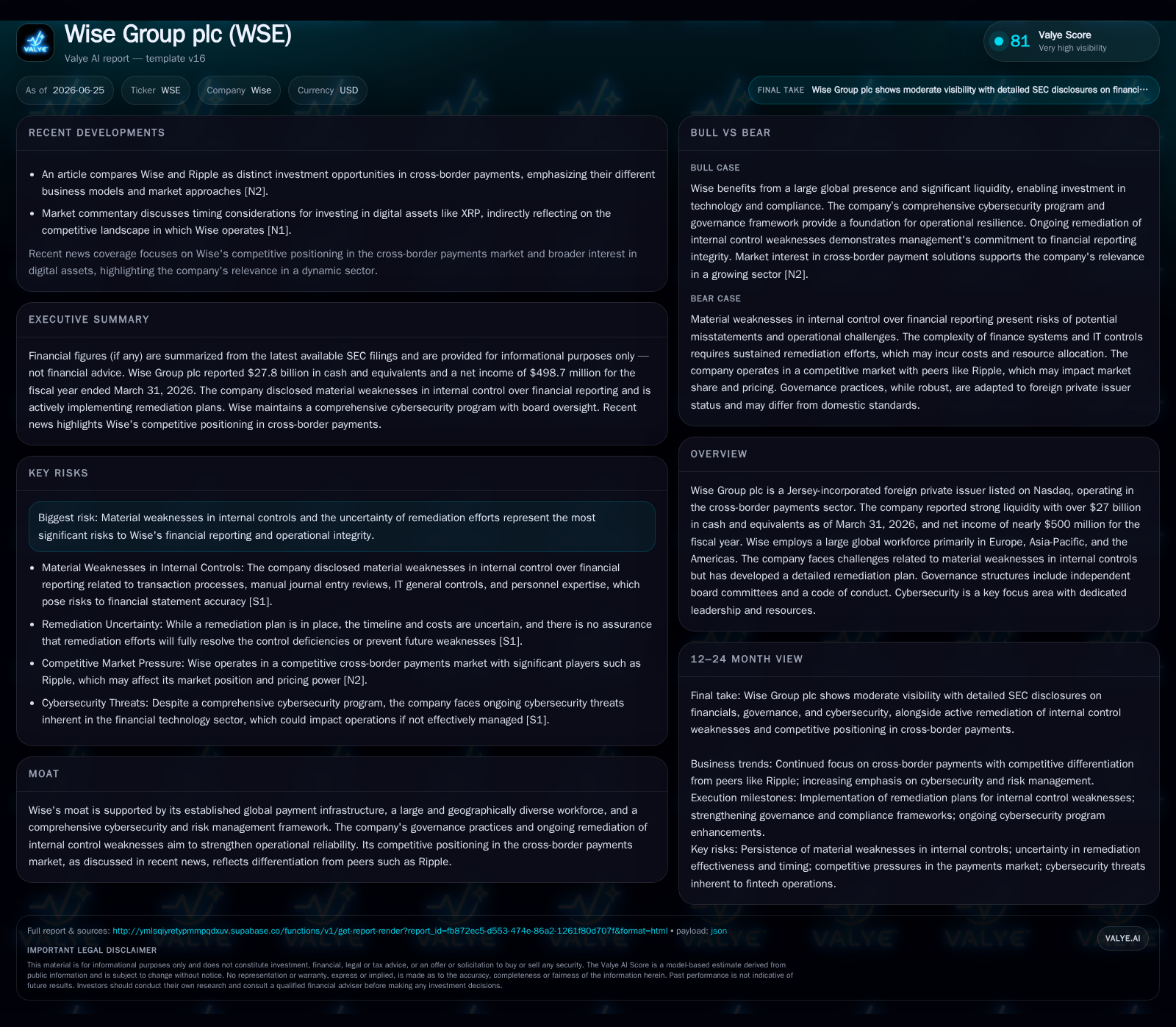
Wise Group plc's 2026 fiscal year-end disclosures reveal ongoing remediation of significant material weaknesses in internal controls over financial reporting. Despite these challenges, the company maintains a commanding position in the cross-border payments market, serving over 19 million active customers globally and processing approximately 4.7 million transactions daily. Strong liquidity with $27.8 billion in cash and equivalents supports operational resilience as Wise continues investing in cybersecurity and compliance amid heightened regulatory scrutiny. The company’s business model centers on transaction fees and currency conversion spreads, positioning it to benefit from persistent growth drivers like globalization and digital payment adoption, though remediation timelines and regulatory risks remain key watchpoints.
Recent Operating Update: Material Control Weaknesses Amid Robust Operations
Wise Group plc's latest quarterly filing dated June 25, 2026 [S2] confirms continued identification of material weaknesses in internal controls over financial reporting. These deficiencies notably relate to transaction-level business processes — including risk identification gaps — review controls for manual journal entries complicated by complex finance systems environments, as well as IT general controls such as access and change management. Management acknowledges these issues impair disclosure controls effectiveness as of March 31, 2026.
Despite these shortcomings, management asserts that additional post-closing analyses affirm the consolidated financials fairly present Wise’s financial position under U.S. GAAP. A comprehensive remediation plan is actively being executed involving the deployment of internal control experts with U.S. GAAP proficiency, documentation improvements for inherent risks/controls, enhancement of evidence collection for control operations, formalizing management review procedures for complex accounting areas, and critical strengthening of IT controls [S1][S5][S9]. Importantly, a SOX steering committee chaired by the CFO has been established to oversee remediation progress reporting to senior executives and the Audit Committee.
Parallel to these developments on internal governance fronts, operational disclosures from June 1 reveal Wise’s extensive payment ecosystem: over 19 million active customers globally across Europe, Americas and Asia-Pacific territories; approximately 4.7 million daily transactions processed; and holding more than 80 regulatory licenses facilitating compliance across multiple jurisdictions [S3]. The firm confronts evolving sophisticated financial crime risks by continuously investing in advanced technology-driven fraud prevention systems aligned with rigorous AML/KYC procedures.
Business Model Analysis: Platform Linking Customers to Global Payment Rails
Wise’s core value proposition derives from operating an advanced digital cross-border payments platform that reduces traditional banking frictions. The company acts as an intermediary between senders/recipients—both individuals and businesses—and international settlement networks. Revenue engines rely primarily on transaction fees charged per transfer alongside foreign exchange spreads realized via currency conversion margins.
Transaction volume growth directly influences fees collected while currency conversion margins depend on pricing competitiveness balanced against risk exposure from exchange rate fluctuations. Efficient liquidity management enables Wise to optimize settlement timing minimizing capital costs.
The company integrates robust compliance protocols into customer onboarding (KYC) and transaction monitoring to mitigate financial crime risks—a non-negotiable capability given its global footprint across rigorously supervised markets [S3]. Cybersecurity risk management is further embedded intrinsically within product development lifecycles ensuring "secure by design" principles mitigate unauthorized access or data breaches [S1][S16].
Product relevance remains high as customers increasingly demand faster international transfers at lower cost compared to legacy providers. Wise offers a transparent pricing structure without hidden markups which fosters customer trust sustaining low churn rates though explicit figures are not disclosed.
Industry Structure & Competitive Position
Operating in the highly regulated cross-border payments industry dominated by fintech innovators as well as traditional banks' international arms, Wise differentiates itself through its broad regulatory license network exceeding eighty jurisdictions—providing legal operating flexibility unmatched by many peers—and a scalable technology infrastructure supporting millions of daily transactions [S3].
Competition features blockchain-based payment networks like Ripple which emphasize decentralized settlement models offering alternative cost structures [N2]. However, Wise leverages its compliance sophistication and user-friendly platform to maintain a competitive moat supported by loyal customers seeking reliability combined with cost efficiency.
The company’s strong cybersecurity focus evidenced by dedicated senior leadership reporting directly to both the Audit Committee and CTO further cements operational resilience amidst growing cyber threats [S16]. This focus is critical given industry-wide concerns over fraud loss rates and reputational damage caused by breaches.
Growth Drivers
Wise stands poised to capitalize on several structural tailwinds:
- Globalization & Digital Commerce: Increasing cross-border trade amplifies demand for seamless payments.
- Regulatory Evolution: Fintech-supportive frameworks in many regions enable innovation while requiring sophisticated compliance controls where Wise holds strategic licensing advantages.
- Emerging Markets: Expansion plans into regions showing remittance flow growth offer new customer acquisition avenues.
- Technological Integration: Partnerships with banks and e-commerce platforms foster network effects increasing transaction volumes.
- Mobile Wallet Adoption: Growing use of digital wallets globally aligns perfectly with Wise’s platform capabilities boosting usage frequency.
Risks & Constraints
The principal risk lies in the ongoing material weaknesses within internal controls which may affect financial reporting accuracy or delay SEC compliance milestones despite concentrated remediation efforts. Furthermore:
- Regulatory scrutiny continues via enquiries such as those from the Brussels prosecutor’s office without current specific findings although ongoing engagement aims at resolution [S3].
- Cybersecurity threats persist despite robust posture; any breach could result in substantial financial losses or reputational harm.
- Currency volatility impacts foreign exchange margins directly influencing profitability.
- Rising competition especially from blockchain-enabled platforms could pressure pricing or erode market share long term.
- Complex finance system environments pose operational risks complicating manual journal entry reconciliations.
What To Watch Next
Key near-term milestones center on:
- Completion and effectiveness demonstration of internal control remediation testing scheduled per SOX requirements.
- Updates regarding regulatory investigations or clarifications particularly out of Europe.
- Monitoring transaction volume trends for signs of sustained growth or contraction amidst economic fluctuations.
- Stability or improvement trends in currency conversion spreads affecting margin quality.
- Execution pace on technology infrastructure enhancements to maintain platform scalability amidst growing customer base.
This analysis synthesizes disclosed operating data alongside structural industry context to present a domain-informed perspective on Wise Group plc’s current challenges and opportunities without extrapolating beyond verified sources or issuing investment opinions.
Disclaimer: This is research-only, informational analysis and not investment advice. It may include AI-generated interpretation and general industry context. Always verify important details using primary sources.

Comments