
Winnebago Industries Adapts to Macroeconomic Pressure with Production Alignment and Portfolio Focus
Q3 2026 filings reveal cautious dealer inventory management amid inflation and interest rate challenges, while motorhome segment drives revenue growth.
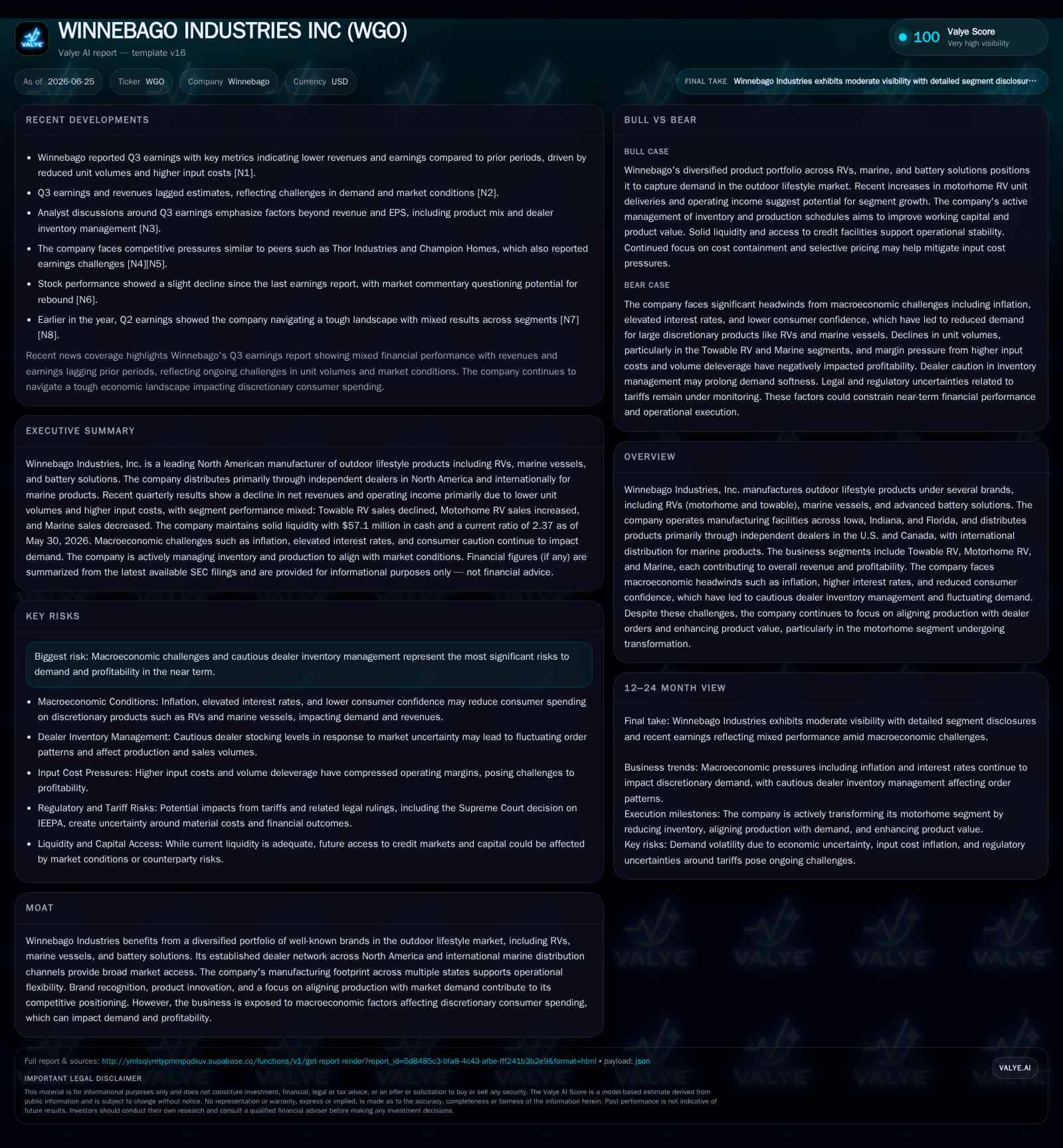
Winnebago Industries' latest quarterly results show modest consolidated revenue growth driven by the motorhome RV segment offsetting declines in towable RV and marine segments, reflecting macroeconomic pressures like inflation and elevated interest rates. Dealer order caution is impacting unit sales volume, leading the company to closely align production with current demand. Winnebago's diversified brand portfolio and manufacturing footprint provide operational flexibility, but near-term demand remains sensitive to discretionary consumer spending. Reduced capital expenditures and improved cash flow from operations support liquidity amid debt maturities beyond the next twelve months.
Recent Operating Update: Q3 Fiscal 2026 Results Anchor Near-Term Trends
Lower unit sales volumes were compensated partly through selective price increases across segments, though product mix shifts towards lower-price models weighed down overall revenue from towable RVs [S14], [S29]. Dealers remain cautious managing inventory levels amidst uncertain consumer confidence, leading Winnebago to focus on precisely aligning production with current dealer orders rather than building inventory [S15]. Lower capital expenditures relative to prior periods have reduced cash outflows in investing activities, supporting liquidity alongside improved operating cash flow of $26.2 million versus last year's negative cash flow [S2], [S7].
Business Model: Revenue Mechanics and Strategic Strengths
Winnebago operates primarily as a manufacturer of outdoor lifestyle products segmented into Motorhome RVs, Towable RVs, Marine vessels, and advanced battery solutions that power internal electrical systems for these vehicles as well as other applications [S2]. Revenue is generated through unit sales largely via a network of independent dealers across the U.S. and Canada who retail directly to consumers [S2]. The firm’s diversified brand portfolio—encompassing names such as Winnebago, Grand Design, Chris-Craft, Newmar, and Barletta—enables cross-segment presence catering to leisure travel and outdoor recreation enthusiasts.
Key revenue drivers include unit volume sold within dealer networks, average selling price (ASP) adjustments influenced by product upgrades or repositioning in market price tiers, and aftermarket parts/services following initial vehicle sales [S2]. Dealer order backlogs serve as a demand barometer tightly linked to macroeconomic conditions impacting consumer discretionary spending [S15]. When dealer confidence wanes due to inflation or borrowing costs rising from higher interest rates, order volumes contract causing direct pressure on production planning and throughput.
Winnebago’s manufacturing footprint spans Iowa and Indiana for motorhomes; Indiana for towables; Indiana and Florida for marine vessels; with battery production centralized in Florida supporting integrated component supply [S2]. This geographic spread enhances operational flexibility but also demands precise supply chain coordination especially under volatile input cost conditions.
Industry Structure and Competitive Position
Embedded in the recreational vehicles and outdoor lifestyle sector, Winnebago competes alongside major North American RV manufacturers like Thor Industries and Forest River while also facing specialized marine manufacturers such as Chris-Craft competitors. The sector has mixed sensitivity profiles: motorhomes tend toward premium discretionary spenders seeking high-tech features whereas towable RVs appeal more broadly but face sharper cyclical demand swings.
Winnebago’s strength lies in its multi-brand strategy combined with extensive dealer networks providing wide geographical reach. Its capability in advanced battery solutions sets it apart within the electrification trend increasingly shaping consumer expectations for energy independence and smart vehicle amenities [S2]. Competitively the company balances scale advantages with innovation cycles influencing model refresh rates critical for maintaining relevance.
Ongoing dealer inventory management practices shape competitive dynamics significantly: tightly controlled stock levels can constrain available product choice but protect dealers from overexposure during economic downturns [S15]. Winnebago’s proactive alignment of production schedules with actual dealer orders reflects an adaptive posture rare among peers who may either overproduce or respond sluggishly.
Growth Drivers
Key growth vectors include:
- Harnessing rising consumer enthusiasm for outdoor lifestyles coupled with demographic tailwinds such as aging populations preferring RV lifestyles.
- Continued innovation leveraging advanced battery technology that differentiates motorhomes and marine vessels by offering superior "house power" capabilities enhancing user experience [S2].
- Expansion of dealer network coverage particularly targeting underserved geographic corridors within North America.
- Enhancing financing options remains crucial given consumer sensitivity to borrowing costs; any easing here could unlock pent-up demand.
- Scaling aftermarket parts & service revenue streams which offer recurring income less sensitive to new-unit sale volatility.
Technological integration including electrification trends represents both an opportunity through battery solutions development as well as a capital intensity challenge requiring ongoing investments prudently managed given current macro uncertainties.
Risks and Watchpoints
Short-term risks revolve largely around sustained macroeconomic pressures:
- Inflation escalates input costs further squeezing margins if priced passed-through is limited due to competitive pressures [S14].
- Elevated interest rates impact consumer financing affordability directly suppressing large-ticket discretionary purchases such as high-end motorhomes or boats.
- Dealer caution on stocking translates into volatile order volumes causing capacity underutilization or uneven production runs potentially driving inefficiencies.
- Supply chain disruptions remain potential threats especially given geographically dispersed manufacturing footprint requiring just-in-time component deliveries.
- Competitive pricing pressure amid commoditization risk if innovation lags or new entrants disrupt established brand loyalties.
From a balance sheet standpoint, as of May 30, 2026, Winnebago maintained $57.1 million in cash and equivalents and total debt of approximately $450 million, resulting in net debt near $393 million [F1]. The company’s current ratio stood at a healthy 2.37, reflecting solid working capital management despite reduced dealer stocking levels [F1]. Liquidity is further supported by full availability of its $350 million asset-based revolving credit facility maturing mid-2027 with no borrowings drawn [S4].
Upcoming quarterly releases will clarify whether the positive momentum in motorhome RVs persists while towable units show signs of bottoming out from steep volume declines evident in recent quarters [S15]. Any shifts in tariffs or trade policies related to the recent Supreme Court IEEPA decision might affect component sourcing costs impacting future cost structure assumptions
Financial Profile Summary
As of May 30, 2026, Winnebago maintained a strong liquidity position highlighted by $57.1 million cash on hand coupled with full availability of its $350 million asset-based revolving credit facility (ABL Credit Facility) maturing mid-2027 without any borrowings currently drawn [F1], [S4]. Current ratio stood at a robust 2.37 reflecting solid working capital management despite reduced dealer stocking levels [F1]. Total debt was approximately $450 million translating into net debt around $393 million after adjusting for cash reserves [F1]. Cash flow from operations swung positively delivering $26.2 million net inflow for the nine months compared to last year’s negative figure driven largely by improved profitability metrics and working capital optimization efforts [S7]. Capital expenditures decreased markedly reducing investing cash outflow relative to prior periods which helped preserve free cash flow amid volatile end-market conditions [S7]. Debt redemption activities included partial repayments of senior secured notes mitigating upcoming maturities ensuring manageable debt service cost profile amid rate hikes experienced recently [S4].
This analysis has been prepared solely for informational purposes based on publicly available regulatory filings dated June 25, 2026 ([S2],[S3]) combined with validated financial snapshots ([F1]) and sector context knowledge. It does not constitute investment advice or research views.
Disclaimer: This is research-only, informational analysis and not investment advice. It may include AI-generated interpretation and general industry context. Always verify important details using primary sources.

Comments