
Capstone Green Energy Expands Direct Sales and Advances AI Data Center Microturbine Innovation
Latest filings highlight Capstone’s strategic shift toward direct market engagement and product development targeting growing AI infrastructure demands.
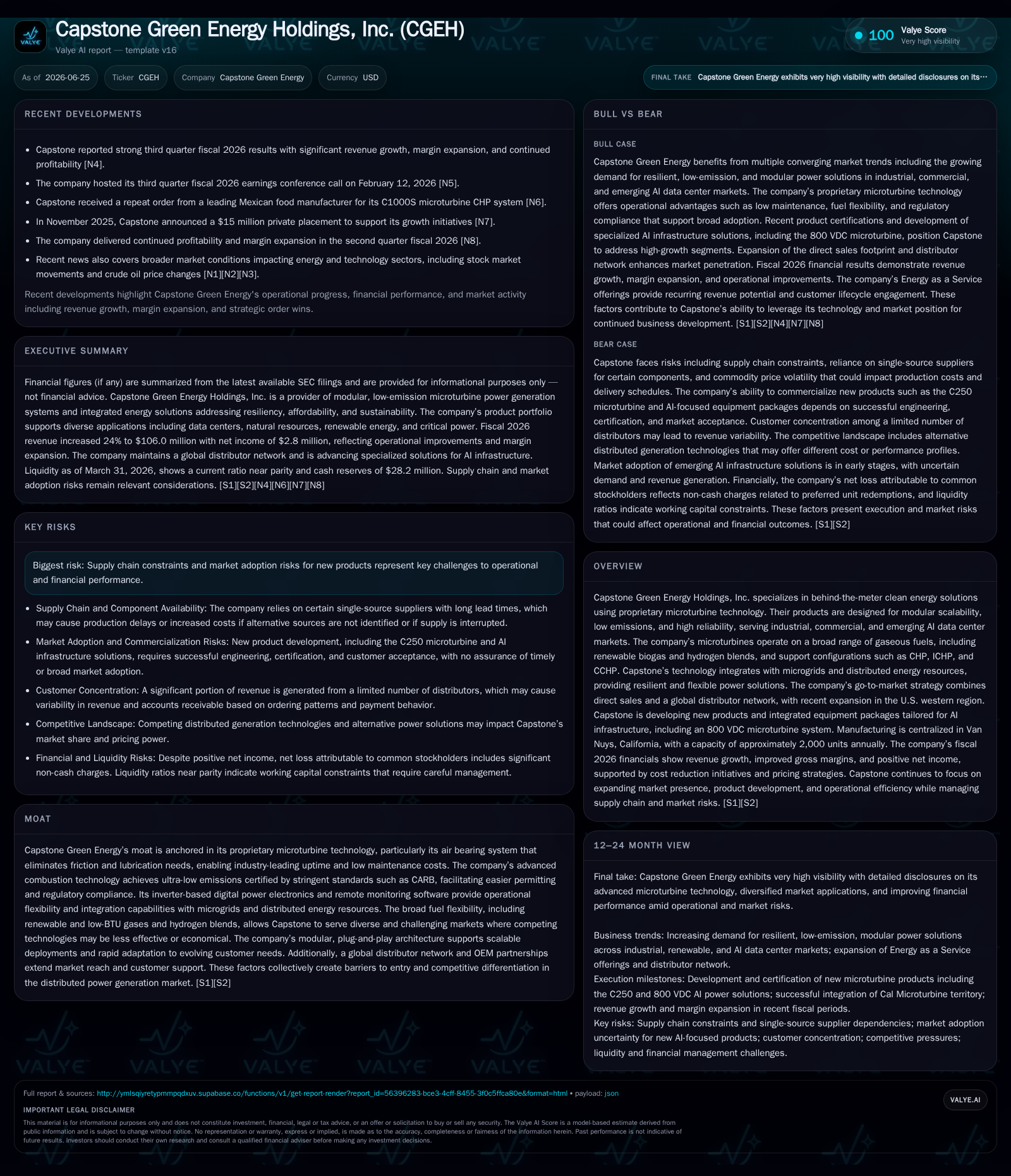
Capstone Green Energy Holdings, Inc. reported fiscal year 2026 results showing improved profitability underpinned by increased revenue from direct sales and service businesses, aided by recent strategic acquisitions. The company leverages proprietary microturbine technology characterized by oil-free air bearings and high fuel flexibility to address the distributed generation market with modular, low-emissions power solutions. Its growth is driven by expansion in energy efficiency markets, renewable fuels adoption, and emerging AI data center needs through new product platforms and integrated power-cooling modules. Supply chain constraints and financing risks remain key challenges as Capstone balances expanding direct sales with its global distributor network to support scalable deployments.
Recent Operating Update: Strategic Gains and Financial Progress
Capstone Green Energy Holdings reported fiscal year ended March 31, 2026 financial results anchored by revenue of $106 million and operating income of $3.4 million, culminating in net income of $2.8 million—marking a significant turnaround from previous losses largely due to stronger pricing execution and expanded sales channels [F1],[S3]. A pivotal operational development was the August 2025 acquisition of Cal Microturbine territory which established a direct sales footprint over several western U.S. states—a historically distributor-led market—allowing Capstone to deepen customer engagement in one of the country’s most active distributed energy arenas [S16].
This transition to hybrid go-to-market strategies—blending direct sales with a global network of authorized distributors—positions Capstone for tighter margin capture while safeguarding broad reach critical for international growth. The distributor ecosystem remains indispensable for localized application engineering support, permitting assistance (notably air quality permits critical for CHP applications), commissioning services, warranty coverage, parts logistics, and long-term service contracts that sustain recurring revenue streams [S16],[S18].
Business Model: Proprietary Microturbines Powering Modular Distributed Generation
Capstone’s core offering is centered on proprietary microturbines distinguished by oil-free air bearing systems that eliminate friction-related wear points and lubrication needs—translating into industry-leading uptime and reduced maintenance interval burdens. This design supports continuous operation behind-the-meter at industrial facilities, commercial sites, hospitals, ports, and increasingly in sophisticated data center environments where power reliability is paramount [S1],[S10].
Their products cover multiple configurations including Combined Heat and Power (CHP), Integrated CHP (ICHP), and Combined Cooling Heat & Power (CCHP), enabling customers to utilize otherwise wasted thermal energy for heating or cooling processes—dramatically improving total energy cost efficiency while lowering carbon footprints compared to simple-cycle grid purchases or diesel backup gensets. Capstone’s inverter-based digital power electronics facilitate seamless integration into broader microgrids alongside renewables (solar/wind) and battery storage assets enhancing system resiliency and grid services capability.
Significantly, Capstone microturbines can operate on a wide spectrum of gaseous fuels: natural gas blends, renewable biogas from agricultural or landfill sources, as well as hydrogen-containing blends aligned with decarbonization mandates—maximizing deployment versatility across evolving energy landscapes [S1],[S16].
Industry Structure & Competitive Position
As a recognized market leader globally based on annual units sold and installed MW capacity—a tally exceeding 10,800 units cumulatively—the company occupies a leadership niche within the specialized distributed clean energy hardware sector focusing on behind-the-meter power solutions using microturbines versus other competing technologies such as fuel cells or conventional reciprocating engines. Peers include firms like Bloom Energy or Cummins that offer related CHP or distributed generation products but differ technically or commercially in emissions standards compliance or fuel flexibility.
Capstone’s competitive moat lies in patented air bearing technology combined with sophisticated combustion controls to meet ultra-low emission targets like California Air Resources Board (CARB) certifications essential for permitting ease in regulated markets. Their modular architectures (e.g., standardized 30kW to multi-hundred kW units) facilitate scalable deployments that closely match site power block requirements—a critical factor in high-growth verticals such as AI-driven data centers where flexible capacity alignment reduces CAPEX waste [S1],[S16].
Growth Drivers
Key growth catalysts stem from several converging trends:
- AI Data Centers: Exploding compute demand has created need for resilient onsite power blocks with fast deployment. Capstone’s development of the C250 microturbine platform tailored for modular data center topologies along with an innovative 800 VDC output configuration integrated into liquid-cooled AI racks represents an early mover advantage addressing this specific use case [S18].
- Energy Efficiency & CHP Expansion: Continuous adoption in commercial buildings (hotels, hospitals) leveraging waste heat recovery maintains steady baseline demand especially amid rising energy prices.
- Microgrids & Distributed Energy Resources: Increased regulatory acceptance and incentives spur deployment where grid connection costs are prohibitive or reliability uncompromising.
- Fuel Flexibility: Transition towards renewable biogas fueling aligns with circular economy goals; hydrogen blends positioning prepares Capstone for future zero-carbon pathways.
- EaaS Offerings: Power purchase agreements (PPAs), leasing options and fixed-price long-term maintenance agreements reduce upfront capital barriers for customers accelerating deal closures while providing recurring revenue streams that enhance lifetime customer value.
Risks / Constraints
Despite these opportunities, Capstone grapples with material risks worth monitoring:
- Supply Chain Constraints: Sourcing specialized components—notably custom turbine parts with extended lead times—remains subject to disruption impacting manufacturing throughput.
- Market Adoption: New product lines such as the C250 require sustained commercial validation amidst competitive alternatives; integration complexity for innovative AI data center solutions adds execution risk.
- Liquidity & Debt Maturity: With about $25.4 million debt outstanding against $28.2 million cash as of March-end but significant near-term maturities on Exit Notes due December 2026 without secured refinancing yet evident presents solvency pressure requiring proactive capital solutions [F1],[S5].
- Regulatory & Permitting Challenges: Certification timelines particularly in stringent geographies like Germany or California can delay deployments.
- Competitive Pressures: Alternative technologies from fuel cell providers or battery vendors may displace some applications depending on evolving economics.
What To Watch Next
Upcoming milestones include successful commercialization ramp of the C250 microturbine—tracking unit shipments and booking inflows will be important indicators. Progress on securing refinancing or extending debt maturities will be pivotal for operational continuity given capital-intensive nature of scaling manufacturing capacity.
Monitoring expansion within AI data center verticals via partnerships such as with Microgrids 4 AI will reveal traction in this high-growth segment. Additionally, order backlog health across both direct sales territories like newly acquired Western US region alongside distributor-delivered projects will provide forward demand signals.
Enhancements in service contract renewal rates can signal maturation of recurring revenue streams underpinning business model stability over time.
Financial Profile Summary
This analysis is based strictly on officially filed documents up through June 25th, 2026 and does not constitute investment advice.
Disclaimer: This is research-only, informational analysis and not investment advice. It may include AI-generated interpretation and general industry context. Always verify important details using primary sources.

Comments