
Mizuho Financial Group's Strategic Share Liquidity Plans and Risk Framework Evolution
Mizuho clarifies its approach to reducing investment units to enhance share liquidity, supported by robust risk management amid evolving market dynamics.
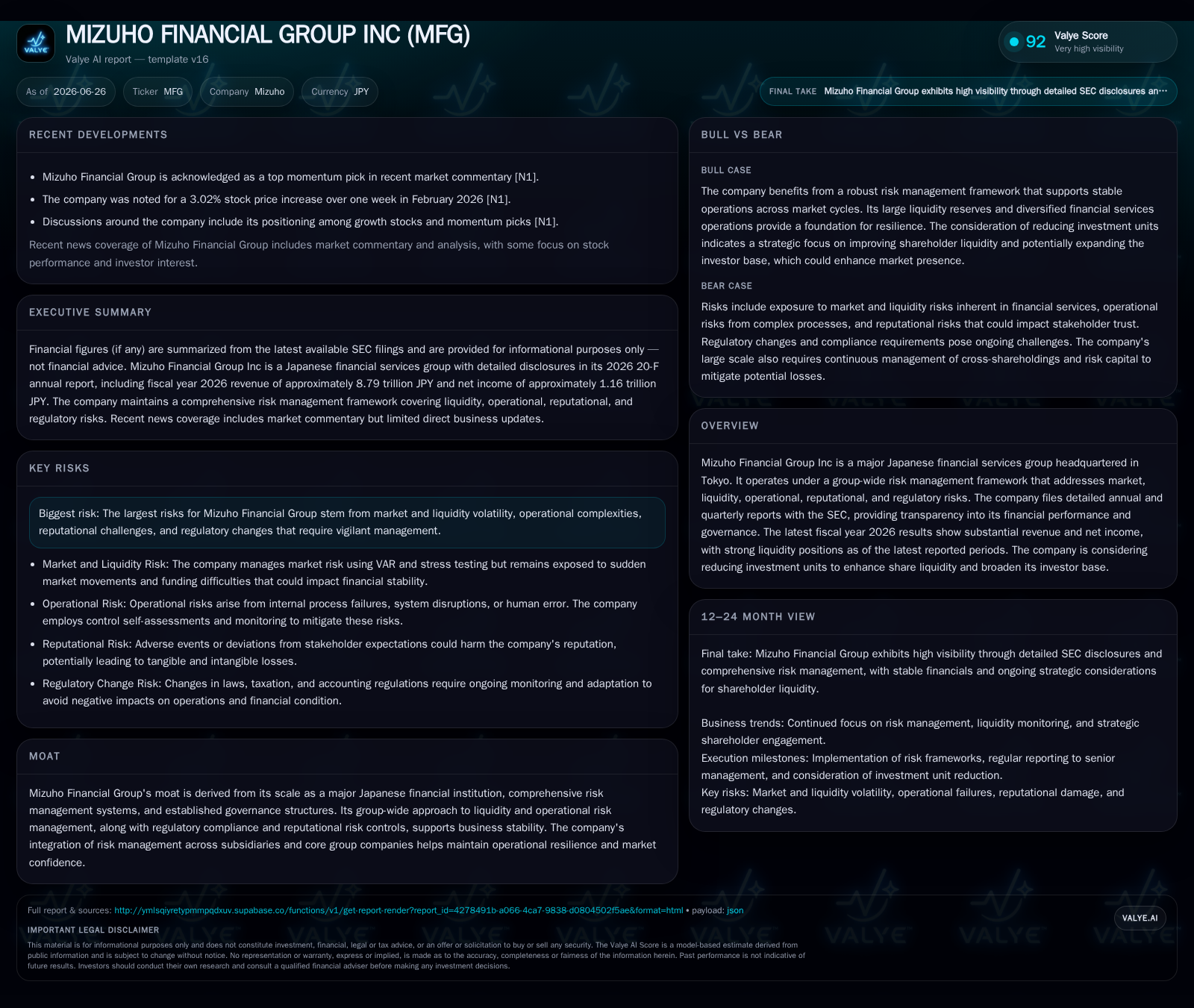
In its latest quarterly filing, Mizuho Financial Group formalized its stance on reducing investment units as a measured strategy to broaden its investor base and improve share liquidity. This move aligns with the group’s disciplined capital management and is underpinned by comprehensive risk control frameworks addressing market, liquidity, operational, and reputational risks. The bank’s diversified revenue streams from net interest income and fee businesses remain stable, bolstered by prudent funding cost management amidst fluctuating interest rate environments. While regulatory headwinds and market volatility persist as watchpoints, Mizuho’s capital adequacy and liquidity policies position it well to navigate these challenges.
Quarterly Operating Update: Investment Unit Reduction Stance Clarified
Mizuho Financial Group’s June 12, 2026 Form 6-K filing explicitly recognizes the strategic significance of reducing investment units to boost share liquidity and broaden its investor base [S2]. This disclosure responds directly to Tokyo Stock Exchange regulations triggered by the high unit price (≥¥500,000 per unit). The company underscores a deliberate approach—monitoring share price dynamics and market conditions comprehensively before adopting structural action. This measured posture implies a cautious but proactive capital strategy aligning with shareholder access enhancement without premature execution.
The announcement frames investment unit reduction as an effective mechanism reflecting Japan’s unique equity market conventions where large unit sizes can constrain tradeability for retail investors. Enhancing liquidity through lower units could catalyze deeper institutional engagement domestically and abroad given increased trading flexibility.
Business Model Overview: Core Banking Services and Revenue Streams
Mizuho operates primarily as a diversified financial institution generating revenues through two main channels: net interest income (NII) derived from lending versus funding costs via deposits and wholesale financing; and non-interest fee income from financial advisory, asset management, cross-border transactional services, and securities operations [S1]. This multi-faceted revenue mix balances traditional banking stability with expanding fee-based offerings that capture wealth management trends in Japan’s aging demographic.
The latest annual filing reflects a total consolidated revenue around ¥8.8 trillion JPY for fiscal year ended March 31, 2026 [S1], evidencing sustained scale. Net interest margins remain sensitive to the Japanese monetary environment; hence, controlling deposit beta—the sensitivity of deposit costs to interest rate changes—is critical for margin preservation. At the same time, diversified fee income streams provide mitigants against cyclical NII pressure.
Risk Management Paradigm: Market, Liquidity, Operational Controls Anchoring Stability
Mizuho deploys an integrated risk framework encompassing market risk quantified by Value at Risk (VAR) models coupled with rigorous back-testing and stress testing to guard against unexpected market shocks [S1]. This sophisticated approach extends to cross-shareholdings portfolio risks where stock price volatilities are closely monitored daily alongside risk capital utilization.
Liquidity risk receives special emphasis through multi-layered categorization into Normal, Anxious, and Crisis states based on funding conditions monitored via Early Warning Indicators including credit ratings, stock prices, cash reserves such as Japanese government bonds (JGBs), and overall funding metrics [S1]. Management accountability cascades from the Group CEO down to subsidiary CEOs who maintain individual liquidity policies ensuring group-wide cohesiveness.
Operational risk controls address system integrity and compliance rigorously with full governance oversight ensuring reputational safeguards integral to large universal banks.
Industry Positioning: Peer Context and Capital-Structure Initiatives in Focus
Within Japan’s top-tier banking landscape—alongside peers like Mitsubishi UFJ Financial Group (MUFG) and Sumitomo Mitsui Financial Group (SMFG)—Mizuho’s move toward potential investment unit reduction is emblematic of a sector shift prioritizing shareholder engagement mechanisms beyond raw financial metrics [S2][S1]. Such structural initiatives complement ongoing efforts to sustain robust Common Equity Tier 1 (CET1) capital adequacy ratios that meet Basel III standards while optimizing equity access.
Growth Catalysts: Enhancing Share Liquidity and Expanding Investor Base
Reducing investment units promises direct growth advantages by making shares more accessible especially for domestic retail investors often cautious about lump-sum purchases. Coupled with this structural catalyst are macro tailwinds supportive of loan growth driven by steady economic activity in Japan’s corporate sectors.
Additionally, recent global upward interest rate trends potentially bolster net interest margins if deposit beta remains contained—a balance carefully managed by Mizuho's treasury functions [S1]. Concurrently, expanding fee-related businesses such as wealth advisory attraction among aging affluent customers provides incremental revenue diversification benefiting long-term growth trajectories.
Digital innovation initiatives complement these drivers by streamlining customer acquisition costs while enhancing product delivery speed—key competitive factors in retail/commercial banking spheres today.
Risks and Constraints: Market Volatility, Regulatory Headwinds, Credit Quality Vigilance
Despite strengths, Mizuho faces pervasive risks inherent in large banking groups operating cross-jurisdictionally within evolving regulatory frameworks [S1]. Credit quality requires vigilant monitoring due to exposure variability amid economic cycles affecting non-performing assets levels. Provisioning policies must retain agility given potential credit loss fluctuations.
Market risk exposure through trading portfolios undergoes ongoing stress testing but remains vulnerable to sudden volatility spikes impacting earnings volatility. Liquidity risk persists as an operational concern particularly if wholesale funding markets contract or experience dislocations despite robust internal controls.
Regulatory changes may impose higher capital cushions or compliance costs curbing some earnings flexibility especially if Japan’s banking reforms intensify post-global prudential standards recalibration.
Outlook Indicators: Monitoring Key Milestones for Execution and Market Response
Investors should track developments around the investment unit reduction implementation timeline closely—with initial progress evidenced by active repurchase of common stock totaling over ¥14.8 billion JPY for approximately two million shares during May 18-31, 2026 as formalized in the early June filing [S3]. These steps may preface further structural changes aimed at boosting secondary market liquidity.
Additionally, loan growth rates alongside deposit inflows will serve as barometers reflecting domestic economic momentum influencing core net interest income generation. Market reaction post any announcement of unit reductions could foreshadow investor sentiment shifts towards Mizuho shares.
Continued disclosures regarding credit loss provisions versus portfolio performance will be equally important given their direct impact on reported profitability.
Summary Financial Snapshot: Reinforcing Operational Insights
Supporting this analysis is Mizuho’s fiscal year ended March 31, 2026 data showing consolidated revenue of approximately ¥8.79 trillion JPY with net income surpassing ¥1.15 trillion JPY according to company facts [F1]. Total debt stood near ¥20.8 trillion JPY at period end balanced against significant cash equivalents indicating conservative leverage positioning resulting in negative net debt coverage around -¥26.9 trillion JPY suggestive of ample liquidity buffers [F1].
This analysis integrates the latest SEC filings up to June 2026 reflecting Mizuho Financial Group's evolving strategic focus on share liquidity enhancements grounded in sound risk governance practices typical for major Japanese financial institutions. It refrains from speculative forward-looking commentary beyond evidence-supported observations herein.
Disclaimer: This is research-only, informational analysis and not investment advice. It may include AI-generated interpretation and general industry context. Always verify important details using primary sources.

Comments